
Representative image
When a magnitude 9.0 earthquake and the devastating tsunami that followed struck Japan’s north-eastern coast in March 2011, entire towns were swept away, nearly 20,000 people were killed or went missing, and vast stretches of coastline were left in ruins. In the years since, Japan has invested billions of yen in massive concrete seawalls, but another, less conventional form of protection has also taken root. Across the country’s Pacific coast, volunteers have planted more than 680,000 native trees as part of the Chinju no Mori Project, an ambitious effort inspired by ancient “guardian forests” that seeks to complement engineered defences by restoring natural coastal ecosystems capable of reducing tsunami impacts.
Why Japan planted more than 680,000 trees after the 2011 tsunami
The Chinju no Mori Project, also known as the Morino Project, was launched in the aftermath of the 2011 Great East Japan Earthquake and Tsunami. Rather than relying solely on concrete infrastructure, the initiative aims to create dense coastal forests that can work alongside seawalls to reduce the force of future tsunamis, trap floating debris and stabilise coastal landscapes.Since its launch, the project has planted more than 680,000 native trees across multiple communities in Japan’s Tohoku region. At annual planting events, hundreds or even thousands of volunteers gather to restore coastal dunes and former disaster zones using locally adapted tree species.
Why Japan turned to forests after the 2011 tsunami
On 11 March 2011, one of the most powerful earthquakes ever recorded struck off Japan’s Pacific coast. The resulting tsunami reached heights of up to 40 metres (131 feet) in some locations, overwhelming existing seawalls and devastating more than 2,000 kilometres of coastline. The disaster claimed nearly 19,700 lives, including those listed as missing, and triggered the Fukushima Daiichi nuclear accident.As communities rebuilt, many local leaders looked beyond conventional engineering solutions. While concrete seawalls remained central to Japan’s disaster strategy, researchers and conservationists argued that healthy coastal forests could provide an additional layer of protection by slowing smaller tsunami waves, reducing erosion and limiting the spread of floating debris.
The Miyawaki Method behind the forests
The project follows the Miyawaki Method, developed by renowned Japanese botanist Akira Miyawaki. Instead of planting rows of a single species, the method recreates natural forests by placing dozens of native tree and shrub species close together.Competition for sunlight encourages the trees to grow rapidly while producing dense vegetation and interconnected root systems. Supporters say this approach creates resilient forests within a few decades rather than centuries. Although the method has gained worldwide popularity, some researchers have questioned whether all of its ecological claims, including faster biodiversity recovery and carbon storage, have been fully supported by long-term scientific evidence.
Ancient guardian forests inspired the project
The idea behind the Chinju no Mori Project has deep roots in Japanese tradition. For centuries, Shinto shrines have been surrounded by sacred groves known as Chinju no Mori, or guardian forests. These woodlands are regarded as spiritually significant while also helping protect shrines from wind, erosion and other natural hazards.Following the 2011 tsunami, researchers found that many coastal shrines surrounded by these forests had survived the disaster. A study by the Public Works Research Center reported that only two of 27 coastal shrines examined in the Tohoku region were destroyed. Many had been built on naturally elevated ground identified by earlier generations as safe locations during previous tsunamis.
Can forests really reduce tsunami damage?
Scientists emphasise that forests alone cannot stop a massive tsunami like the one seen in 2011. However, research comparing multiple historic tsunamis has found that coastal forests can significantly reduce damage from smaller events.Studies led by researchers at Tohoku University found that forests help slow incoming water, trap floating debris and reduce erosion. They can also discourage construction in highly vulnerable coastal zones. Larger seawalls, particularly those taller than five metres, generally provided greater protection, leading many experts to recommend combining natural forests with engineered coastal defences rather than relying on either solution alone.
Why not every town chose forests
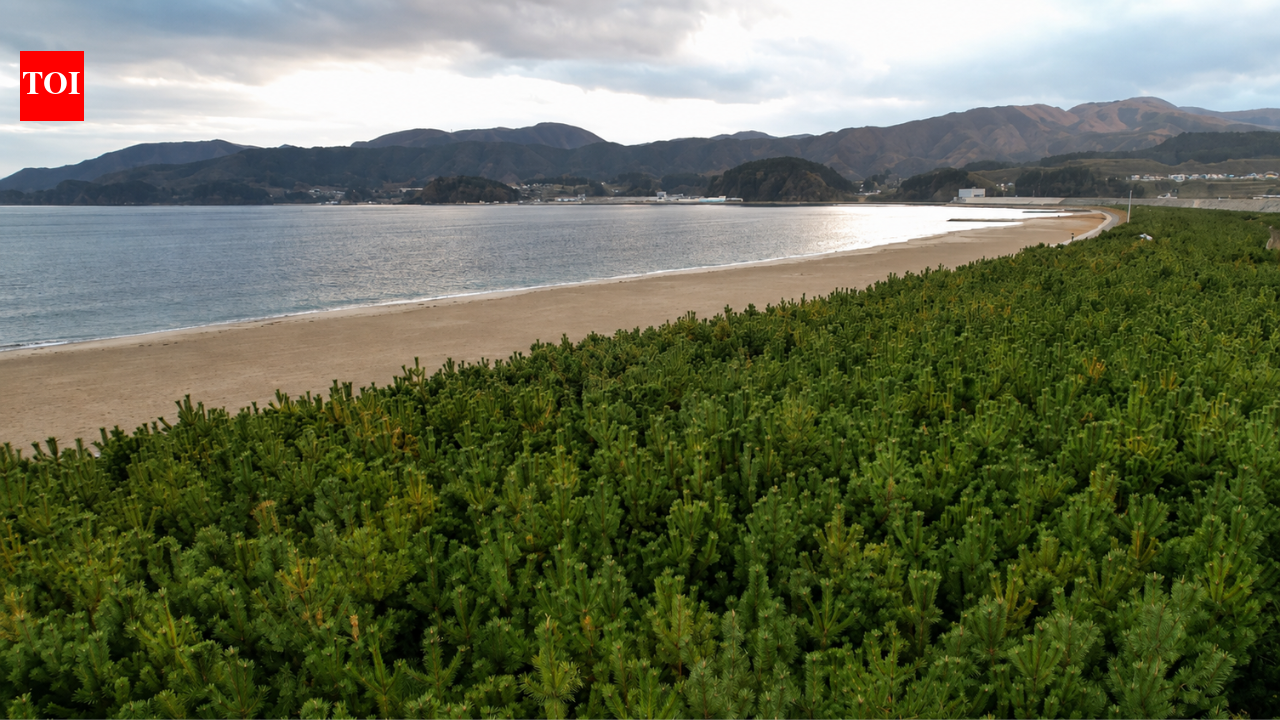
Although the Chinju no Mori Project has attracted widespread public support, many municipalities continue to prioritise concrete seawalls. Since 2011, Japan has spent approximately 1.4 trillion yen (around US$8.2 billion) constructing 432 kilometres of seawalls at more than 620 locations along the country’s coastline.Some communities have also disagreed over which tree species should be planted. While the Morino Project favours diverse native broadleaf forests, several municipalities have continued planting traditional Japanese black pine, which has been closely associated with coastal landscapes for centuries despite concerns that its relatively shallow roots make it more vulnerable during powerful tsunamis.
More than disaster protection
The new forests are expected to deliver benefits that extend well beyond tsunami resilience. Native vegetation helps stabilise sand dunes, improves biodiversity, provides habitat for birds and insects, stores carbon and restores degraded coastal ecosystems. For many volunteers, the planting events have also become a way to honour the communities lost in 2011 while contributing to their long-term recovery.The project demonstrates that rebuilding after a disaster is not only about replacing damaged infrastructure but also about restoring the natural landscapes that support healthier and more resilient communities.
Japan’s coast is gaining a second line of defence
Fifteen years after the devastating tsunami reshaped Japan’s north-eastern coastline, the Chinju no Mori Project continues to grow one forest at a time. While concrete seawalls remain the country’s primary defence against future tsunamis, the expanding network of native coastal forests offers an additional layer of protection rooted in both modern ecological science and centuries-old Japanese tradition. Together, they reflect a broader understanding that resilient coastlines are built not only with concrete, but also with healthy ecosystems capable of protecting people and nature alike. Go to Source