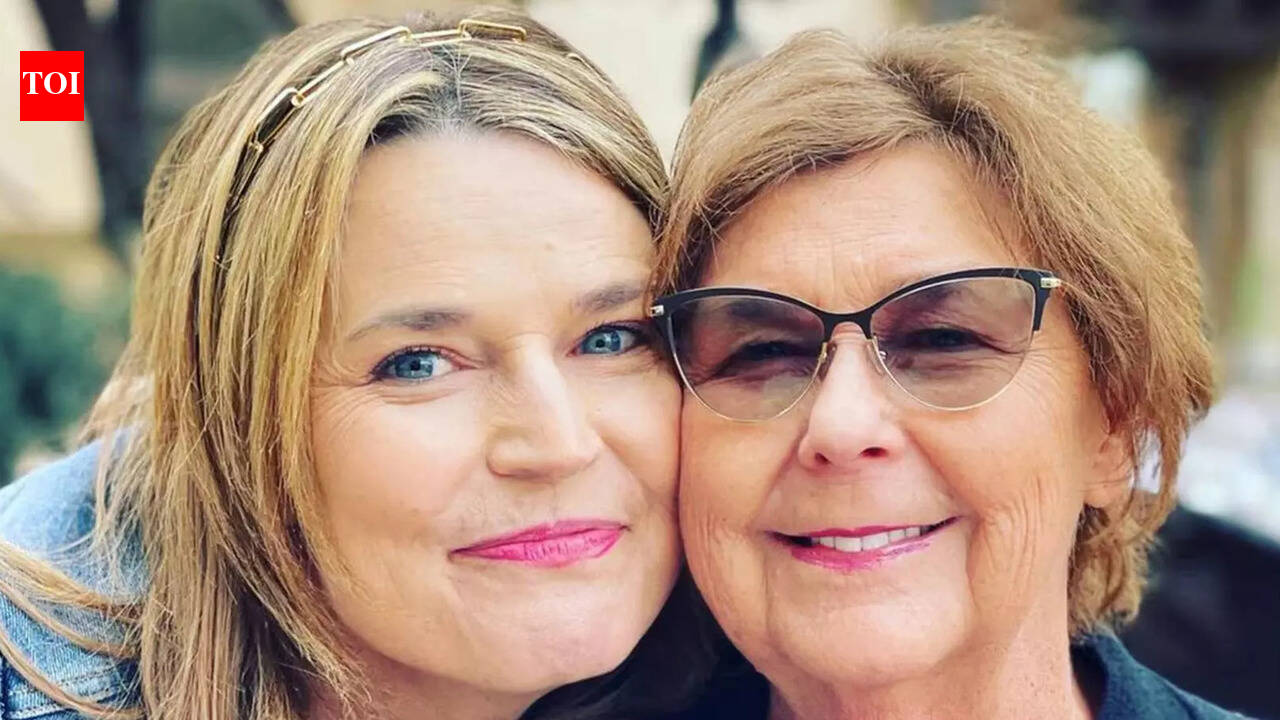

A familiar morning-TV face does not normally become the story. She delivers the story. She packages chaos into three-minute blocks, smooths the rough edges with professional calm, and sends America off to work believing the world is still, broadly, readable.Then Savannah Guthrie’s mother vanished, and the neat boundary between “news” and “life” collapsed in real time.Nancy Guthrie, 84, disappeared from her home in Tucson, Arizona after she was last seen on January 31, 2026, when she was dropped off following dinner with family. She was reported missing the next day when she did not turn up for Sunday church. Investigators later treated the case as a criminal matter after signs of a struggle were found at her home. From that moment, the story stopped being a local missing-person call and became something bigger: a national vigil conducted through clips, deadlines, and a daughter’s public pleas.It is a grimly modern kind of attention, part empathy, part suspense, and part collective obsession. The facts remain stubborn and sparse. The public appetite remains enormous. And in the middle of it all is the unnerving spectacle of an anchor who cannot anchor her own life.
The big picture
This case captured the country for three blunt reasons. First, there is the human centre: an elderly woman with reported health and mobility issues, missing in circumstances that suggest she did not simply wander off.Second, there is the clock: ransom notes with specific deadlines, turning an investigation into a countdown that people can follow minute by minute.Third, there is the messenger: Savannah Guthrie, a household name in American morning television, suddenly speaking not as the one who asks the questions but as the one begging for answers. The result is a story that feels personal even to strangers. It is not only about a missing woman, but about what happens when familiarity meets fear, and when the face of calm becomes the face of panic.
What we know so far
Here are the hard, reported facts that have shaped the case.Nancy Guthrie was last seen on January 31, 2026. She was dropped off at her Tucson home after dinner with family. She did not appear for church the following day and was reported missing. Investigators found indications of a struggle at the home, which led authorities to treat the matter as a criminal investigation rather than a routine missing-person search.Law enforcement involvement escalated, with federal authorities joining local investigators as the case drew national attention. Public messaging from the family stressed that Nancy could not have left without help, given her age and reported health limitations, and that time was a critical factor.As the search intensified, ransom communications entered the story. Notes were reported to have surfaced that demanded money in cryptocurrency and included deadlines. The reported demands shifted, with one deadline tied to a lower amount and a later deadline tied to a higher amount, culminating in a widely discussed evening deadline that passed without publicly confirmed proof of life.The ransom claims themselves have been a central complication. Authorities have not publicly confirmed the authenticity of the notes or the identity of whoever sent them. Outside experts and former law enforcement officials have raised doubts about whether the ransom narrative is genuine, pointing to the lack of standard proof-of-life signals that often accompany real kidnappings. At the same time, investigators and the family have been forced to treat the threat seriously because the alternative is too dangerous to assume.That is where the case stands publicly: a missing elderly woman, a crime scene, ransom claims with deadlines, and a high-profile family pleading for help, while investigators work through leads that have not yet produced a clear breakthrough.
Driving the news
In most disappearances, the public sees the story through police briefings, the occasional local press appearance, and a poster that circulates for a day before the internet moves on. This case has moved differently because the family’s communication has been direct, frequent, and emotionally raw, and because the ransom angle produces new “beats” for the media cycle. The most gripping element has been the countdown effect. A ransom deadline is not just a logistical demand. It is a narrative device. It turns a sprawling investigation into something that feels like a single, brutal question: what happens when the clock hits zero?That deadline-driven frame was reinforced when the family posted video appeals asking the public to report anything unusual, even if they lived far from Tucson. Savannah Guthrie described the moment as desperate, urged people to call law enforcement if they saw anything strange, and said her family believed her mother was still out there. The appeal did not sound like a television segment. It sounded like a person trying to widen the circle of help because every private channel felt too small.There were other details that kept the story alive. Reports described ransom notes that referenced specific household information, apparently intended to sound credible. Reports also described a cryptocurrency address that did not show publicly visible transaction activity at certain points, feeding speculation about whether the demand was real, whether the sender was bluffing, or whether the public was watching the wrong signal altogether.The investigation, meanwhile, has remained largely quiet in terms of confirmed public milestones. There has been no publicly identified suspect. There has been no public confirmation of direct contact with kidnappers beyond what has been reported through the existence of notes and messages. When the official flow of information slows, the vacuum fills quickly, and that is exactly what happened here.
Why it matters
This case is a mirror held up to two things at once: how policing works in an uncertain, high-stakes investigation, and how the public processes fear when it arrives with a recognisable face.Start with the policing problem. Even when authorities have signs of a struggle, cases can stall for reasons that do not show up on television. A crime scene can tell you something happened without telling you who did it, where the person went, or whether the person is alive. Leads can be plentiful and still unhelpful. Tips can flood in and still fail to produce a single actionable break. Every hour that passes increases pressure, reduces certain kinds of evidence, and raises the risk that the case turns from rescue to recovery.Now add the ransom layer. Ransom claims force investigators into a tight corridor of risk. If the demand is real, the priority is to keep the victim alive and trace the chain back to the perpetrator. If the demand is fake, it can still be dangerous because it distracts, it exploits, and it creates copycats. Either way, the family is trapped in a dilemma that feels morally impossible from the outside and physically exhausting on the inside.Then there is the public, and this is where the Savannah Guthrie factor matters. People do not merely recognise her. They have invited her into their lives at the most ordinary, intimate time of day. That creates a strange closeness. When she appears on social media pleading for help, it does not land like a celebrity statement. It lands like a neighbour knocking on the door.The danger is that this kind of attention comes with a shadow. High-profile cases attract opportunists. They invite scams, impersonators, false sightings, and conspiracy theories. They also risk turning a real woman’s disappearance into a participatory drama where strangers feel entitled to the story as entertainment. The public can be helpful. The public can also be harmful. Both can happen at the same time.
Timeline
A clean timeline does not solve a case, but it shows why the story spread so fast.
- January 31, 2026: Nancy Guthrie is last seen when she is dropped off at her Tucson home after dinner with family.
- February 1, 2026: She is reported missing after she does not show up for church.
- Early February: Investigators treat the matter as a criminal investigation after signs of a struggle are reported at the home.
- Following days: Ransom communications are reported, including demands for cryptocurrency and specific deadlines.
- Weekend into Monday: The family issues public video appeals, stating they believe Nancy is still out there and urging the public to report anything unusual.
- Monday evening: A widely reported ransom deadline passes without publicly confirmed proof of life.
These points are what the public has been able to track. Behind the scenes, investigators are believed to be reviewing surveillance, re-interviewing witnesses, and working through tips, but the specifics of that work are not usually disclosed in an active investigation.
The ransom question
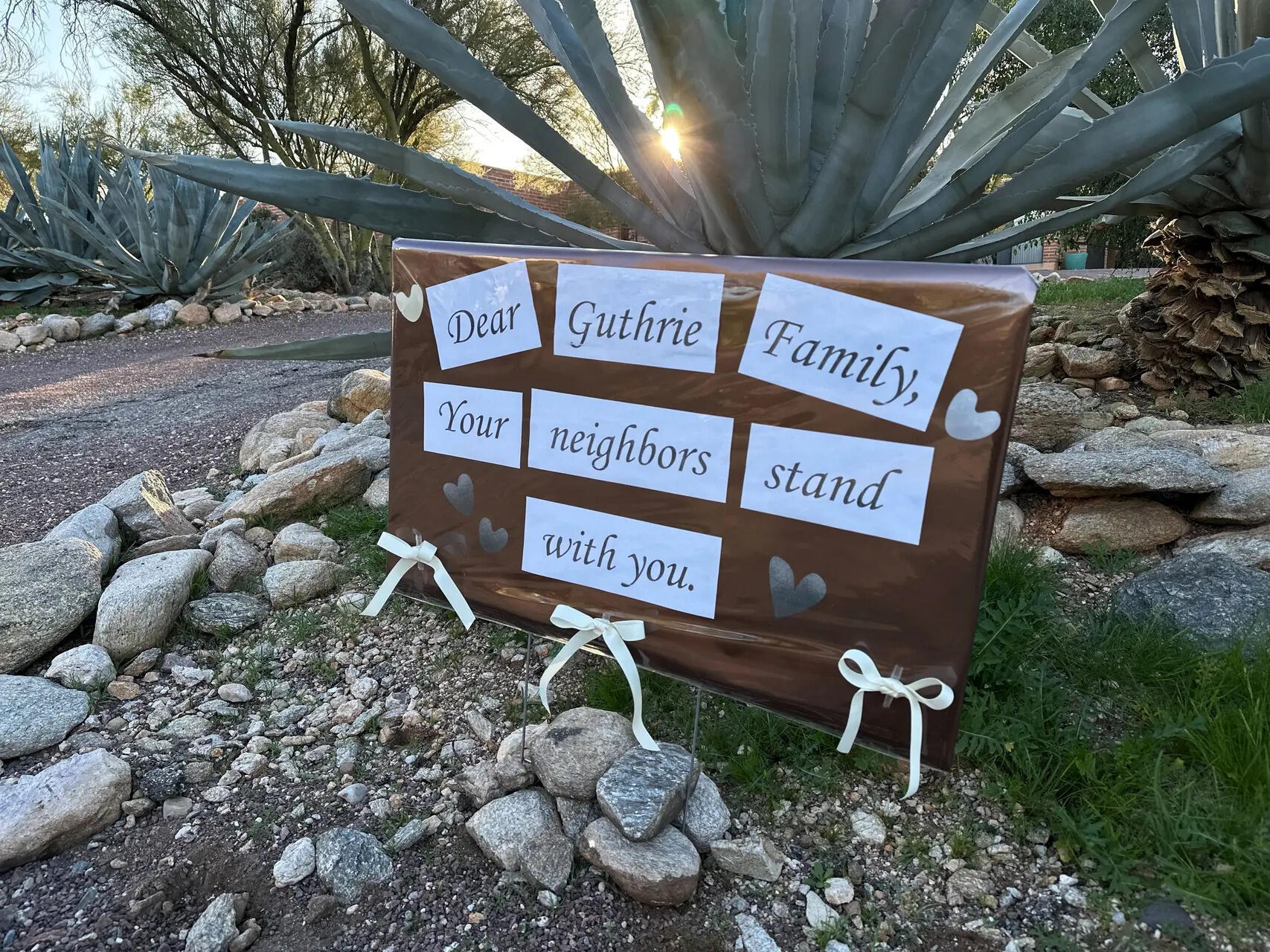
/// Neighbors of Nancy Guthrie, the daughter of “Today” host Savannah Guthrie, show support for the family in metro Tucson, Ariz., on Tuesday, Feb. 3, 2026, as the search continues to find Nancy who was reported missing. (AP Photo/Sejal Govindarao)
The most combustible element of the case is also the least stable: the ransom narrative.On one hand, ransom demands are a known criminal tactic, and the use of cryptocurrency is consistent with how extortion schemes often try to avoid traceability. Notes that reference details at a scene can be meant to signal credibility, implying the sender knows something only the perpetrator would know.On the other hand, the absence of publicly confirmed proof of life is a glaring gap. In genuine kidnappings where money is demanded, perpetrators often provide some form of verification to keep the family engaged and to prove that payment has a purpose. When that does not happen, experts tend to raise the possibility of a scam, a hoax, or a situation that is not a straightforward ransom kidnapping.Authorities have not publicly validated the notes as authentic. That matters. It means the public should treat details circulating online with caution, even if they are widely repeated. At the same time, families and police cannot afford to dismiss threats when a person is missing and the scene suggests violence.The case therefore sits in a limbo that is emotionally brutal and operationally complex. It is possible that the ransom communications are central. It is possible they are a distraction. It is possible they are a secondary exploitation layered on top of a separate crime. Each possibility changes what matters most, and none can be ruled out publicly from what is known so far.
Why Savannah’s plea changed the story
A missing-person story becomes national news for many reasons: unusual circumstances, new evidence, a public safety angle, or sheer randomness. This one also became national because the spokesperson was not a detective or a press officer. It was a daughter whose voice millions have trusted to tell them what is real.There is a reason her videos travelled. They were not polished. They were not structured like a segment. They were direct appeals, delivered without the protective language public figures usually adopt. She asked for prayers, yes, but she also asked for something practical: attention, vigilance, reporting, and help.That matters because it turns passive viewers into active participants. It widens the investigation’s public net. It also shifts the emotional burden onto strangers, who now feel they are part of the story, whether by sharing a poster, discussing a lead, or simply watching the clock.The impact is real. Tips can come from unexpected places. Awareness can surface a sighting. A neighbour can remember something that seemed insignificant. Public attention can help. It can also flood investigators with noise. Both outcomes are possible, and neither is entirely avoidable once the story reaches this scale.
What happens next
Publicly, the next phase will depend on what investigators can confirm and what they choose to share. The key questions are straightforward, even if the answers are not.
- Can authorities confirm any direct communication with whoever claims to be responsible?
- Can they verifywhether the ransom notes contain details only a perpetrator would know?
- Can surveillance, digital trails, or witness accounts narrow the window of movement after January 31?
- Can forensic evidence clarify what happened in the home and whether the incident involved more than one person?
- Can credible sightings be separated from noise?
In cases like this, a breakthrough often arrives as a single, unglamorous detail: a vehicle, a camera angle, a transaction, a pattern of movement, a neighbour’s recollection, an inconsistency in a claim. The public usually sees it only after it has been processed and verified.Until then, the story remains what it has been from the start: a frightening absence surrounded by partial signals, and a family asking the country to look harder than it normally would.
Bottomline
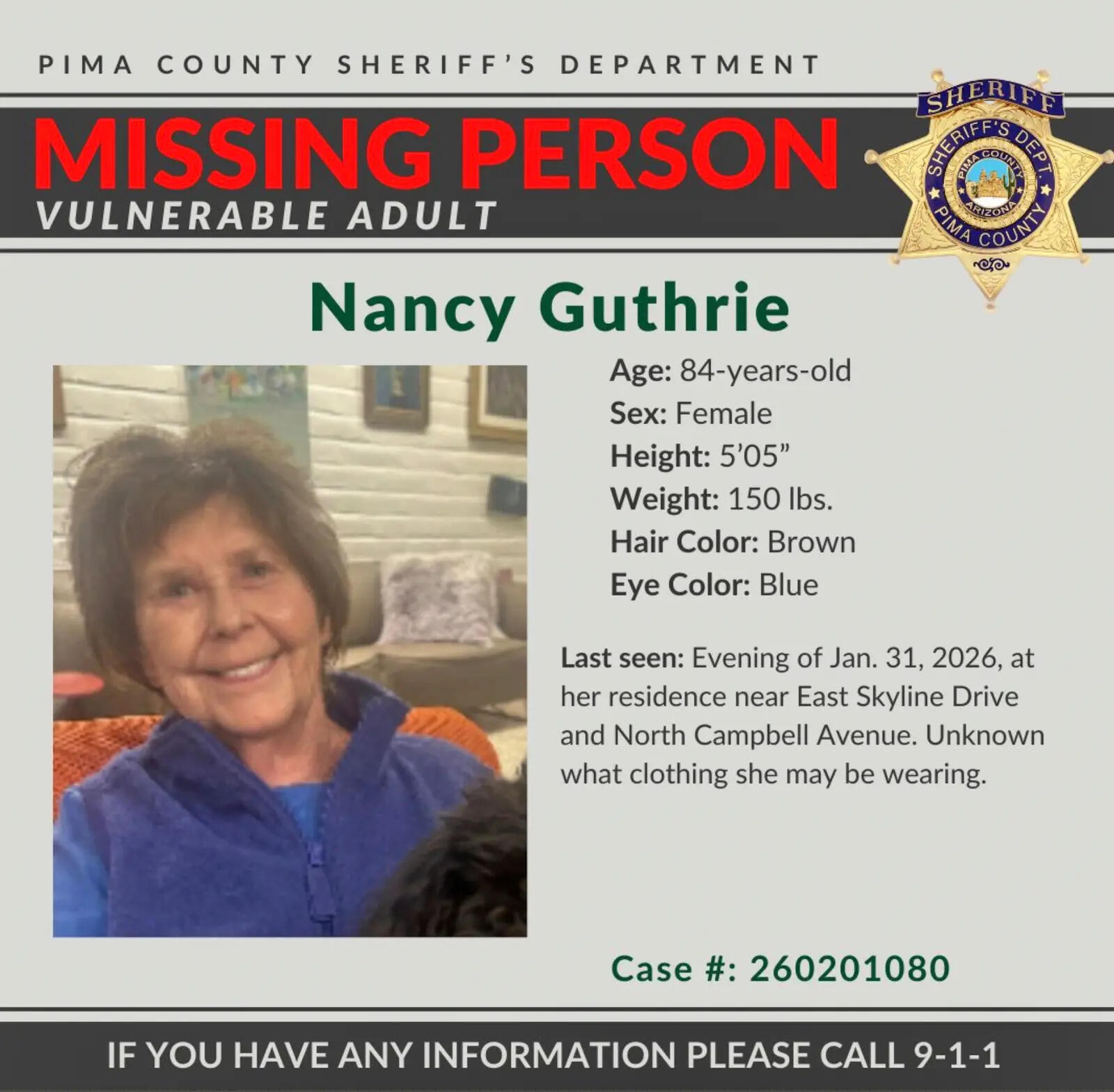
FILE – This image provided by the Pima County Sheriff’s Department on Feb. 2, 2026, shows a missing person alert for Nancy Guthrie. (Pima County Sheriff’s Department via AP, File)
Nancy Guthrie’s disappearance has gripped America because it sits at the intersection of the oldest human fear and the newest mechanics of attention. An elderly woman is missing. A home shows signs of struggle. Ransom messages introduce deadlines, and deadlines turn fear into a public countdown. A familiar television anchor becomes a daughter asking for help, and the audience shifts from passive consumption to uneasy witness, aware that this is not a story designed for resolution on schedule.The hardest discipline in moments like this is restraint. To hold on to what is known, to resist filling silence with speculation, and to accept that real investigations move at the pace of evidence rather than outrage or online momentum. Certainty may be comforting, but it is often dishonest, and in cases like this, dishonesty can cost time, clarity, and lives.For now, there is only one frame that matters. A woman did not come home. Each passing hour narrows the margins of hope. And somewhere beyond the headlines and the deadlines, a family is still waiting for a door to open, a phone to ring, or a truth to finally arrive. Go to Source