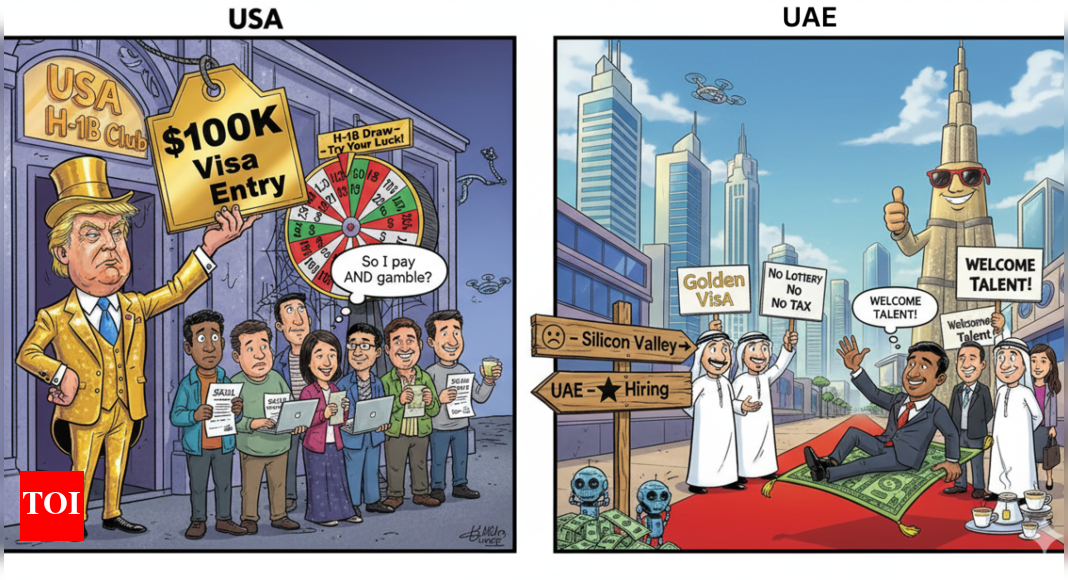

US prestige is unmatched, but the UAE now delivers access, clarity, and long-term paths/ AI Image for illustrative purposes only
By January 2025, the H-1B visa, long the golden key for global tech talent, was still a prized entry into the US dream. A few days ago, Donald Trump’s administration decided to gild it further, to the tune of $100,000 per key, leaving thousands to wonder if the door to opportunity was still worth opening. The new fee represents a seismic jump from the previous $1,700–$4,500 range for filing, premium processing, and other associated charges, making the path to America suddenly as much about financial resources as technical skill.But as one gate closes, another opens. While the US tightened its skilled labor funnel, the Gulf, and in particular the United Arab Emirates has long been expanding its visa programs, offering a structured, multi-tiered ecosystem designed to attract talent, retain it, and provide paths to long-term residency. Beyond visas, the UAE is building a global ecosystem of opportunity, underpinned by mega-projects, ambitious economic diversification goals, world-class infrastructure, and an expat-friendly environment. The comparison, when taken seriously, is less about political allegiances and more about pragmatism, economics, and lifestyle considerations.
Navigating the new US H-1B landscape
The September 19 proclamation was stark: any H-1B petition filed for a worker outside the US now carries a $100,000 fee per year, in addition to existing charges for filing, fraud detection, and premium processing. To put that in perspective, where employers previously faced fees topping $4,500 for premium services, they now confront costs that are twenty-two times higher. Even top IT firms may rethink sponsoring executive-level employees at that scale.“A company that wants to buy an H-1B visa… it’s $100,000 per year,” Commerce Secretary Howard Lutnick said, underscoring the sharp shift in financial calculus for companies seeking foreign talent. The H-1B remains capped at 65,000 general visas and 20,000 for advanced degree holders from US universities, but the steep fees are expected to reduce applications significantly. Exceptions exist, notably for workers already present in the US, approved petitions prior to September 21, or those who qualify under the Secretary of Homeland Security’s discretion in the national interest. Yet, for the average foreign professional abroad, the calculus has shifted dramatically: For foreign workers, getting to the US now requires not just skill, but employers willing to foot a six-figure bill.For companies, the administration framed this as a measure to protect American workers and prioritize elite talent. “No longer will you put trainees on an H-1B visa, it’s just not economic anymore,” Lutnick said. “If you’re going to train people, you’re going to train Americans.” The policy is designed to preserve entry-level opportunities for domestic workers while concentrating visas in the hands of companies willing to pay for high-value hires. Yet this emphasis on elite specialization comes with trade-offs: the bureaucracy remains, the lottery is still a gamble, and employers must weigh not only the fee but the administrative weight. For many, particularly those outside corporate giant circles, the US option has become less about meritocracy and more about economic calculus. The US, while maintaining its historic appeal in tech, finance, and research, is now becoming a highly filtered arena: prestige remains, but accessibility has narrowed. For those considering family relocation, long-term settlement, or lower-cost pathways, these structural barriers have tangible implications.
US alternatives to H-1B: L-1, O-1, and other skilled work options
The tightening of H-1B pathways has prompted professionals to explore other avenues. The cap-exempt H-1B remains open for nonprofit institutions and research organizations, allowing year-round hiring without lottery interference. Intracompany transfers through the L-1 visa provide a channel for employees who have worked abroad for at least one year in managerial, executive, or specialized roles. Here, too, the H-1B model of “elite plus company sponsorship” applies, but the transfer mechanism avoids the lottery. The O-1 visa offers an alternative for individuals demonstrating extraordinary ability in fields ranging from science and medicine to arts and business. Similarly, country-specific visas , the E-3 for Australians, TN for Canadians, and H-1B1 for Chile and Singapore, provide smaller, less competitive quotas but limited reach. Exchange programs such as the J-1 allow for training or internship experiences, though their durations are capped at 12–18 months depending on the field. For temporary assignments, the B-1 in lieu of H-1B remains an option, albeit with strict limitations: the employee must remain on foreign payroll, and the work must be short-term and specialized. Even educational pathways such as F-1 Optional Practical Training (OPT) and STEM extensions offer continuity, allowing up to three years of work experience while maintaining legal US status. Yet all of these alternatives, while valuable, exist within a complex web of conditions and caps, making them suitable only for those who can navigate the bureaucracy with precision. Meanwhile, the UAE is quietly innovating on these fronts with clear, predictable pathways. The country’s investment in AI, self-driving vehicles, fintech, manufacturing, and crypto infrastructure is generating new roles that are not yet fully mirrored in US visa categories. Expat professionals can tap into a dynamic, interconnected job market while enjoying zero income tax, world-class infrastructure, and sectors that are actively diversifying beyond oil. Even those in finance, technology, or creative industries find a global community of professionals spanning all tiers, a mirror to what US tech hubs once promised, but with structured access and long-term clarity.
Against this backdrop, the UAE’s visa ecosystem reads like a structured, multi-tiered ladder for global talent. At the base is the Standard Work Visa, employer-sponsored for 2–3 years, renewable, and covering virtually all job roles if licensing requirements are met. Costs are modest by comparison, ranging from AED 3,000 to 7,000 ($820–$1,910). For remote professionals, the Remote Work Visa offers one-year residency without an employer sponsor, requiring proof of $3,500 monthly income and costs of AED 1,054–1,600 ($290–$430). The Green Visa, self-sponsored for five years, expands access to freelancers, highly skilled workers, and investors, with eligibility verification through income or skill level and a starting cost of AED 2,280 ($620). Importantly, family sponsorship is included. The UAE’s long-term ambitions manifest in the Golden Visa. Available for 5–10 years and starting at AED 4,500 ($1,220), it caters to investors, entrepreneurs, highly skilled professionals, scientists, doctors, nurses, teachers, content creators, e-sports professionals, and maritime executives. Family sponsorship comes as standard, providing extended stability. By offering extended residency and privileges akin to permanent residence, it bridges the gap that many H-1B aspirants seek in the US, without the lottery, exorbitant fees, or bureaucratic unpredictability. In 2025, the UAE introduced the Blue Visa, a 10-year residency for individuals contributing to sustainability, renewable energy, or environmental research. Unlike the Golden Visa, it does not require investment or business ownership, yet still offers family sponsorship and full residency rights. It represents a strategic focus on talent aligned with national and global priorities, rewarding contribution rather than capital.Beyond visas, the UAE has invested in world-class infrastructure that now hosts a dazzling array of global sporting spectacles. From the high-octane thrill of the Formula 1 Abu Dhabi Grand Prix at Yas Marina Circuit, to UFC Fight Nights and marquee NBA games, to elite golf tournaments like the DP World Tour Championship, the country’s stadiums, arenas, and championship venues, such as the Etihad Arena and Zayed Sports City, signal more than athletic competition. They reflect ambition, international visibility, and a lifestyle designed to attract talent and families seeking cosmopolitan vibrancy. These facilities, alongside luxury accommodations, state-of-the-art healthcare, and cutting-edge transport, position the UAE as a global stage where work, culture, and recreation converge.At the same time, the UAE is cultivating a thriving expat ecosystem that blends professional ambition with high-quality living. Luxury real estate, internationally accredited schools, world-class healthcare, and zero income tax create an environment that appeals to both career-driven professionals and families seeking stability. Ambitious mega-projects, cutting-edge AI and technology investments, and economic diversification away from oil toward tourism, entertainment, and high-value industries are generating opportunities across the spectrum—from elite specialists to mid-level professionals aiming for long-term growth. Anchored by a cosmopolitan community and strengthened by strategic collaboration with neighboring Gulf states, the UAE has crafted an ecosystem that is simultaneously ambitious, practical, and globally interconnected—a place where career, lifestyle, and opportunity converge.
Weighing the two realms
The comparison is subtle yet instructive. The US H-1B, now a steeply priced instrument, offers a path to green cards and unparalleled exposure to the world’s leading technology and finance ecosystems, as well as the prestige of working in globally recognized companies and institutions and the intangible allure of living the American Dream. However, the new fees and enduring bureaucracy significantly narrow its accessibility, particularly for mid-tier talent and companies unable to absorb $100,000 per visa. For families and long-term planners, the administrative unpredictability, high cost, and federal income taxes, which can easily exceed 20–30% for mid-to-high earners, now weigh heavily. The UAE, in contrast, presents predictable, cost-efficient, and long-term alternatives. Golden, Green, and Blue visas are structured to retain talent, offer family stability, and even allow quasi-permanent residence without an employer sponsor. They also span emerging sectors, e-sports, content creation, environmental sustainability, AI, and self-driving vehicles, which remain peripheral or unrecognized in traditional US visa schemes. Zero income tax, world-class infrastructure, and a global expat community amplify the appeal. That said, major cities such as Dubai and Abu Dhabi, while rapidly staking their claim as global business and cultural hubs, still have a long way to go before they can rival the scale, history, and sheer gravitas of New York, Washington, or Los Angeles. But with strategic bets on diversified industries, cutting-edge technology, and world-class entertainment, the UAE is quietly carving out a space as a serious, practical alternative for professionals chasing stability, opportunity, and a globally connected lifestyle. For professionals, the decision may no longer hinge solely on prestige or historical precedent. Factors such as financial feasibility, family inclusion, sector alignment, and quality of life now weigh as heavily as the allure of US opportunity. The Gulf is no mere alternative; it has created an ecosystem where planning a global career is more predictable, diversified, and potentially rewarding.In many ways, the UAE offers the kind of structured opportunity the US once promised, a place where ambition doesn’t come with a lottery, and the path to reward is clear, not contingent on luck. Go to Source