


Many confuse mental illnesses and do not understand its magnitude
Conversations around mental health have grown louder over the past decade. Understanding and care, however, have struggled to keep pace.For decades, popular culture has turned complex psychiatric conditions into dramatic plot devices. Today, social media and AI-generated content are adding to the noise, making it easier than ever for misinformation to spread alongside genuine medical information.Thus, awareness without accurate understanding can create a different problem in itself. When psychiatric conditions become internet buzzwords or fictional tropes, myths often travel faster than facts.To understand how these misconceptions take shape, three serious but among the most misunderstood mental illnesses have been analysed – schizophrenia, dissociative identity disorder (DID) and bipolar disorder. Each is medically distinct, yet all three have many attached stereotypes that continue to influence how society views mental illnesses.According to the WHO, one in every eight people globally lives with a mental disorder. Around 24 million people have schizophrenia, while nearly 40 million live with bipolar disorder.DID is considerably rarer, but its frequent portrayal in books, films and television has made it disproportionately familiar to the public.
Different diagnoses, different realities
One of the biggest misconceptions surrounding mental illness is the tendency to treat different psychiatric conditions as interchangeable. Terms such as schizophrenia, DID and bipolar disorder are often used loosely.Psychiatrists say that misunderstanding not only creates confusion but can also delay diagnosis, reinforce stereotypes and shape unrealistic expectations about treatment and recovery.Schizophrenia is a psychotic disorder that affects how a person perceives reality. It is characterised by symptoms such as hallucinations, delusions and disorganised thinking. Many people also experience what clinicians describe as “negative symptoms”, including reduced motivation, diminished emotional expression and difficulty initiating conversations or completing everyday tasks. Together, these symptoms can make studying, working and maintaining relationships challenging.Dissociative Identity Disorder (DID) belongs to an entirely different category of psychiatric conditions. Classified as a dissociative disorder, it is characterised by two or more distinct identity states and is usually associated with severe and prolonged trauma, especially in childhood. People may even experience memory gaps and disruptions in their sense of identity.Bipolar disorder, meanwhile, is a mood disorder marked by episodes of depression alternating with periods of mania or hypomania. During manic episodes, a person may experience unusually elevated energy, racing thoughts, impulsive behaviour, increased confidence and a significantly reduced need for sleep.
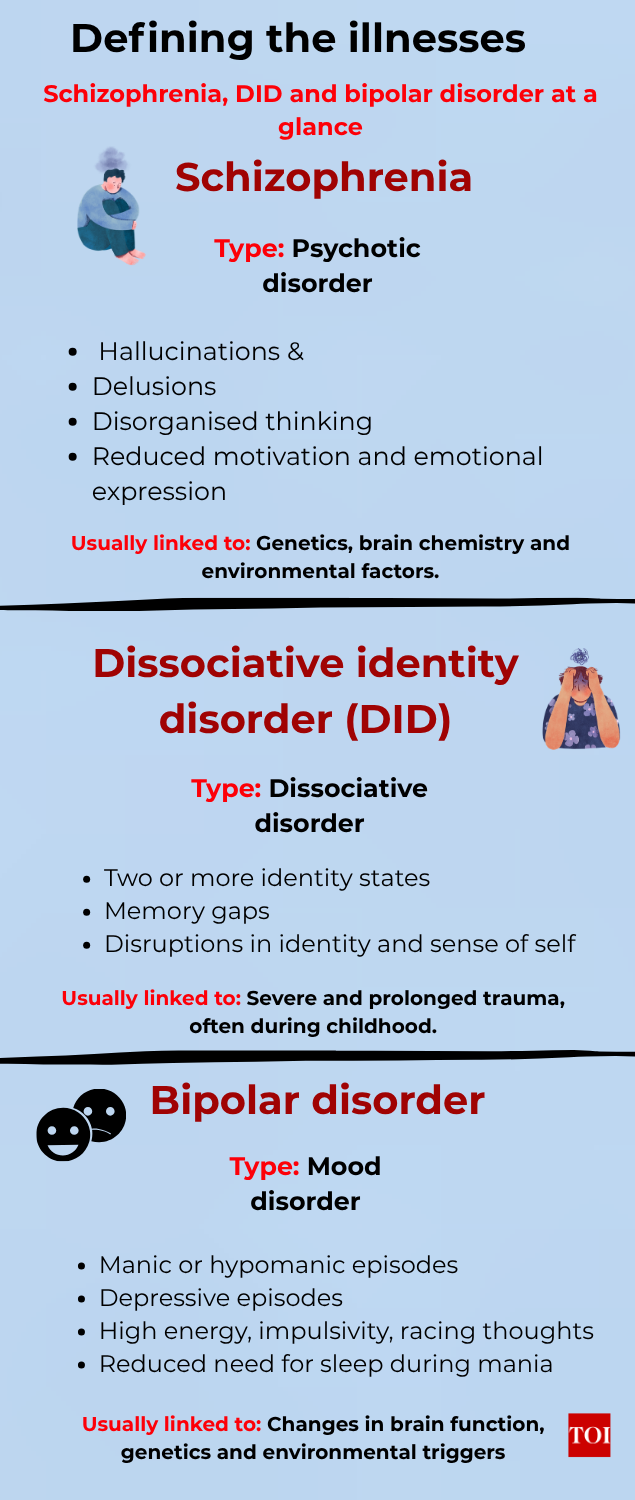
Three disorders, three different realities
Despite these differences, public understanding often blurs the boundaries between them.”The most common one I come across, even today, is people assuming schizophrenia means multiple personalities. It doesn’t. These are two separate conditions, and we treat them very differently,” says Dr Divya Nallur, Clinical Director at Amaha, a mental healthcare provider offering psychiatric services.According to her, much of the confusion stems from history as much as medicine. The word “schizophrenia” itself led many people to associate the illness with split personalities, a misunderstanding that popular culture amplified over decades.Dr Asha, psychiatrist at Bengaluru’s SPARSH Hospital, said the same misunderstanding continues to surface in clinical practice. “They are usually confused since popular media inaccurately portrays schizophrenia (Heavily influenced by a combination of genetics, brain chemistry, and environmental factors) as split kind of personalities. In order to improve understanding and reduce stigma surrounding both of the disorders good public education is very much essential,” she said.Additionally, despite being different diagnoses, schizophrenia, DID and bipolar disorder share one common challenge. They are all burdened by stereotypes that often overshadow medical reality. “Lock them up, stay away, dangerous, evil,” are some of the casual ways people describe someone struggling with a mental illness.For psychiatrists, that misconception has real consequences. “A diagnosis of schizophrenia or DID does not mean the person is dangerous. With the right treatment, psychological support and importantly, a supportive environment, many of these patients study, work, marry, raise children and live full lives,” said Amaha’s Dr Nallur.
The fictional narrative
For many people, the first introduction to serious mental illness did not come from a doctor or a classroom. It came from a film, a TV series or social media.For decades, cinema has relied on psychiatric conditions to build suspense, explain criminal behaviour or create dramatic plot twists. The villain hears voices. The killer has multiple personalities. The unpredictable character is casually described as bipolar or having “split personality”.Additionally, on one hand, psychologists, hospitals and advocacy groups are trying normalise discussions around mental health. On the other, short videos and simplified explainers can encourage self-diagnosis or blur the line between everyday emotions and clinical disorders.“In reality, the vast majority of these patients are not violent. If anything, they’re more likely to be on the receiving end of violence,” said Dr Nallur.”A thirty-second reel cannot explain a psychiatric condition,” she added. “People watch these and start labelling themselves, or their friends or family members. No assessment, nothing.”
A thirty-second reel cannot explain a psychiatric condition.
Dr. Divya Nallur, clinical director, Amaha
Dr Asha also said, “Both film and television have historically portrayed DID and schizophrenia in some sensational ways, often linking them with violence or unpredictable behaviour.”According to her, authentic storytelling backed by evidence can help correct these misconceptions.Public awareness, she says, must extend beyond recognising the names of disorders. It should help people understand symptoms, encourage timely treatment and replace judgement with empathy.
When diagnosis becomes characteristic
A diagnosis is meant to explain what a person is experiencing. Too often, it ends up becoming the only thing people see.Stereotypes follow people into classrooms, workplaces, neighbourhoods and even their own homes. They shape who gets hired, who is trusted, who is included and, in many cases, who feels safe enough to ask for help.Mental health professionals say this fear of being judged is one of the biggest reasons people delay seeking treatment.”I’ve had patients who suffered for years before walking into a clinic, purely because of what people would say,” says Dr Divya Nallur. “Stigma often does as much damage as the illness.”That delay can have lasting consequences. Symptoms become more difficult to manage, relationships begin to strain and recovery often takes longer than it otherwise might have.Seema Rekha, founder and director at a workplace mental health and organisational wellness consultancy Antarmanh consulting said stigma also discourages honest conversations within families.”Delayed help-seeking can be considered one of the main consequences of stigma. The delay in treatment can result in further deterioration of mental disorders and make rehabilitation more difficult.”Further talking about the portrayal in films and TV she added, “Previously, Hollywood used mental illnesses like schizophrenia or dissociative identity disorder to make their films or TV shows more interesting and exciting. Although it was entertaining to watch those films, the problem is that they gave a completely wrong perspective on those diseases, making it difficult for people to get an accurate picture of the issue.”
Media that tell the story with respect and science-based accuracy can change the existing misconceptions into understanding and eliminate stigma.
Seema Rekha, founder and director Antarmanh Consulting
Meanwhile, Sparsh hospital’s Dr Asha reiterating sensitivity towards the people, said people living with these conditions are “not simply their condition” and should be treated with empathy and dignity rather than suspicion or fear, adding, “with timely treatment, psychological care, social support and understanding from families, they can lead productive and fulfilling lives”.
Individuals suffering from DID or schizophrenia are not simply their condition.
Dr. Asha, psychiatrist, SPARSH Hospital, RR Nagar, Bangalore
For many families, however, the challenge still does not end once treatment begins.
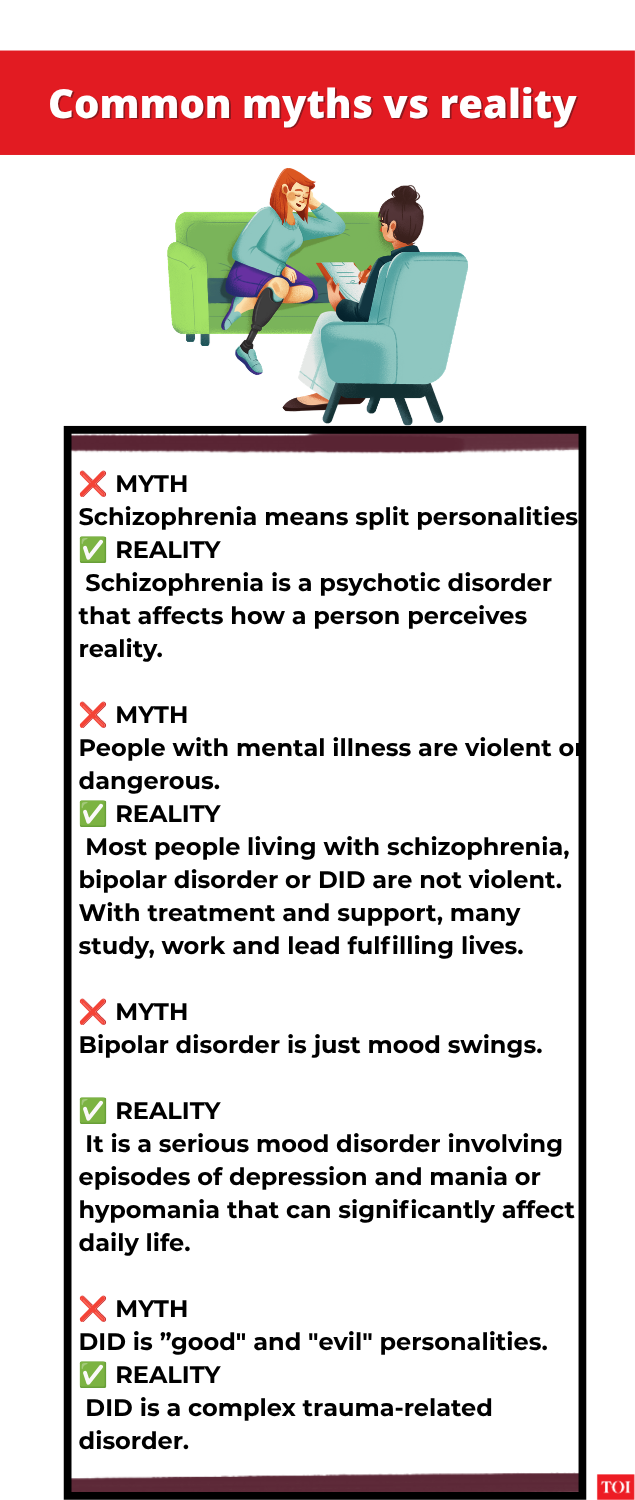
Myths vs reality
A systematic issue
Medicines can reduce symptoms. Therapy can help people cope. But recovery depends on much more than treatment alone. It requires families who understand, communities that include rather than isolate, and systems that help people.WHO highlighted that that stigma and discrimination often lead to social exclusion, limiting access to education, employment, housing and healthcare for people living with schizophrenia and other severe mental illnesses.Additionally, according to the US Substance Abuse and Mental Health Services Administration, more than one in four adults living with serious mental health conditions also has a substance use disorder.Yet the mental healthcare system continues to focus largely on diagnosis and treatment, while rehabilitation and long-term community support remain limited.Most specialised rehabilitation services are concentrated in a handful of tertiary care centres, leaving many families in smaller towns and villages with few options beyond hospital admissions and medication.For Bhawesh Jha, whose brother lives with schizophrenia, the shortcomings of the system are deeply personal.Growing up in a small town in Bihar, his family struggled to find an experienced psychiatrist. Years of heavy medication, severe side effects and repeated relapses followed before his brother finally received a proper assessment in Mumbai.”But not everyone can afford to go to Mumbai for care,” said Jha, who is also project & policy officer with University of Edinburgh and a member of the Bihar State Mental Health Authority.He believes India’s mental healthcare conversation remains centred on diagnosis and psychiatrists, while rehabilitation and community support receive far less attention. Services such as supported employment, day-care centres, skill development programmes and trained social workers remain scarce outside a handful of specialised institutions in cities like Bengaluru and Delhi.”The question is, how are the 60 per cent of Indians living in villages and small towns supposed to access these?” he asked.Jha also highlighted an interesting point that India’s continued reliance on institutional care is rooted partly in history. Colonial-era laws treated people with mental illnesses as individuals who needed to be confined in asylums, a mindset that, he says, still influences public attitudes and is often reinforced by films portraying people with schizophrenia as violent or dangerous.”Mental hospitals remain necessary during acute phases of illness, but they should not become the default simply because community support doesn’t exist,” he said.According toJha, the illness itself is often only part of the challenge. “Often, I’ve felt that the illness itself is only 40 per cent of the problem. The rest of the suffering is caused by society and community.”He says the discrimination often continues long after people leave the hospital, affecting employment, relationships and even basic legal rights. “There are people, including close relatives, who use the diagnosis itself to deny someone the right to property or marriage.”
The first thing to understand is that it is the illness that is the problem, not the person suffering from it.
Bhawesh Jha, caregiver, member of the Bihar State Mental Health Authority, project & policy officer with the University of Edinburgh
Yet his own family tells a different story. After their mother suffered a paralytic stroke, it was his brother who became one of her primary caregivers, helping with her daily needs and supporting the family.For people like Jha, it is a reminder that a diagnosis says little about a person’s ability to care, contribute or live with dignity.
Forgotten people in the conversation
Mental illness rarely affects one person alone.Behind every diagnosis is often a parent trying to understand, a sibling managing hospital visits or a spouse balancing work, finances and caregiving responsibilities. Yet while patients are increasingly part of conversations around mental health, caregivers often remain invisible.Many experience exhaustion, financial strain and social isolation while supporting a loved one through years of treatment. Formal support systems for caregivers remain scarce, especially in smaller towns and rural areas.Peer support groups have emerged as an important source of guidance for many families, allowing caregivers to exchange practical advice and emotional support with people facing similar challenges.Jha said these communities reminded him that caregivers also need care. “If your loved one is living with schizophrenia or any mental illness, I want you to know that you are not alone. Do not forget to take care of yourself. Self-care is as important as caring for your loved ones.”Experts believe that strengthening caregiver networks, expanding community-based rehabilitation and improving mental health literacy could significantly improve long-term outcomes for patients and families alike.
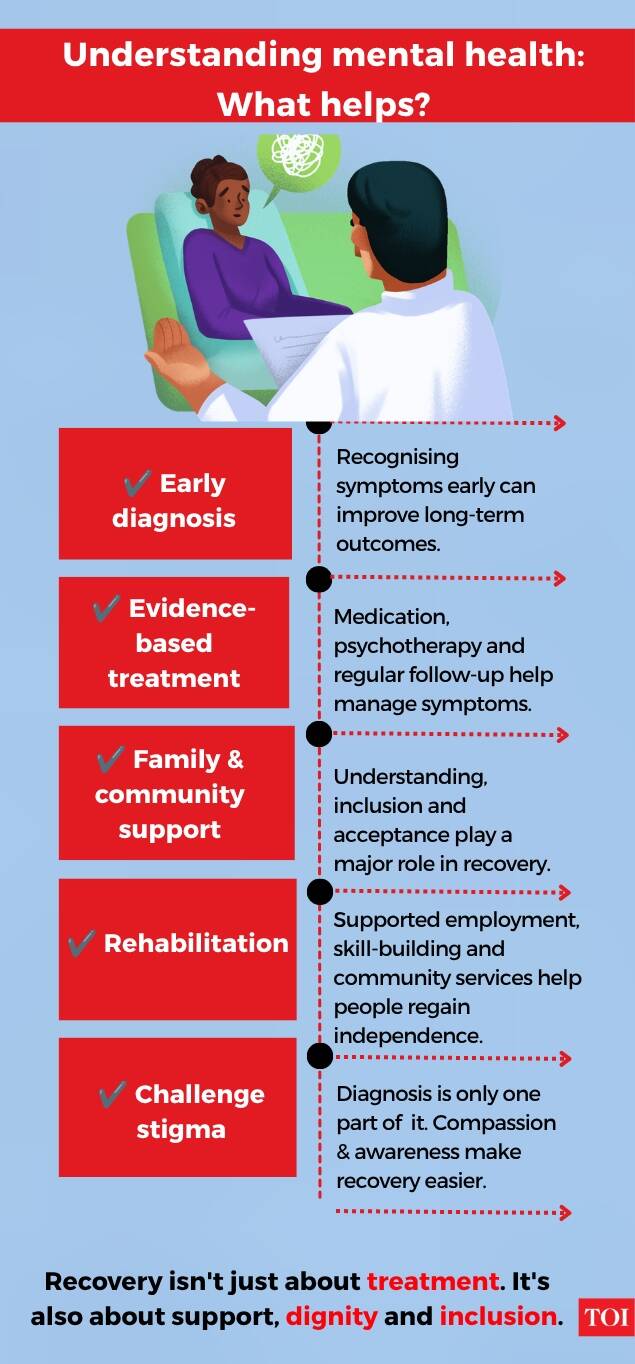
What helps people
Looking beyond labels
Mental health has come a long way from being a subject people avoided discussing altogether.Today, schools are beginning to introduce conversations around emotional well-being. Workplaces are investing in mental health programmes. Public figures are speaking openly about their experiences. Governments, too, have taken steps to strengthen mental healthcare and recognise the rights of people living with mental illnesses.But awareness alone cannot dismantle decades of misinformation.Schizophrenia is not synonymous with violence. DID is not the fictional battle between “good” and “evil” personalities. Bipolar disorder is far more than changing moods. These are complex medical conditions that require accurate diagnosis, evidence-based treatment and, above all, compassion.Perhaps that is the conversation mental health now needs. To encourage people to talk about mental illness and help them accept it. Because, at the end it is a person whose life is far bigger than the illness they happen to live with. Go to Source