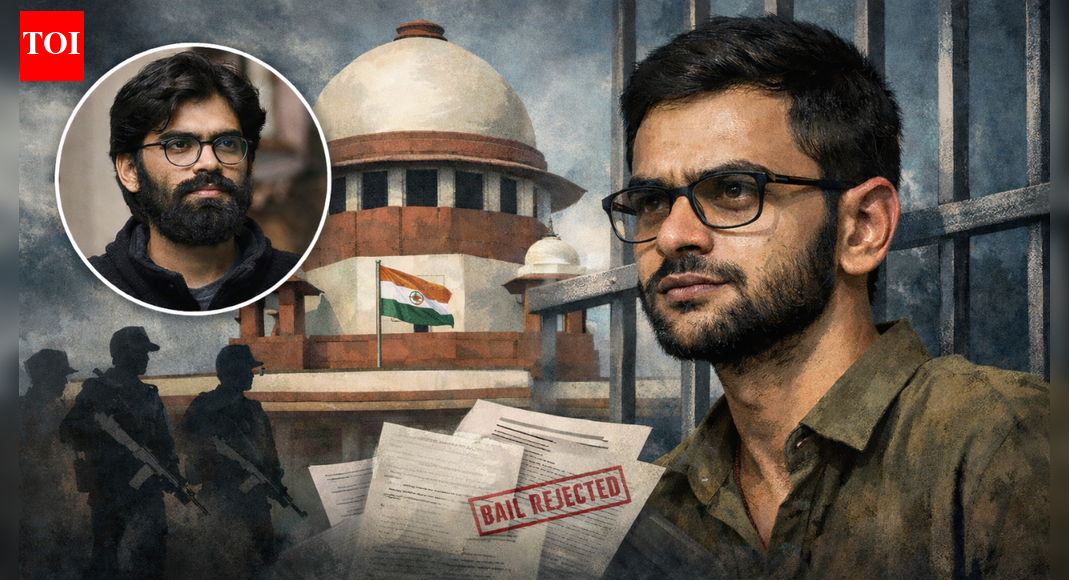

AI-generated image used for representation (Source: ChatGPT)
Umar still in “qaid,” and there is no different picture for Sharjeel Imam. A long spell behind bars, even before the formal beginning of the trial, cannot simply be a “trump card” or a “gateway to bail” in cases under the Unlawful Activities (Prevention) Act, the Supreme Court has said while rejecting the bail pleas of student activists Umar Khalid and Sharjeel Imam.Arrested in connection with the 2020 Delhi riots case, both have spent more than five years in custody, with the trial yet to formally begin.For Khalid and Imam, both former Jawaharlal Nehru University PhD scholars, the new year brought no relief. In a 142-page judgment delivered on January 5, 2026, the top court declined to grant them bail and restricted any fresh consideration of bail, permitting them to approach the court again only after one year or once protected witnesses are examined.In the same verdict, however, the court drew a clear line of distinction. Five other co-accused — Gulfisha Fatima, Meeran Haider, Shifa-ur-Rehman, Mohd Saleem Khan and Shadab Ahmad — were granted bail, underscoring what the bench described as a difference in culpability within the same case.
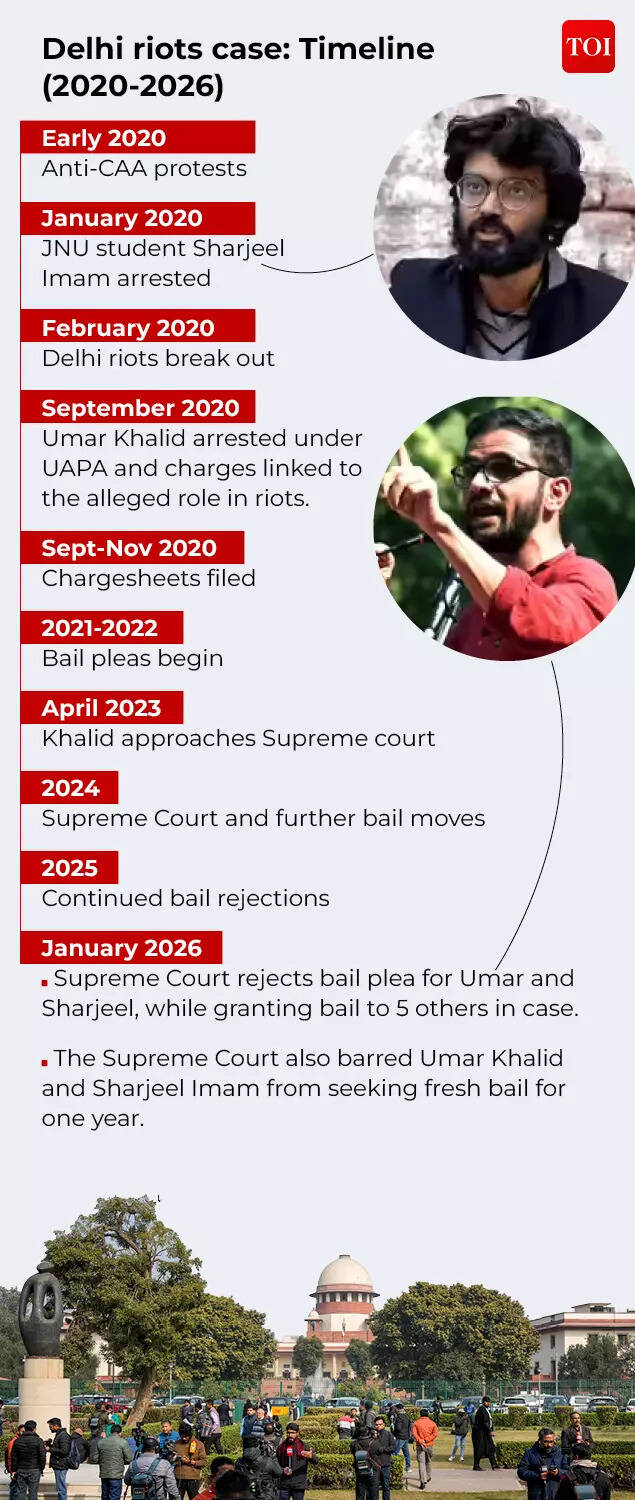
A bench of Justices Aravind Kumar and N V Anjaria refused to extend the “relieving shadow of bail” to Khalid and Imam, invoking a “hierarchy of culpability” and noting that the two stood on a “qualitatively different footing” from the co-accused who were granted relief the very same day.
What the case is about
The case traces its origins to the large-scale protests against the Citizenship (Amendment) Act and the NRC that later turned violent, culminating in communal clashes in parts of Delhi in February 2020, coinciding with the visit of then US President Donald Trump.At the bail stage, the court proceeded on the prosecution’s claim that Khalid and Imam were “ideological drivers” of the alleged conspiracy linked to the Delhi violence.The ruling, delivered in the first week of 2026, has once again brought judicial focus on prolonged pre-trial incarceration under special laws, the limits of personal liberty, and the scope of Article 21 when statutes like the UAPA come into play.
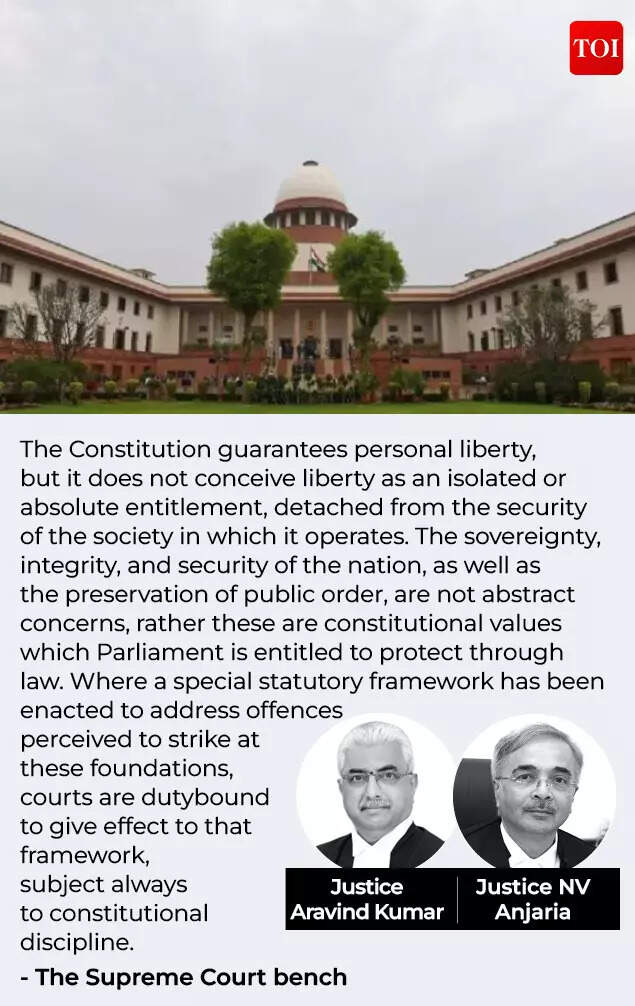
At the heart of the court’s reasoning lies a combination of statutory barriers and judicial interpretation, particularly its reading of Section 15 of the UAPA, including the “by any other means” clause defining a “terrorist act”, and Section 43D(5), the stringent bail provision that allows courts to deny bail if the accusations appear “prima facie true”, irrespective of the duration of custody.
Why others got bail — and they did not
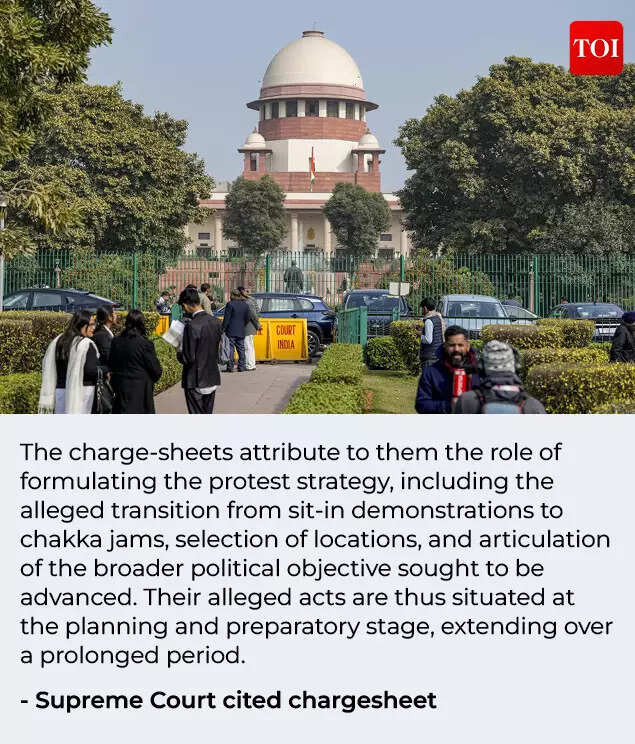
According to the Supreme Court, the prosecution material was sufficient, at the stage of considering bail, to place Umar Khalid and Sharjeel Imam on a “qualitatively different footing” from the five co-accused who were granted bail. This distinction, the bench said, flowed from what it described as a “hierarchy of culpability” emerging from the chargesheets.The judges observed that Khalid and Imam could not be treated on par with the other accused, whose alleged roles were confined to participation at protest sites or logistical facilitation. By contrast, the allegations against Khalid and Imam were held to be central to the planning and preparatory stages of the alleged conspiracy.The court noted that the prosecution had attributed to the two the role of formulating protest strategies, including the alleged transition from sit-in demonstrations to coordinated road blockades or “chakka jams”, selection of locations, and articulation of the broader objectives sought to be achieved through such actions.Quoting from the chargesheet, the bench said, “The charge-sheets attribute to them the role of formulating the protest strategy, including the alleged transition from sit-in demonstrations to chakka jams, selection of locations, and articulation of the broader political objective sought to be advanced. Their alleged acts are thus situated at the planning and preparatory stage, extending over a prolonged period.”
By contrast, the five co-accused who were granted bail were characterised as “local-level facilitators”, whose alleged involvement was limited to logistical arrangements and on-ground coordination. Their participation, the court said, was “derivative in nature”, flowing from directions allegedly issued by those placed higher in the chain.It was this judicial demarcation — between alleged planners and alleged facilitators — that ultimately shaped the differing outcomes on bail.
‘Terrorist act’ and the scope of Section 15
A key legal question before the Supreme Court was whether the acts attributed to Khalid and Imam could fall within the definition of a “terrorist act” under Section 15 of the Unlawful Activities (Prevention) Act.Under Chapter IV, Section 15 of the UAPA defines a “terrorist act” as an act committed with the intent to threaten, or likely to threaten, the unity, integrity, security, economic security or sovereignty of India, or with the intent to strike, or likely to strike, terror among the people or any section of the people in India or in any foreign country.
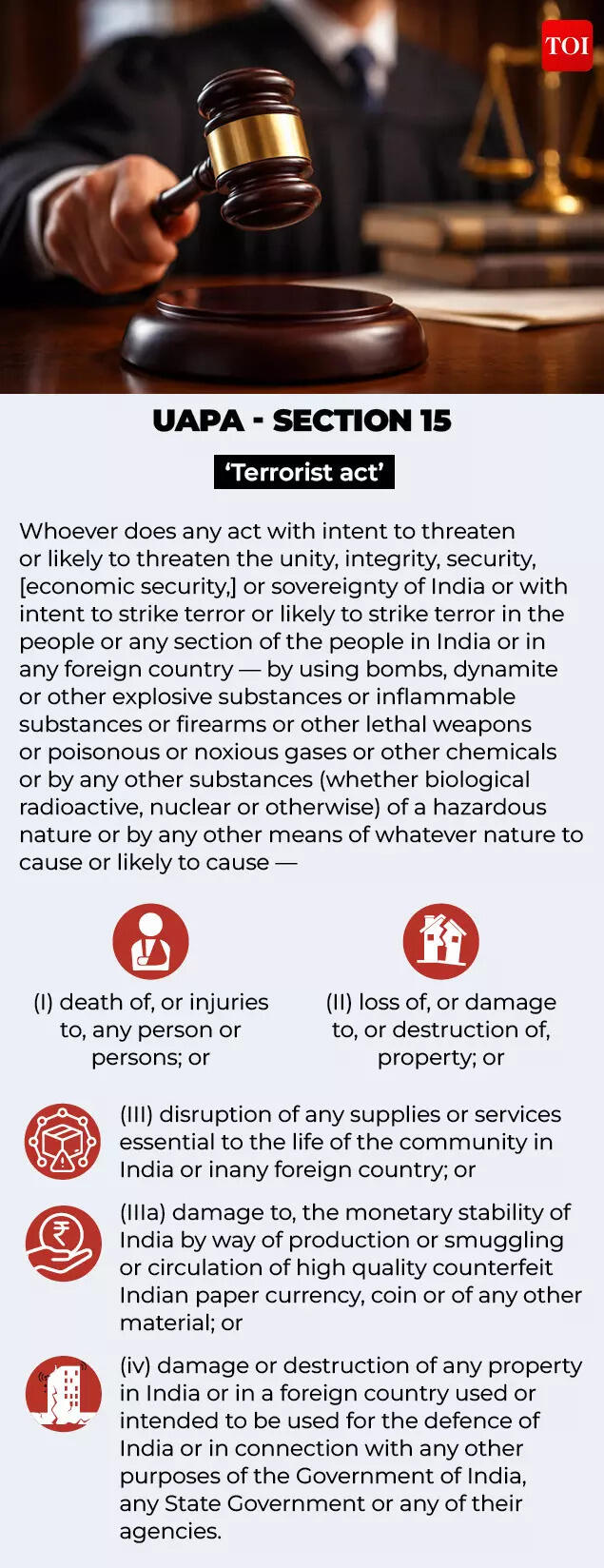
By using bombs, dynamite or other explosive or inflammable substances; firearms or other lethal weapons; poisonous or noxious gases; other chemicals; or any other substances of a hazardous nature, whether biological, radioactive, nuclear or otherwise; or by any other means whatsoever, to cause or likely to cause, death or injury to any person, or loss of or damage to property, etc.The defence argued that the allegations, even if accepted at face value, disclosed issues of public order at best and could not be elevated to the level of terrorism in the absence of overt violence, weapons, or explosives. The defence contested that, in the absence of overt violence, the organisation of protests and calls for “chakka jams” amounted to constitutionally protected dissent and could not be stretched to fit the contours of Section 15.It was submitted that even the alleged “inflammatory” speeches and appeals for road blockades, at their highest, constituted a public order issue and not a terrorist act, since the accused were not involved in any overt act of violence and did not use firearms, explosives or other lethal weapons.The Supreme Court rejected this narrow construction.Interpreting Section 15, which defines a terrorist act and includes the phrase “by any other means”, a bench of Justices Aravind Kumar and N V Anjaria specified that the provision is not limited to “conventional forms” of violence.
The means by which such acts may be committed are not confined to the use of bombs, explosives, firearms, or other conventional weapons alone. Parliament has consciously employed the expression ‘by any other means of whatever nature’, which expression cannot be rendered otiose.
The bench
The court stressed that the focus of the law is not merely on the weapon used, but on the intent and impact of the act itself. “The statutory emphasis is thus not solely on the instrumentality employed, but on the design, intent, and effect of the act. To construe Section 15 as limited only to conventional modes of violence would be to unduly narrow the provision, contrary to its plain language,” it observed.The bench further explained that the consequences envisaged under Section 15 shed light on Parliament’s understanding of terrorism. It mentioned that acts threatening economic security or disrupting essential supplies also fall within the provision’s sweep, making a reference point to the allegations that Khalid called for traffic paralysis in cities and Imam sought to cut off the Northeast, including through his controversial “chicken-neck” remark.On the clause of “by other means” Senior advocate and former Delhi high court bar association president Kirti Uppal told TOI: “The Court appears to read the phrase “by any other means” in Section 15 of the UAPA as a conscious legislative choice to widen the law’s scope, focusing on intent and impact rather than only physical violence. That is why even calls like a ‘chakka jam’, if alleged to be part of a larger disruptive design, are sought to be brought within its ambit.”
Sections 15 and 18: Planning as liability
“Apart from death or destruction of property, the provision expressly encompasses acts which disrupt supplies or services essential to the life of the community, as well as acts which threaten the economic security of the nation. This reflects Parliament’s recognition that threats to sovereignty and security may arise through conduct that destabilises civic life or societal functioning, even in the absence of immediate physical violence,” the top court said.The accused had contended that the allegations by the Delhi Police, even if accepted in full, disclosed only a case of public disorder and that invoking UAPA amounted to an overstretched understanding of terrorism. They argued that, at most, the case could attract conspiracy under Section 18.The prosecution, however, represented by Solicitor General Tushar Mehta and Additional Solicitor General S V Raju, countered that the statutory definition of a terrorist act is not confined to traditional violence — a position the court ultimately accepted.Clarifying the relationship between the two provisions, the bench said, “Read together, sections 15 and 18 disclose a legislative design wherein Section 15 defines the nature of acts which Parliament has characterised as terrorist acts, while Section 18 ensures that criminal liability is not confined only to the final execution, but extends to those who contribute to the commission of such acts through planning, coordination, mobilisation or other forms of concerted action. Whether particular conduct ultimately attracts Section 15 directly, or Section 18 read with Section 15, depends upon the role attributed and the statutory ingredients alleged to be satisfied.”When asked about the “open-ended” nature of the “by any other means” clause in Section 15 of the UAPA, senior advocate Kirti Uppal told TOI, “The court seems to interpret ‘by any other means’ as a deliberate legislative choice to broaden the law’s scope, emphasizing intent and impact rather than just physical violence. That is why even actions such as a ‘chakka jam,’ if alleged to be part of a larger disruptive design, are being brought within its ambit.”
Prolonged custody and the UAPA
The bench also rejected the contention that Khalid and Imam were “innocently incarcerated”, holding that the record did not support the claim that the delay in trial was wholly unjustified or attributable solely to the prosecution.Under Section 43D(5) of the UAPA, the court reiterated, bail must be denied if there are reasonable grounds to believe that the accusations are “prima facie true”.
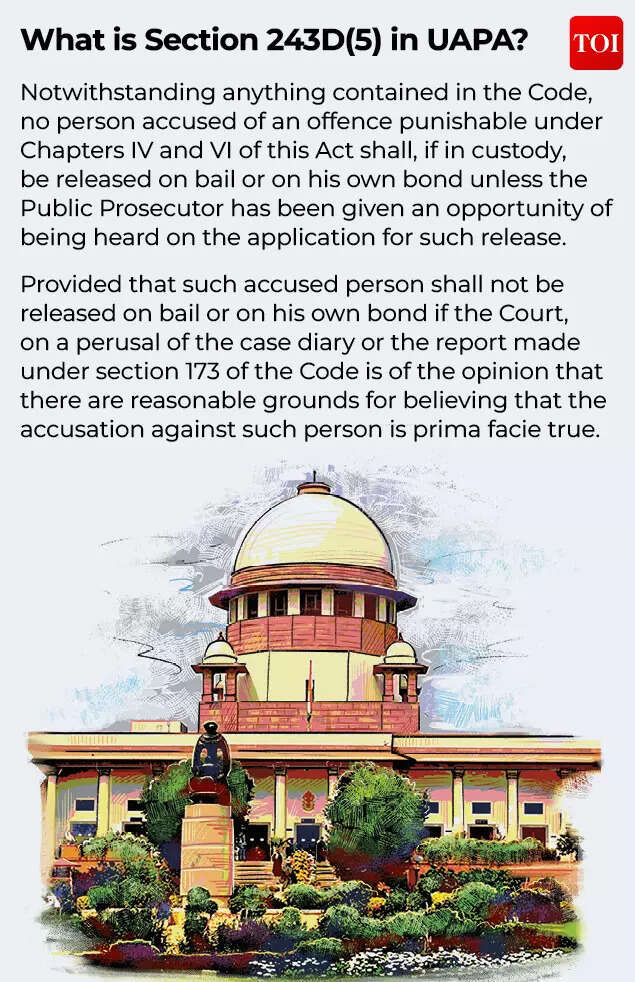
“At the stage of bail, the court is not required to weigh evidence or test its admissibility,” the bench said, adding that once the statutory threshold is crossed, prolonged incarceration alone cannot override the legislative embargo.
When bail is sought in prosecutions governed by a special statute, the court is required to undertake a difficult and sensitive balancing exercise, conscious that neither liberty nor security admits of absolutism.
The Supreme Court
The judges made it clear that once the prosecution places material that meets the “prima facie” threshold, the statutory bar under Section 43D(5) must ordinarily come into operation.A constitutional court, it said, cannot treat such a restraint as optional or easily avoidable.”Where Parliament has prescribed a distinct statutory threshold for the grant of bail, and where the prosecution places prima facie material suggesting organised and deliberate activity affecting public order and security of the nation, the court cannot turn a Nelson’s eye to such material merely because incarceration is prolonged or liberty is invoked in the abstract. Equally, where continued detention is not shown to be necessary to serve a legitimate purpose recognised by law, the court must not hesitate to restore liberty, subject to stringent conditions that safeguard the larger public interest,” the Supreme Court said.Addressing Sharjeel Imam’s submission that he was already in custody at the time of the riots and had publicly appealed for non-violence, the bench held that such assertions do not, at the bail stage, neutralise allegations of conspiracy.Similarly, Umar Khalid’s claim that his actions amounted to political dissent was rejected at this stage, with the court emphasising that the protection of dissent does not cover alleged conduct aimed at systemic disruption.
What the court clarified
For now, the Supreme Court’s ruling draws a clear boundary at the stage of bail. Its assessment, the bench said, rests on the role attributed to the accused, the material placed by the prosecution, and the statutory framework governing offences under the UAPA — not on ideology or identity.”The court does not proceed on identity, ideology, belief or association. It proceeds on role, material and the statutory threshold governing the exercise of jurisdiction. Criminal law does not mandate identical outcomes merely because allegations arise from the same transaction,” the Supreme Court said.For Umar Khalid, the Supreme Court’s ruling marks not an end, but a pause — with the next move resting in the trial court. Go to Source