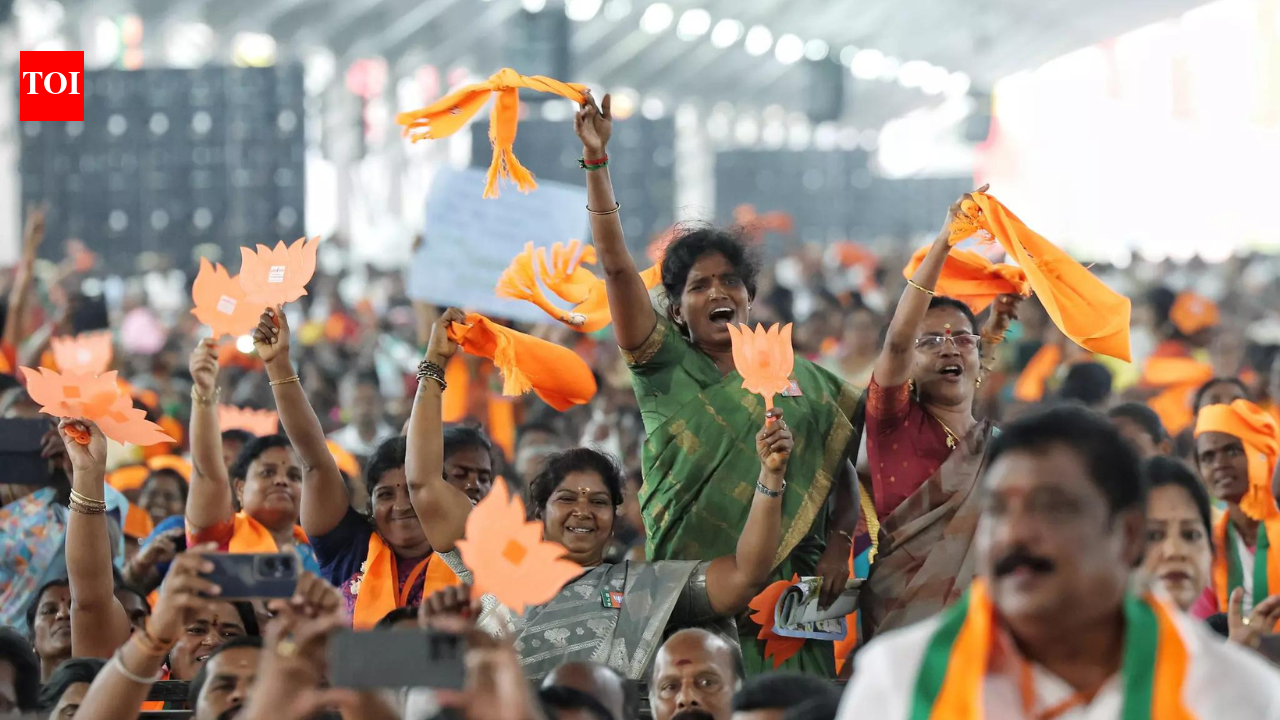

NEW DELHI: As Tamil Nadu gears up for assembly elections in a couple months, the BJP is looking to consolidate opposition forces. With an anti-DMK alliance, the BJP, it seems is also trying to “do a Bihar” in a state it has struggled to make a mark in till now.As the party takes winning lessons from recent Bihar assembly victory, it is forming a social alliance that represents every major caste segment in the state. Earlier in Bihar assembly election, BJP had a fool-proof plan. The party, along with its NDA partners, built a social coalition that represented the major castes, isolating the Rashtriya Janata Dal-led Mahagathbandhan with its Muslim-Yadav voter base.The five NDA partners represented almost all segments of society. LJP and HAM had Dalit faces like Union minister Chirag Paswan and Jitan Ram Manjhi. EBC and non-Yadav OBC castes were represented by JD(U) and the Rashtriya Lok Morcha. Meanwhile, the BJP had its vote banks among the upper castes and the Baniya community. This fine-tuned caste coalition brought an overwhelming majority for the NDA. The alliance won 202 seats in the 243-member Bihar Assembly.Forging allianceDominated by Dravidian politics, alliances also play a huge role in Tamil Nadu. Apart from a peak DMK or AIADMK, no single party can dominate the Assembly without a broad coalition. To prevent vote-splitting, which could favour the DMK, the BJP is trying to inculcate as many parties as it can to rebuild a broader NDA. Former alliance partners and breakaway factions are being approached, including leaders who had earlier left.Two years after the split, the BJP and AIADMK came together in 2025 and announced that the NDA will contest the upcoming assembly polls under the leadership of former chief minister Edappadi K Palaniswami (EPS).The BJP’s alliance with the AIADMK has been more than tactical and is seen in Delhi as the primary vehicle for relevance in the southern state. However, the current BJP strategy, curated mainly by Amit Shah, reflects this urgency. Additionally, the AIADMK also has a voter base among Dalit communities. This voter base constitutes almost 20 per cent of the state’s population.Meanwhile, AIADMK leader O Panneerselvam (OPS) also declared that he was “ready” for reunification with Edappadi K Palaniswami’s (EPS) AIADMK faction ahead of Tamil Nadu’s 2026 assembly polls.At a press meet in Madurai, OPS threw a pointed challenge at both EPS and AMMK general secretary T T V Dhinakaran, asking whether they were prepared to take the leap. “I am ready for that. Are they ready?” he said, invoking the possibility of rival factions closing ranks under the NDA umbrella.The Pattali Makkal Katchi (PMK) also entered the NDA, giving it a symbolic boost. However, this did not come without complications. Anbumani Ramadoss’s decision to align with the AIADMK-BJP front was meant to strengthen the NDA’s presence in northern Tamil Nadu, where the PMK traditionally draws support from the Vanniyar community. Though this adds social breadth to the coalition at a time when consolidation is critical, the PMK is far from united. Meanwhile, the BJP has also reportedly approached TVK’s Vijay to join the NDA after he positioned his party as an alternative political force in Tamil Nadu.Vijay hails from a Christian community that constitutes about 6 per cent of the population in the state. Additionally, Vijay commands huge popularity among youngsters. Unlike the parties of other film stars, Vijay’s supporters are organised and politically active.What political pundits sayAccording to poll analysts, caste equations have always played a role in Tamil Nadu. However, they believe the BJP’s efforts to bring different castes on one stage have not gained much traction.Speaking to *The Times of India*, political analyst Kannan R said that the saffron party does have a number of leaders from the backward classes but so far, the party seems to rally Hindus as a monolithic unit.“Caste and cash remain two important factors in TN’s electoral politics and will continue to play a crucial role. I don’t think the BJP is trying to bring different castes on the stage, or if it is, it hasn’t gained traction so far,” Kannan said.“It does have a number of leaders from the backward classes, but so far the party seems to rally Hindus as a monolithic unit, which has so far been a no-go in this state,” he added.Another analyst, Shyam Shanmugaa, said that elections cannot be won purely on caste equations in Tamil Nadu.“Caste equations are always at play in rural Tamil Nadu. But in urban areas, it does not matter. Tamil Nadu is a heavily urbanised state. Hence, elections cannot be won purely on caste equations. If one caste is mobilised in a particular rural constituency, counter-mobilisation takes place,” Shanmugaa told TOI.“Therefore, winning chances are there for candidates who are caste-neutral and appeal to all castes. The BJP is mostly seen as a Brahmin upper-caste party. It is unable to mobilise one particular OBC caste. Even when TN BJP leaders from particular dominant communities were made state presidents, the BJP could not win,” he added.Why caste matters in Tamil NaduDalitsDalits constitute around 19% to 21% of the state’s population. They are spread across the state, with their population higher in districts such as Cuddalore, Villupuram, Tiruvallur and Madurai.The larger Dravidian political movement, which has evolved over the past two centuries and given rise to parties such as the Dravida Kazhagam, the DMK and the AIADMK, has historically reached out to Dalits.ThevarsConcentrated mainly in southern Tamil Nadu districts such as Madurai, Theni, Dindigul, Sivaganga and Ramanathapuram, the Thevars are a politically influential community and fall under the MBC category. Several prominent Thevar leaders are part of the AIADMK.Former chief minister J Jayalalithaa’s close aide V K Sasikala and rebel leader O Panneerselvam both belong to the community.Thevars played a notable political role during the British period. Pasumpon Muthuramalinga Thevar, a revered leader and freedom fighter, was associated with the Indian National Congress and later the Forward Bloc. His birth anniversary is observed as “Thevar Jayanthi”. The community is also said to have participated actively in the armed struggle led by Subhas Chandra Bose.The Thevar population is estimated at around 10% to 12%.VanniyarsVanniyars, largely based in northern Tamil Nadu, are among the biggest and most politically active Most Backward Classes (MBCs) in the state. Tamil Nadu categorises OBCs into BC and MBC groups. The Vanniyars are primarily an agrarian community and have largely retained land ownership despite industrialisation. Members of the community are frequently named in connection with anti-Dalit violence in the state.Politically, Vanniyars are represented by the Pattali Makkal Katchi (PMK), which is currently part of the BJP-led NDA. Founded and led by S Ramadoss, the party has wielded influence due to the community’s numerical strength, organisational structure and sustained political mobilisation. Ramadoss began organising Vanniyars in the 1980s and is credited with improving educational outcomes within the community from the 1990s onwards.Vanniyars are estimated to make up about 12% to 15% of Tamil Nadu’s population, with a strong presence in Villupuram, Cuddalore, Thiruvannamalai and parts of Vellore, and smaller concentrations in Salem and Dindigul.NadarsNadars are a trading community with a strong footprint in commerce and politics. Their leaders cut across party lines and have successfully translated economic strength into political influence.In 1921, the community founded The Nadar Bank Limited, which was renamed Tamilnad Mercantile Bank in 1962. In 1922, P Ayya Nadar and A Shanmuga Nadar travelled to Kolkata to learn the safety match manufacturing process, leading to the establishment of manual match production under the ‘Bengal Lights’ brand in Sivakasi. The town remains a major centre for firecracker manufacturing.The most prominent Nadar leader in Tamil Nadu’s political history is K Kamaraj, a senior Congress leader and former chief minister. Alongside Hindu Nadars, Christian Nadars also hold a significant presence in institutions and power structures.The community’s population is estimated at around 4% to 6%, with a concentration in southern Tamil Nadu districts such as Kanyakumari, Tirunelveli, Thoothukudi and Virudhunagar.GoundersGounders fall under the Backward Classes (BC) category and account for roughly 5% to 7% of Tamil Nadu’s population. They are largely concentrated in western Tamil Nadu, or the Kongu Nadu region, which includes districts such as Coimbatore, Tiruppur, Erode, Namakkal, Karur and Salem.Primarily dependent on agriculture and allied sectors, the community is also known for its entrepreneurial presence and influence in regional industries. Prominent figures include industrialist and philanthropist N Mahalingam, who was involved in several educational initiatives.After J Jayalalithaa’s death, Edappadi K Palaniswami, a Gounder, assumed control of the AIADMK, sidelining the Sasikala family and O Panneerselvam, and assigning key Cabinet portfolios to leaders from the community.The Election Commission is expected to announce the assembly elections in Tamil Nadu in April–May this year. In the 2021 assembly elections, the DMK won 133 seats, while the Congress won 18 seats. Meanwhile, the AIADMK secured 66 seats with 33.5% of the vote; the PMK secured five seats with a 3.8% vote share, while the VCK won four seats with a 1% vote share. Go to Source