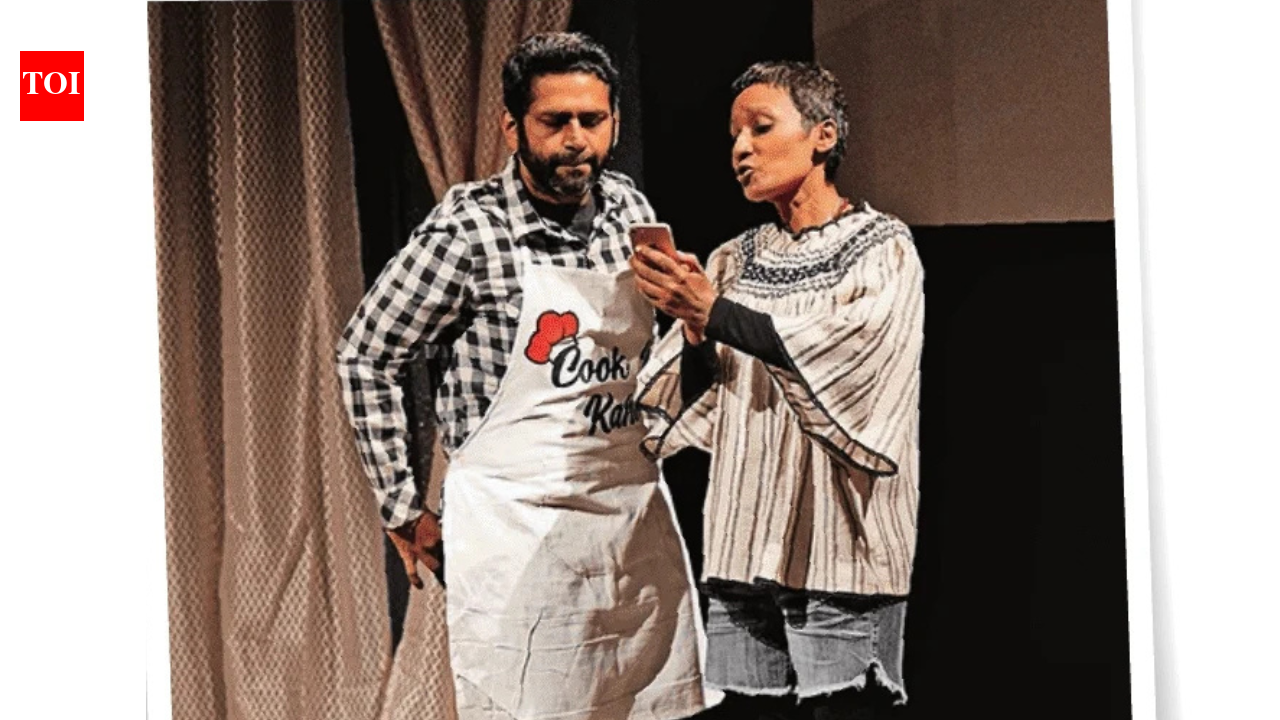

So, your doctor is a man?” he asks, eyes on the road.“Yes,” she shrugs, head wrapped in a scarf. “The oncologist is a man. He was referred to me by my gynaecologist.”“Okay. She must be sure of his credentials then.”“He. My gynaecologist is a man.”“What? You mean he touches you?”₹Questionable questions, awkward puns, well-timed expletives and several unreciprocated high-fives animate ‘Breast of Luck’, a play whose protagonists choose to sing, dance and laugh their way through the grimness of cancer.Co-written and staged by Tannishtha Chatterjee — who was diagnosed with stage IV oligometastatic cancer last year — and Sharib Hashmi, whose wife has beaten mouth cancer four times, the musical comedy, directed by Leena Yadav, opened at the G5A in Mumbai recently to a packed house. The room included Naseeruddin Shah, Dia Mirza, Tanvi Azmi and Divya Dutta, apart from Chatterjee’s doctors and cancer survivors. At the end of the first show, Chatterjee turned to the room and said, “Honestly, I don’t know how I am doing except that I have stopped chasing certainty.” Shah reassured her: “This is the most cathartic and best thing you could have done for yourself.”Songs Over SorrowTo be staged at the Kala Ghoda Arts Festival on Feb 4 to mark World Cancer Day, the script sees opposites distract before they attract. Sheila Roy is a cool, composed classical singer, while Arun Mohan is a goofy divorced stockbroker who punctuates dad jokes with high-fives. When she launches into her riyaaz every morning at 5, he winces and rings her up on the intercom, begging her to stop. Their heated exchanges morph into real-world meetings on a dating app. Just as Roy begins to enjoy Mohan’s company, the story swerves: she is diagnosed with stage IV oligometastatic breast cancer.She pushes Mohan away, convinced love will only expose her vulnerability. He refuses to leave, insisting on staying, his caregiving peppered with relentless puns. That refusal to surrender humour, intimacy or companionship to illness anchors the play’s emotional centre. Often reduced to a serious trope in movies, the Big C finds its funny bone in the drama. “Exactly. That is the USP,” Hashmi says. “Otherwise, it could easily have become a sad story. We chose to see it from a lighter side — with songs, jokes, laughter.”The play draws from a deep personal well. Interspersed through the second half are real hospital visuals — insurance IVRs (interactive voice responses), chemotherapy rooms, and injections. At one point, you watch Chatterjee singing through an injection. “The targeted medicine was extremely painful. But when I sing, those 10 minutes used to pass more quickly,” says Chatterjee, who had invited her friend, a documentary cinematographer, to shoot on the last day of her chemo.Music, laughter and community sustained Chatterjee through the medical journey. Incidentally, Chatterjee — best known for her performances in ‘Dekh Indian Circus’ (2011), ‘Gulaab Gang’ (2013), and ‘Angry Indian Goddesses’ (2015) — was supposed to meet Hashmi of ‘Family Man’ and ‘Filmistaan’ fame on the day her biopsy report arrived. Hashmi had been shooting for her film ‘Full Plate’ and had casually discussed a collaboration.“The day I got my report, I was supposed to meet Sharib for coffee. I almost cancelled,” she recalls. “I was devastated. But I thought if I go home, I’ll have to tell my mother and I’ll feel worse. So I went.”A year before Chatterjee was diagnosed, she had lost her father to cancer. “He died in my arms in the hospital ICU. He was so full of life. When I was diagnosed, my main concern was my mom, who’s 70plus. How would I give this news to her? Because it wasn’t stage one, or stage two, or even stage three — it was stage four.”When she confided in Hashmi, he called his wife Nasreen, who has lived with cancer since 2018. “She gave me a lot of strength,” Chatterjee says. “She said, ‘Look at me. I’ve relapsed four times. I’m here. I’m doing everything.’ After that call, I looked at Sharib and said, let’s write a play for her.”The script took shape during chemotherapy. Rehearsals were scheduled between hospital visits. Improvisations were shaped as much by pain as by laughter. “I was writing while going through treatment. I wanted to laugh constantly. I didn’t want to pull myself down,” says Chatterjee, who found humour in the mundane — doctors clinically debating silicone implants, nurses scolding her and her friends for laughing too loudly in hospital rooms.The rehearsals weren’t easy. “I had, and still have, terrible nerve damage in my shoulder and left arm. Everyone had to be careful while hugging me or touching me because it’s excruciating if it goes beyond a certain range of mobility.”Hashmi relates to Arun Mohan not only as a performer but as a caregiver. “After my wife’s diagnosis, our lives changed completely,” he says. “But she treated cancer like a fever — with courage, humour, incredible strength. We tried to bring that spirit into the play.”Medical professionals echo that sentiment carefully. Breast oncoplastic surgeon Dr Vani Parmar notes that a cancer diagnosis often arrives as a shock, particularly for younger women. “The treatments — radical surgeries, long chemotherapy sessions, hair loss, weakness — lead to immense physical, emotional, social and financial strain, along with a constant fear of recurrence and death,” she says. Changes to appearance, she adds, often trigger anxiety and depression. “‘Chemo brain’, or brain fog, is also part of the territory.”Chatterjee recalls days when she told her doctor she couldn’t do another chemo cycle. “He understood. He knew that in three days, I’d feel differently.” That reassurance — from doctors and fellow survivors — mattered enormously.While psychological counselling is not routinely integrated into many hospitals, it is increasingly being recognised as an essential part of cancer care. Priyadarshini Deo, counsellor at the Centre for Cancer and Palliative Care at Kokilaben Dhirubhai Ambani Hospital, points to studies showing that humour and movement-based activities can significantly enhance emotional health. “Humour and lightness reduce stress, ease anxiety, improve communication and strengthen relationships, especially with caregivers,” she says.Argument For LightnessA case for lightness arrives in actor Lisa Ray’s memoir Close to the Bone, in which she recalls the day she was diagnosed with cancer by a “jittery, rabbit-faced doctor”. “He spoke very slowly, pausing for a long time between each word, as if to gauge my reaction. You. Have. Multiple. Myeloma.” The doctor, Ray writes, reminded her of the rabbit in ‘Alice in Wonderland’. “As he kicked me down the hole, he never said the word ‘cancer’.”“Oh,” Ray replied. “Do you want me to get you some water?”Her response, she writes, might seem strange. “But he did look parched. Also, it never occurred to me that I wouldn’t get better… I was framing it as just another adventure.”Apart from music, what sustained Chatterjee after her diagnosis was community. “I cried alone in my car with my reports,” she says. “My sister told me — you can’t save yourself alone.” Friends video-called her and joked about everything from Trump’s antics to local absurdities. “It helped me sleep. It made me feel light.”Why, we ask her, is cancer so often portrayed in popular culture only through despair and solemnity? “Because it usually comes from an external perspective, not lived experience,” Chatterjee says. “I think there’s a fear — how can I be sensitive (towards the topic)? I was fearless because it’s me.”The play does not trivialise her struggles, including her prolonged insurance battles. Her arguments with an automated voice convey her frustration. “The day my insurance refused me, I was at my lowest. The treatment is excruciatingly expensive. I’m not a commercial actor. I’m an alternative, arthouse actor. I’m not rolling in money. And I have a mother and a daughter to take care of,” says Chatterjee. Her daughter lived with the actor’s sister in the US during treatment.Care for the caregiver, too, is crucial, Dr Parmar reminds us. “There is emotional burnout, financial strain and disrupted routines. Clear communication, shared decision-making and emotional support make the biggest difference.” She urges the integration of psychological and financial support into standard cancer care. “Good healthcare at an affordable cost is a right.”“My doctors told me this isn’t just about cancer,” Chatterjee says. “In any illness, people should watch it — to see how art, music, laughter and community are therapeutic.”The audience response suggests the message has landed. Survivors have cried and laughed in equal measure. Caregivers have recognised themselves. Those who have lost loved ones have found something gentler than grief alone. Hashmi’s wife has seen the play three times. “She loved it,” he says. Go to Source