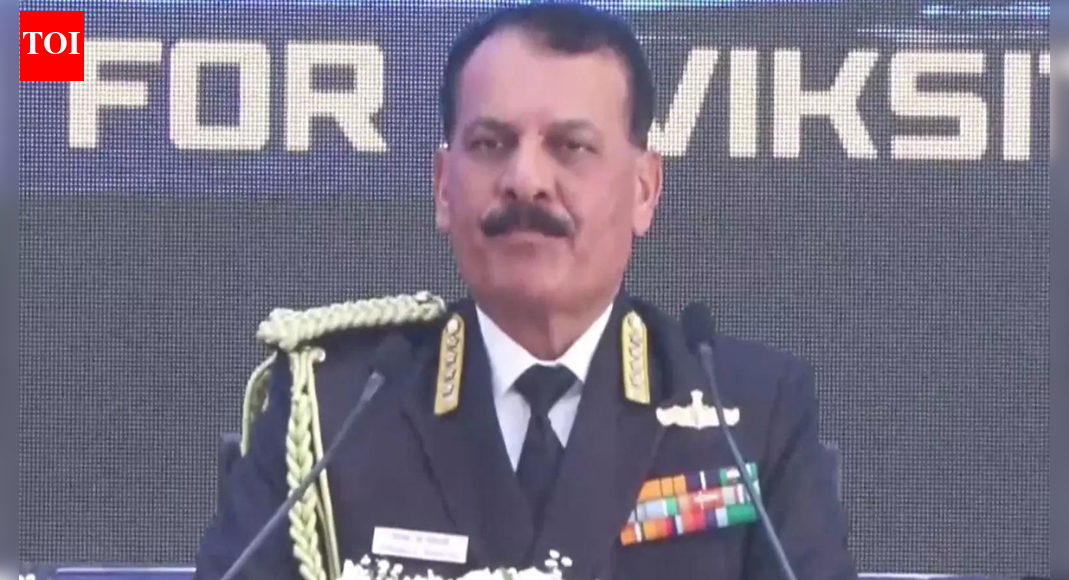

Navy chief Admiral Dinesh K Tripath
NEW DELHI: India will early next year add some sharp teeth to its sea-based leg of the nuclear triad by commissioning its third nuclear-powered submarine, which is larger than the first two and capable of carrying more long-range nuclear-tipped ballistic missiles.The third such submarine, called SSBN in naval parlance, is in “the final stages of trials and will be commissioned soon” as INS Aridhaman, Navy chief Admiral Dinesh K Tripathi said on Tuesday. Sources, in turn, said the fourth SSBN (codenamed S-4*), which will also have a displacement of 7,000-tonne like INS Aridhaman, is likely to be commissioned in 2027. The first two, INS Arihant and INS Arighaat, both with a 6,000-tonne displacement, became fully operational in 2018 and 2024, respectively.Parallelly, India will also get a nuclear-powered attack submarine (called SSN), armed with conventional or non-nuclear weapons for long-range hunting-killing missions, on a 10-year lease from Russia by 2027-28.The delivery of this advanced Akula-class SSN, which will be commissioned as INS Chakra-3, was to take place much earlier under the $3 billion deal with Russia in March 2019 but has been delayed due to the ongoing Ukraine war, as reported by TOI earlier. Both SSBNs and SSNs, which can stay underwater for months on end, are crucial for India’s credible strategic deterrence against the collusive and fused China-Pakistan threat, which is only going to further expand in the coming years.While SSBNs are meant for retaliatory nuclear strikes in line with India’s “no first-use” policy, SSNs are designed for conventional warfare by quietly gathering intelligence, tracking and destroying enemy targets at extended ranges.India’s first two nuclear triad legs are the land-based Agni series of ballistic missiles and fighters like Sukhoi-30MKI, Mirage-2000, Jaguar and Rafale capable of delivering nuclear gravity bombs. SSBNs, however, are considered the most secure, survivable and potent platforms for retaliatory nuclear strikes, which in turn can deter an adversary from launching a first strike.Admiral Tripathi, on his part, said India’s own project to build two SSNs is “proceedings as per plans” after being cleared by the PM-led cabinet committee on security for Rs 40,000 crore in Oct 2024.The first of these two 9,800-tonne SSNs, each with a 190 MW pressurised light-water reactor, will be ready for induction by 2036-37, followed by the second one a couple of years later, as was earlier reported by TOI.On the SSBN front, INS Aridhaman will be capable of carrying double the number of K-4 ballistic missiles, which have a strike range of 3,500-km, as compared to INS Arighaat. INS Arihant is armed only with 750-km range K-15 missiles.The K-4 missile is going to be soon tested for the second time from INS Arighaat after the first test in Nov last year did not meet all the laid down parameters. There are also K-5 and K-6 missiles, with strike ranges of 5,000 to 6,000-km, on the anvil.India’s existing SSBNs are less than half the size of the ones with the US, China and Russia. China is rapidly expanding its existing fleet of six Jin-class SSBNs, with 10,000-km range JL-3 missiles, and six SSNs. The US, in turn, has 14 Ohio-class SSBNs and 53 SSNs.India also has the plan to eventually build 13,500-tonne SSBNs, with much more powerful 190 MW pressurised light-water reactors instead of the existing 83 MW ones. Go to Source