


Representative image
NEW DELHI: In a significant effort to speed up diagnosis of serious infections – a move that experts say could also help reduce unnecessary use of broad-spectrum antibiotics and mitigate the risk of anti-microbial resistance – Indian Council of Medical Research (ICMR) has moved to develop a single diagnostic test capable of detecting multiple infections simultaneously.Patients arriving at hospitals with fever, breathlessness or severe illness are often subjected to a cascade of tests – dengue, influenza, Covid and typhoid – as doctors rule out infections one by one. Each negative report delays diagnosis and treatment, sometimes with serious consequences.To change this, ICMR has drawn up a plan to develop multiplex molecular diagnostic tests that can identify several infections in a single run, sharply cutting diagnostic delays and improving clinical decision-making.
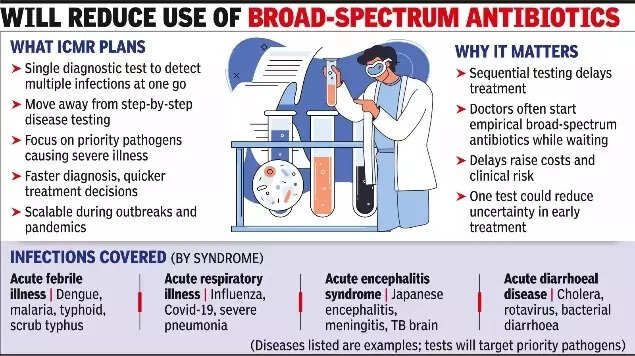
Currently, hospitals rely largely on symptom-based provisional diagnosis. “Once a patient comes to a hospital with a suspected infectious cause, samples are sent for testing based on the provisional diagnosis,” said Dr Hitender Gautam, professor of microbiology at AIIMS. “If the test is positive, definitive diagnosis is made and treatment started. But if it is negative, testing for other pathogens follows – and this often leads to delay in diagnosis and delay in correct treatment.”ICMR has flagged that this step-by-step approach not only raises costs, but also risks missing the actual cause, as many infections present with overlapping symptoms. The planned single-test model is intended to screen for priority pathogens in one go, allowing clinicians to move faster from suspicion to confirmation. The diagnostic delays have wider clinical consequences. While test results are awaited, doctors often initiate empirical broad-spectrum antibiotics. “Empirical antibiotic therapy is started during the provisional diagnosis phase and broadly covers many microorganisms,” Gautam said. “If this continues for long without a positive report, it increases the chances of antimicrobial resistance,” he said.Concerns over this trend are reflected in the ICMR-Antimicrobial Resistance Research & Surveillance Network (AMRSN) annual report 2024, which shows that several routinely used antibiotics are rapidly losing effectiveness against bacteria most frequently isolated from hospitals.Faster, syndrome-based diagnosis could help reverse this pattern by enabling an early shift to targeted therapy, which carries a much lower risk of resistance. ICMR has also linked quicker diagnosis to stronger outbreak surveillance, citing lessons from Covid, when delayed detection allowed early silent transmission.The proposed tests will be tailored to India’s disease burden, using national surveillance data. ICMR will support Indian manufacturers and research institutions to develop, validate and scale up these kits, including rapid production during outbreaks and future pandemics. Proposals are due by Jan 25.