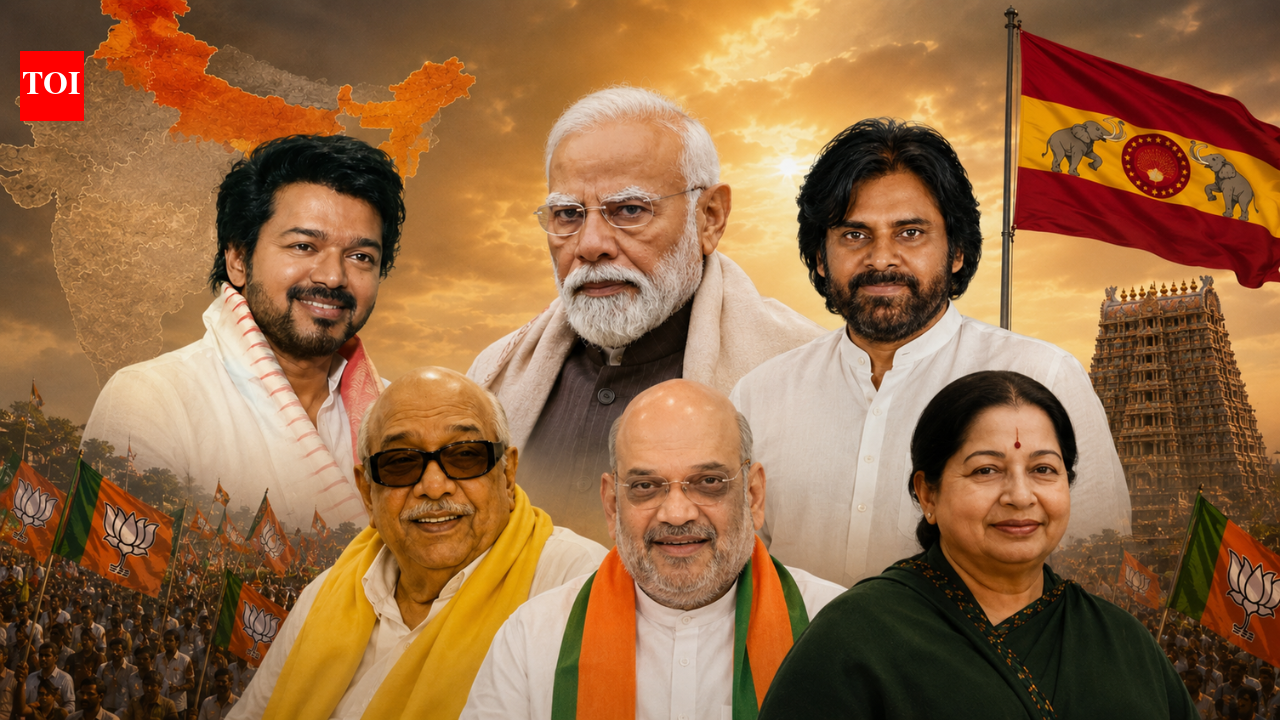

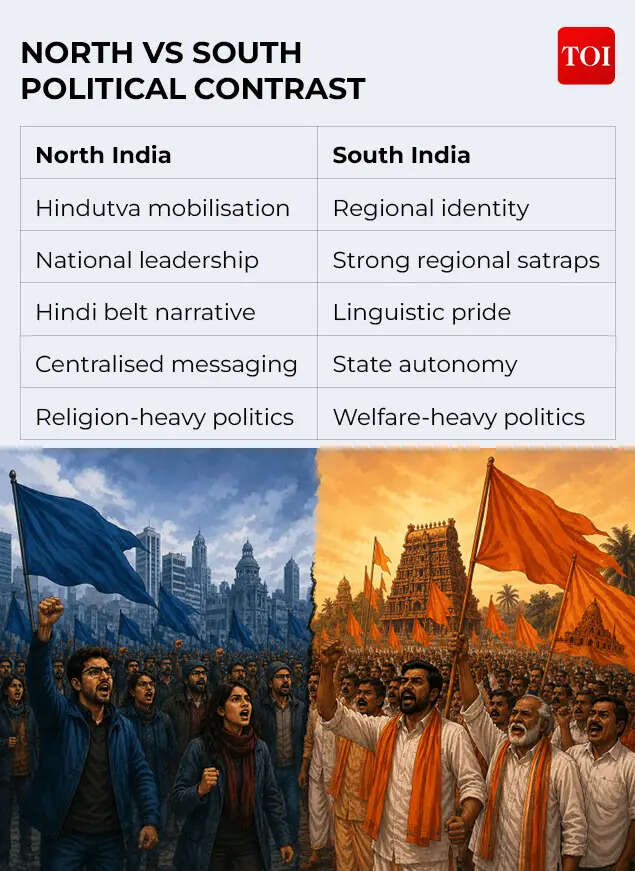
This image is used for representation purpose only (AI-image)
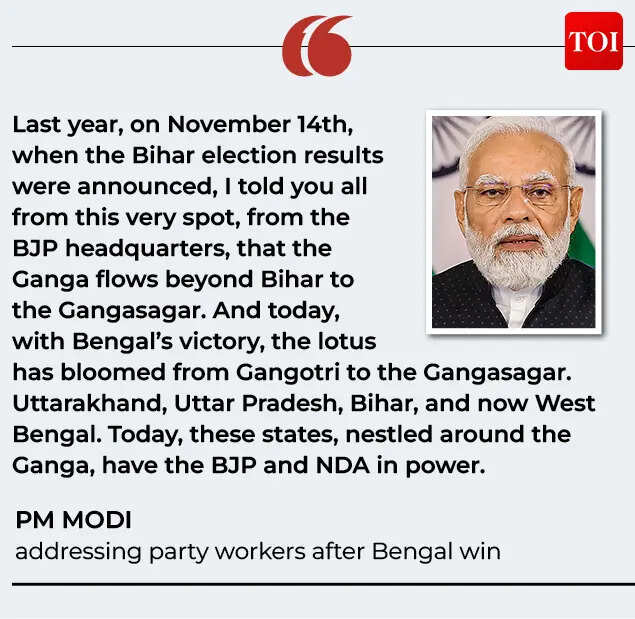
NEW DELHI: It was May 4. Bharatiya Janata Party had scripted one of its biggest political breakthroughs in eastern India. In West Bengal, BJP dethroned Mamata Banerjee and ended the dominance of the Trinamool Congress in a result that dramatically altered the state’s political landscape. The slogan once weaponised against the BJP – ‘Khela Hobe’ appeared to come full circle as the saffron party celebrated a historic victory in Kolkata.Addressing jubilant party workers after the win, Prime Minister Narendra Modi declared, “Ganga se Gangasagar tak BJP ki vijay yatra ne naye itihaas ka nirman kiya hai.”
.
On the same day, the BJP-led NDA also secured a third consecutive victory in Assam, further consolidating the party’s hold in the Northeast. “Assam blesses BJP-NDA once again!” PM Modi posted on X soon after the results. Yet, even as celebrations erupted across the two states, the electoral map in southern India told a sharply different story.In Tamil Nadu and Kerala, the BJP once again failed to translate aggressive campaigning and high-decibel outreach into a major electoral breakthrough. Despite months of political mobilisation led by PM Modi and Union home minister Amit Shah, the party failed to secure double-digit victories in the southern states that remain its most difficult political frontier. The setback was particularly striking in Tamil Nadu, where the BJP had hoped anti-incumbency against the ruling DMK and its alliance arithmetic would create space for expansion. Instead, the emergence of Vijay and his TVK dramatically reshaped the contest. The 2026 assembly elections once again underlined a political reality that has persisted despite the BJP’s rapid national rise: while the party has succeeded in expanding geographically across much of India, the South continues to operate through a distinctly different political grammar.Southern politics is shaped by regional identity, linguistic pride, welfare politics, strong state leadership and the enduring influence of cinema.
.
Still, the BJP insists the southern story is unfinished. After the results, party president Nitin Nabin asserted confidently, “South India will also bloom with BJP’s lotus.”For BJP, however, the 2026 verdict raised a larger question: why does a party that dominates vast stretches of India continue to struggle in crossing the southern political barrier?
Southern wall BJP still cannot cross
Despite its extraordinary electoral expansion across northern, western and parts of eastern India over the last decade, BJP continues to face its most persistent resistance in southern India.Karnataka is still the party’s only major and durable success story in the region. Built through decades of Rashtriya Swayamsevak Sangh (RSS) groundwork, Lingayat support, urban consolidation and organisational depth, Karnataka gave the BJP a stable southern base that no other state has yet replicated.Elsewhere, the party’s growth has remained uneven.In Tamil Nadu, the party has struggled to independently emerge as a dominant force despite years of aggressive expansion efforts.In Kerala, it managed to secure its first-ever Lok Sabha seat only in 2024 through actor-politician Suresh Gopi’s victory in Thrissur but continues to struggle in assembly politics dominated by the Congress-led UDF and CPI(M)-led LDF. In Andhra Pradesh, the BJP’s fortunes have largely depended on alliances with the Telugu Desam Party (TDP) and Jana Sena Party (JSP), while in Telangana, an initial surge after the 2019 Lok Sabha elections lost momentum following the Congress resurgence in 2023.The BJP also attempted to counter accusations that it represented a ‘north Indian political imagination’ disconnected from southern linguistic and cultural sensitivities.PM Modi repeatedly invoked Tamil civilisation in speeches, praised Tamil as one of the world’s oldest languages and elevated Tamil cultural symbols onto the national stage. The installation of the Sengol in the new Parliament building and initiatives such as the Kashi Tamil Sangamam formed part of that broader outreach.Yet the electoral conversion remained limited.One major reason is that southern politics often prioritises regional identity, state autonomy and local leadership over centralised national narratives. For the BJP, the challenge in the South is no longer visibility. It is becoming organically rooted within political cultures that remain deeply regional in character.South campaign lacked Bengal-like intensityUnlike West Bengal, where the BJP ran an extraordinarily aggressive and centralised campaign, its southern push lacked the same electoral intensity and sustained ground mobilisation. In Bengal, Amit Shah spent nearly 15 days on the ground overseeing booth-level strategy, while the party deployed its full organisational machinery during the Special Intensive Revision (SIR) exercise and the election campaign. That same level of intense campaigning was found missing in the South.
Identity before ideology: Why southern politics works differently
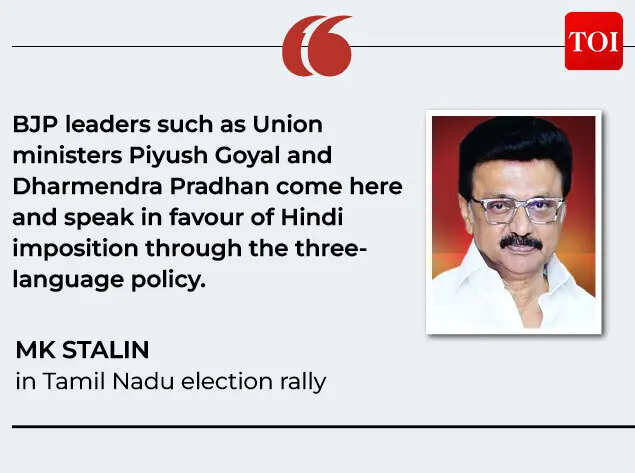
One of the BJP’s biggest challenges in southern India lies in the region’s deeply entrenched linguistic and cultural politics, where regional identity often outweighs religious consolidation in shaping electoral behaviour.This divergence is most visible in Tamil Nadu, where the Dravidian movement transformed politics around Tamil identity, social justice and resistance to perceived central domination from Delhi.The anti-Hindi agitations of the 1960s continue to influence political discourse even today. Resistance to Hindi is often framed not merely as a language debate but as a defence of regional identity and state autonomy.This explains why issues such as the three-language policy, NEET and delimitation continue to generate sharp political reactions.Ahead of the 2026 elections, DMK chief MK Stalin repeatedly accused the BJP of attempting to impose a northern cultural framework on southern states.“BJP leaders such as Union ministers Piyush Goyal and Dharmendra Pradhan come here and speak in favour of Hindi imposition through the three-language policy,” Stalin said during an election rally.
.
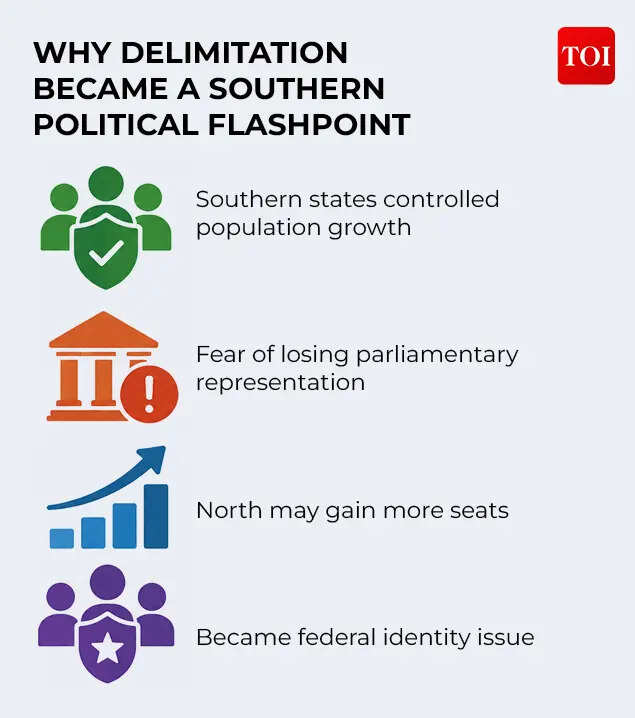
The proposed delimitation exercise further intensified concerns across the South, with regional parties arguing that states which performed better on population control could eventually lose parliamentary representation.The ‘North versus South’ political narrative has also expanded beyond language into economic debates surrounding taxation and fiscal devolution.Tamil Nadu leaders repeatedly argued that the state receives disproportionately low financial returns despite contributing heavily to national tax revenues.
.
DMK leader TKS Elangovan alleged that while Tamil Nadu receives ‘27 paise’ for every rupee contributed in taxes, states such as Uttar Pradesh receive significantly higher returns. Karnataka chief minister Siddaramaiah similarly accused the Centre of causing a loss of over Rs 45,000 crore to the state through reduced tax devolution after the 15th Finance Commission.Even Karnataka has witnessed visible language assertion movements. In Bengaluru, pro-Kannada groups blackened Hindi signboards and protested against what they described as ‘growing linguistic imposition’.
Cinema, charisma and the southern political imagination
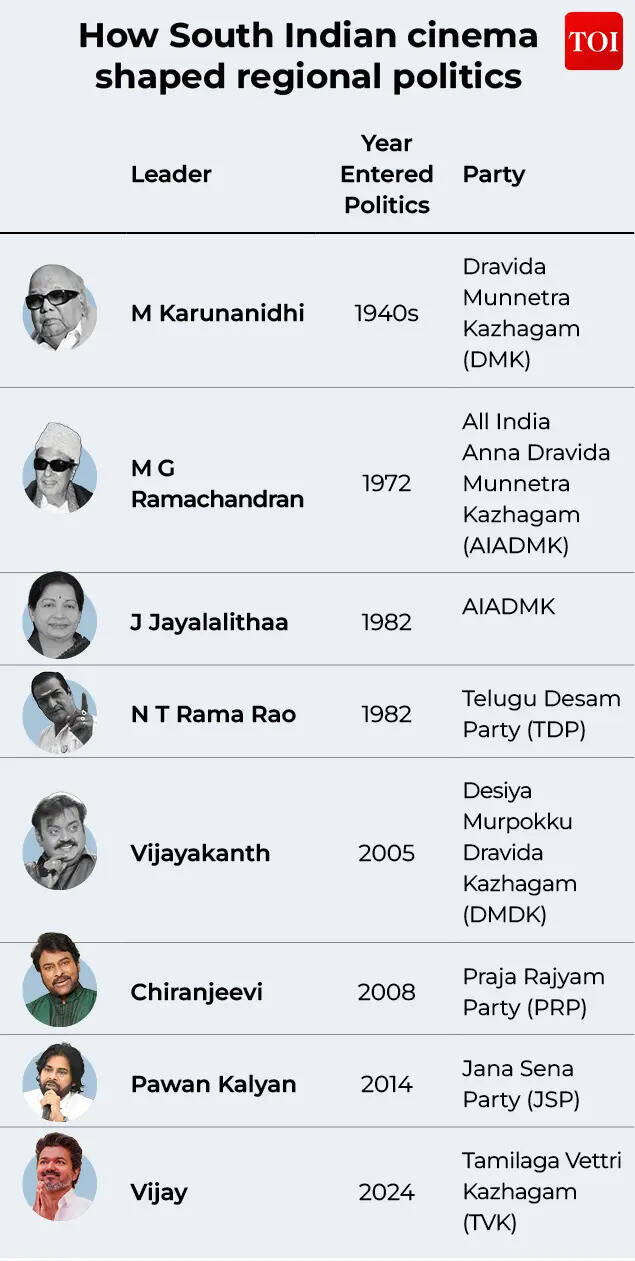
If regional identity shapes southern politics, cinema often shapes its emotional imagination.Few regions have witnessed as seamless a transition from film stardom to political leadership as South India. For decades, cinema has functioned not merely as entertainment but as a powerful vehicle of political mobilisation.Tamil Nadu and Andhra Pradesh pioneered the actor-politician model through leaders such as M Karunanidhi, M G Ramachandran (MGR), J Jayalalithaa and NT Rama Rao (NTR), all of whom converted cinematic popularity into long-term political influence.Their success demonstrated how emotional familiarity and cultural connection could often outweigh ideological mobilisation.That political tradition continues even today.
.
In Andhra Pradesh, actor Pawan Kalyan emerged as a key political player through the Jana Sena Party and later became deputy chief minister. In Kerala, actor Suresh Gopi delivered BJP its first-ever Lok Sabha seat from the state in 2024.The latest and perhaps most consequential entrant, however, is Vijay.Through TVK, Vijay transformed one of Tamil cinema’s largest fan bases into an organised political force that reshaped the 2026 electoral landscape in Tamil Nadu.Fan associations in southern India have historically functioned as proto-political organisations conducting welfare activities, building local networks and cultivating long-term emotional loyalty.For parties such as the BJP, this creates a distinct challenge. While PM Modi remains personally popular and capable of drawing large crowds, southern politics has historically rewarded leaders who are viewed as culturally embedded within the state itself rather than nationally projected figures alone.
Tamil Nadu: BJP’s 2026 reality check
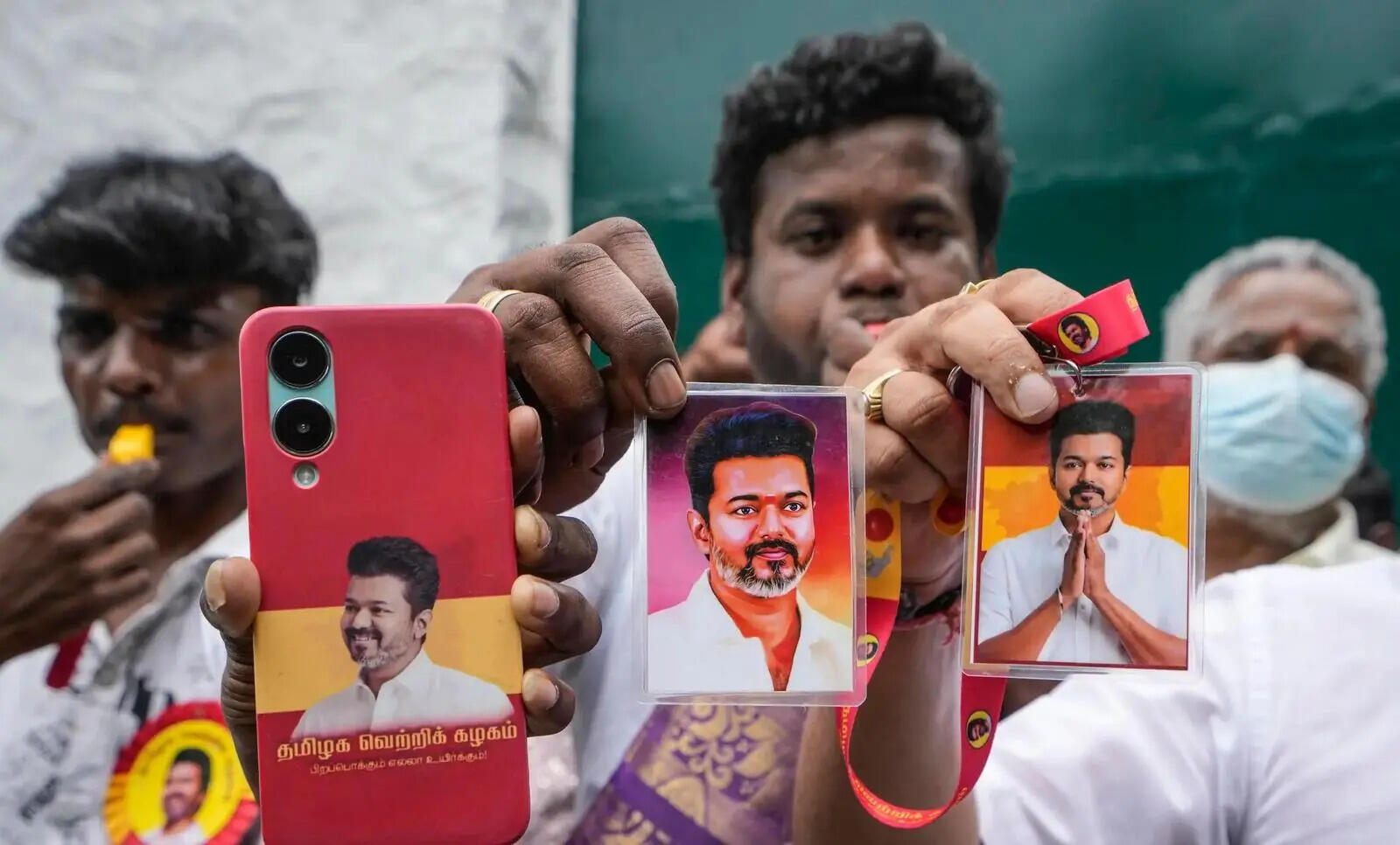
The 2026 Tamil Nadu assembly elections exposed the limits of the BJP’s expansion strategy despite years of aggressive campaigning and organisational investment in the state.While the BJP celebrated landmark victories in West Bengal and Assam, its performance in Tamil Nadu remained modest. Contesting as part of the AIADMK-led NDA, the BJP won just one seat out of the 27 constituencies it contested. This reflected a decline from the four seats it held after the 2021 assembly elections.But the biggest political development was the rise of Vijay’s TVK.Within BJP circles, there had been expectations that Vijay’s entry would primarily split anti-DMK votes and indirectly aid the NDA. Instead, TVK emerged as an independent political force capable of attracting first-time voters, sections of youth and even portions of the traditional Dravidian support base. Vijay’s appeal went beyond conventional electoral arithmetic. Much like earlier actor-politicians in Tamil Nadu, he benefited from emotional familiarity, fan-club mobilisation and the perception of representing a fresh political alternative outside both the BJP and the established Dravidian parties.His rise also signalled the possibility that Tamil Nadu may slowly be entering a more fragmented post-DMK-versus-AIADMK political phase.
.
Welfare politics and federal fault lines
Another major obstacle for the BJP in southern India has been the region’s deeply entrenched welfare-driven political culture, where elections are often shaped more by governance delivery and state-specific economic concerns than by ideological mobilisation alone.Across southern states, regional parties have historically built durable voter loyalty through expansive welfare programmes, subsidised services and targeted social schemes. From Tamil Nadu’s long-standing welfare model and Jayalalithaa’s ‘Amma’ schemes to Telangana’s cash-support programmes, governance delivery has remained central to electoral success.This has allowed regional parties to position themselves as protectors of state interests against what they describe as excessive centralisation by Delhi.There have been disputes over the Centre’s handling of education funding and language-linked policy. Tamil Nadu repeatedly accused the Union government of withholding funds under schemes such as the Samagra Shiksha Abhiyan (SSA) over disagreements surrounding the National Education Policy and the three-language formula.Left parties, particularly the CPM, also framed the BJP’s governance model as excessively centralised and argued that federal institutions were increasingly being weakened.
Kerala, Telangana and Andhra: BJP’s uneven southern experiment
Beyond Karnataka, the BJP’s southern expansion has remained uneven, highly state-specific and often dependent on alliances rather than independent organisational dominance.In Kerala, the party continues to face perhaps its toughest electoral terrain. The state’s politics has long been dominated by the Congress-led United Democratic Front (UDF) and the CPIM-led Left Democratic Front (LDF), leaving limited political space for a third force.
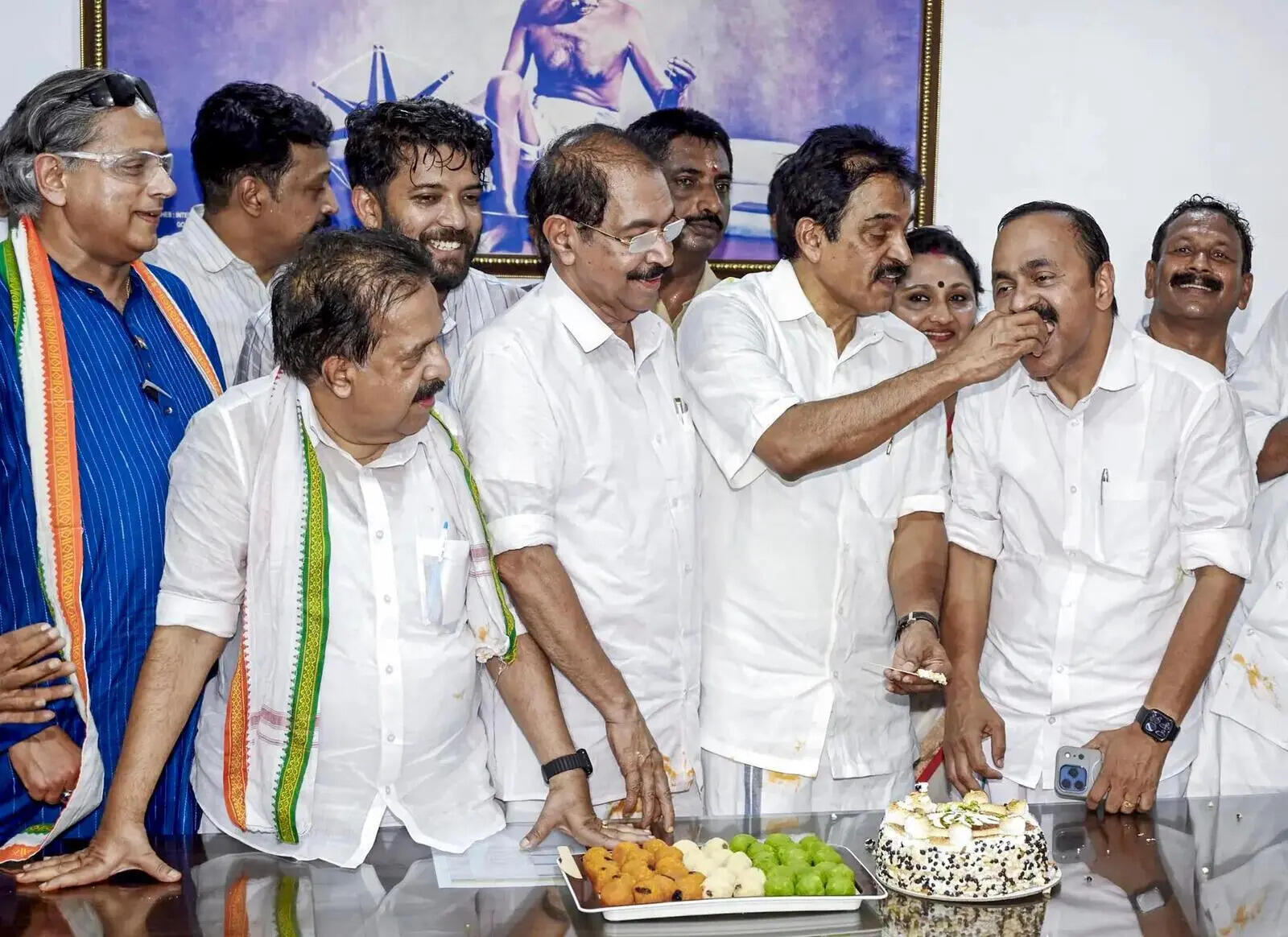
The 2026 Kerala assembly elections offered the BJP a modest but symbolically significant breakthrough. The party won three assembly seats for the first time in the state’s history.In Telangana, the BJP appeared to emerge as a major force after its strong 2019 Lok Sabha performance, when it won four parliamentary seats and positioned itself as the principal challenger to K Chandrasekhar Rao’s Bharat Rashtra Samithi (BRS). However, that momentum slowed significantly after the Congress returned to power in the 2023 assembly elections under Revanth Reddy.Internal leadership changes also affected the party’s momentum. The replacement of Bandi Sanjay Kumar with G Kishen Reddy as state BJP chief triggered dissatisfaction within sections of the cadre base, while the Congress successfully consolidated anti-incumbency sentiment against the BRS.In Andhra Pradesh, the BJP’s position has remained heavily dependent on alliances with Chandrababu Naidu’s Telugu Desam Party (TDP) and Pawan Kalyan’s Jana Sena Party (JSP). The party has struggled to recover from backlash over the long-standing Special Category Status issue, with many voters viewing the BJP as having failed to fulfil promises made during Andhra Pradesh’s bifurcation.
Karnataka: BJP’s southern exception
Karnataka remains the BJP’s most successful and durable experiment in southern India and the only southern state where the party has managed to build an independent, long-term political base.The BJP’s rise in the state was built gradually through decades of RSS organisational work, particularly in coastal Karnataka and urban centres such as Bengaluru. The party also consolidated strong support among sections of the influential Lingayat community while expanding its appeal among urban middle-class voters.Unlike Tamil Nadu or Kerala, Karnataka proved more receptive to national political narratives and Hindutva mobilisation.Even when the BJP lost assembly elections in Karnataka, it has historically remained highly competitive in parliamentary contests. This pattern became visible again after the Congress secured a sweeping victory in the 2023 assembly elections, winning 135 seats with around 43 per cent vote share, while the BJP was reduced to 66 seats.Karnataka too continues to display strong regional assertion.Pro-Kannada groups have repeatedly protested against the growing use of Hindi in public spaces, including incidents where Hindi signboards in Bengaluru were blackened during demonstrations.
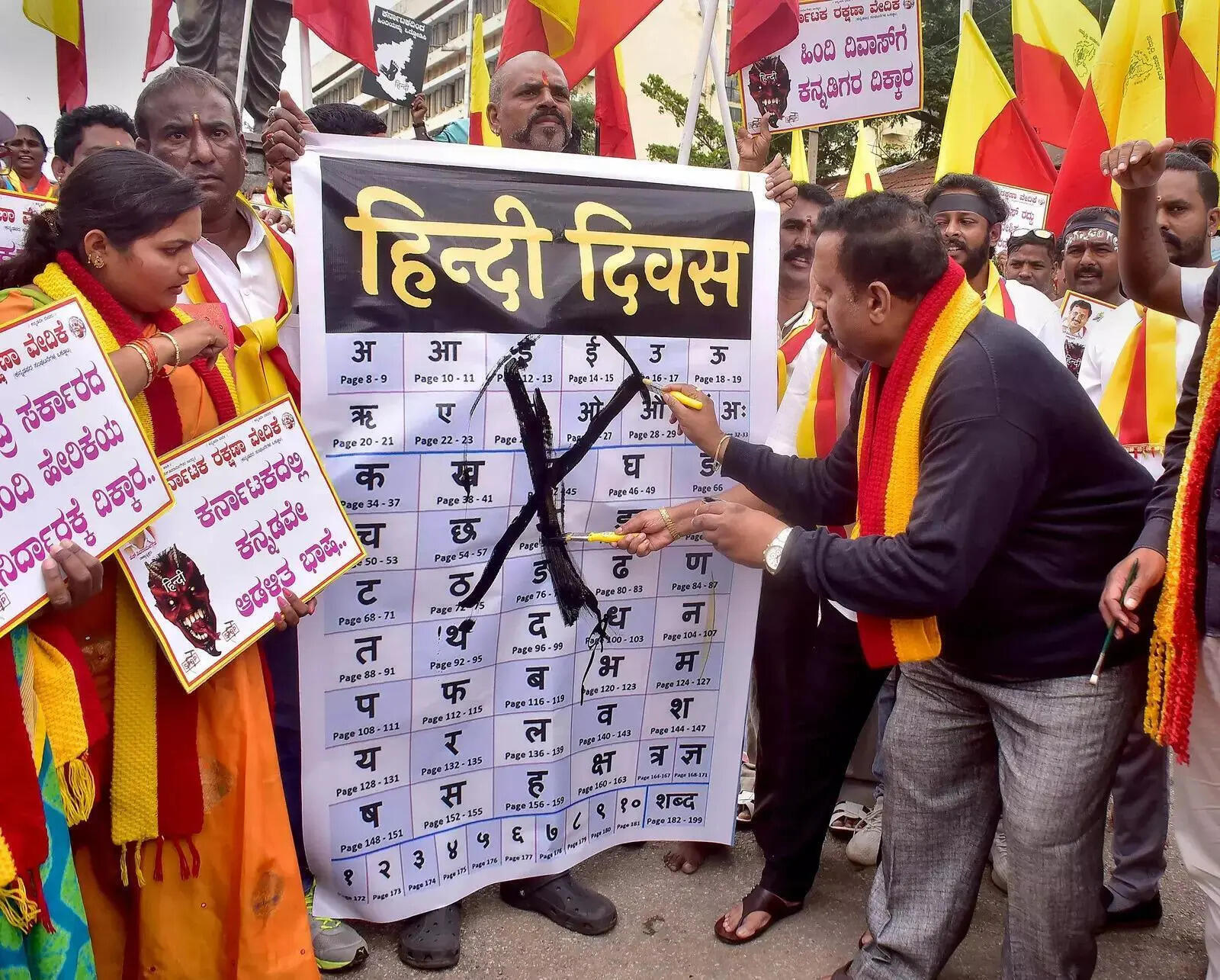
That contradiction is politically significant. Karnataka shows that while the BJP can succeed in southern India, regional identity and linguistic sensitivity continue to remain powerful political forces even within the party’s strongest southern bastion.
Conclusion
The BJP’s southern challenge is no longer simply electoral. It is a contest against deeply embedded political ecosystems shaped by language, welfare politics, cinema, federal identity and regional pride.In much of northern India, the BJP successfully built a broad national political imagination. In the South, however, voters continue to reward parties and leaders who are seen as protectors of state identity and regional autonomy.The question now is whether the BJP can evolve from being viewed as a powerful national force into a party that southern voters also see as culturally rooted within their states. Because in southern India, electoral success is rarely decided by ideology alone, it is determined by who best understands the emotional, linguistic and political soul of the region. Go to Source