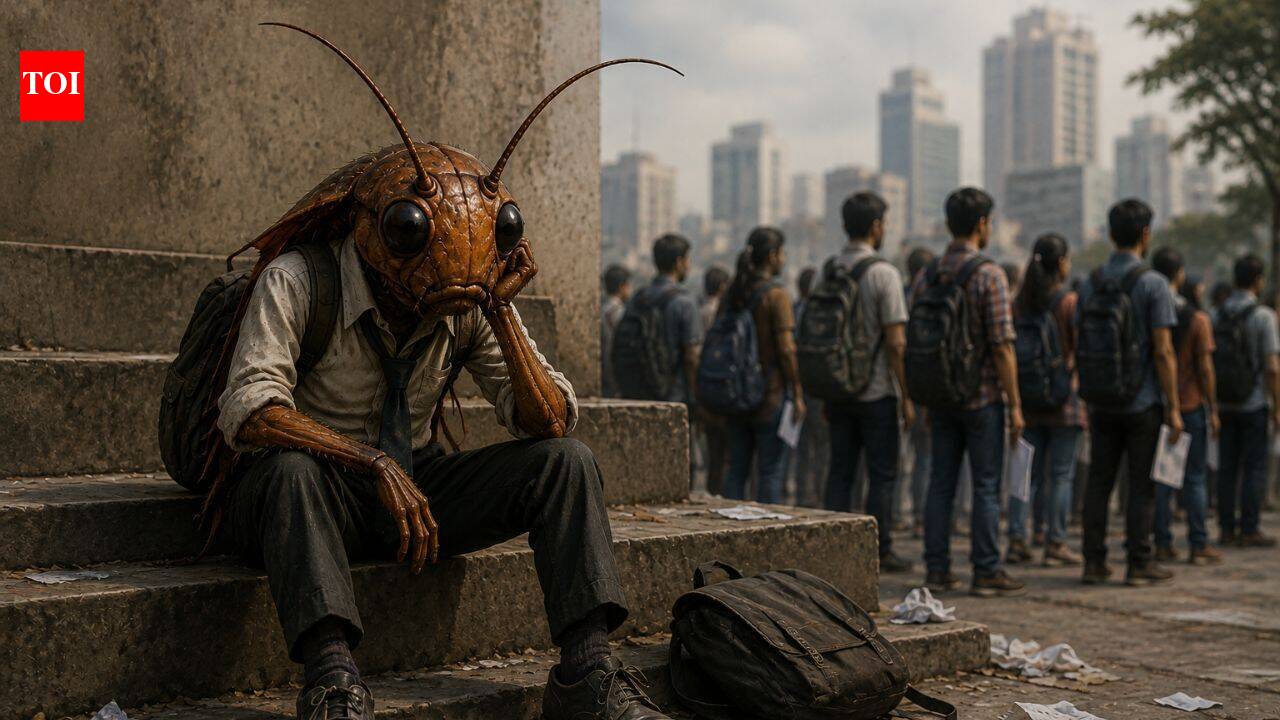


India’s un-employment crisis and helplessness of modern life. (Representative image)
Franz Kafka’s The Metamorphosis transformed an ordinary man into a giant insect to explore alienation, helplessness and the dehumanising pressures of modern life.More than a century later, India’s self-styled Cockroach Janta Party (CJP) has adopted a similarly unsettling symbol, not to tell a work of fiction, but to express the frustrations of a generation increasingly unsure whether years of education, expensive coaching and relentless competition will ever translate into a stable job.What began as a social media sensation with a strong and straightforward satirical structure, quickly evolved into one of the country’s biggest youth-led movements in recent years.Calling itself the “voice of the lazy and unemployed,” the movement grew from memes mocking joblessness, paper leaks, inflation and the political establishment into street protests.The protest may have become a trigger for a generation already grappling with shrinking employment opportunities, rising educational costs and growing uncertainty about the future.And at its heart lies a simple question: what happens when an economy produces millions of graduates every year but fails to create enough quality jobs?According to veteran economist Arun Kumar, a retired professor at JNU, “This unemployment crisis has created a huge gap between expectations and reality.””Young people earn degrees believing they will secure good jobs, but when those jobs do not materialise, they continue preparing for competitive examinations year after year. Many take these exams four, five or even six times because they still hope to secure an organised sector job. Their parents also encourage them because they know such jobs offer stable salaries and social security,” he said.”But the increasing privatisation of education has intensified competition. Coaching institutes want to showcase high success rates because that is their biggest selling point. That creates incentives for unethical practices, including paper leaks. The greater the privatisation, the greater the pressure to resort to illegal methods to ensure students succeed. Fake degrees, cheating and question paper leaks are all symptoms of a much deeper problem. They are linked to unemployment and the shortage of quality jobs in the organised sector,” he added.
India’s employment challenge
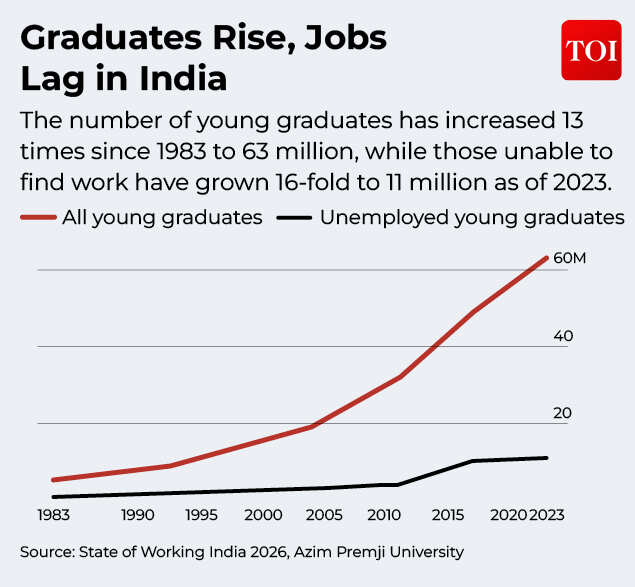
India has spent decades expanding access to higher education. Universities have multiplied, enrollment has surged and millions of families have invested heavily in degrees, viewing education as the surest path to upward mobility.The numbers tell a remarkable story. According to the State of Working India 2026 report by Azim Premji University, the number of young graduates in India increased nearly 13-fold, rising from around 5 million in 1983 to 63 million in 2023.But while the supply of graduates has grown rapidly, employment opportunities have not kept pace.The report estimates that graduate unemployment among people below the age of 25 is now close to 40%, while graduates accounted for nearly two-thirds of India’s unemployed population in 2023.Even more striking is the rise in the number of unemployed graduates, which has increased from less than one million in 1983 to around 11 million in 2023, a 16-fold increase over four decades.The mismatch between education and employment has widened steadily since the mid-2000s as higher education expanded much faster than the creation of quality jobs. For millions of families, earning a college degree no longer guarantees stable employment or financial security.Recent government data suggest that the challenge is becoming even more severe.According to the government’s flagship Periodic Labour Force Survey (PLFS), unemployment among Indians aged 15 to 29 rose to 16.2% in June, the highest level recorded since monthly estimates became available in April 2025. At that time, youth unemployment stood at 13.8%.The ministry of statistics and programme implementation (MoSPI) has cautioned that monthly figures may fluctuate because of seasonal factors, academic cycles and the increased frequency of surveys. Even so, the latest numbers are significant because they fit into a broader pattern rather than representing an isolated spike. Youth unemployment has increased across all six categories tracked by the survey, urban and rural areas, men and women alike, during the 15 months for which monthly data are available.At the same time, the Labour Force Participation Rate (LFPR) among young people has declined from 42.7% to 40.3%. In simple terms, fewer young people are actively looking for work.Ordinarily, such a decline would be expected to reduce unemployment because fewer people are participating in the labour market. Instead, unemployment has continued to rise, suggesting that the economy is not generating enough opportunities even for the shrinking pool of job seekers.Annual PLFS data reinforce the same trend. Between 2022 and 2025, youth unemployment increased in 13 states and Union Territories, including Andhra Pradesh, Delhi, Telangana and West Bengal.The situation appears even more challenging for young women, with unemployment rising across 16 states and Union Territories during the same period.Taken together, the figures suggest that youth unemployment is becoming a structural challenge rather than a temporary fluctuation.
The problem isn’t just unemployment, it’s job quality
Headline unemployment figures often fail to capture the deeper challenges within India’s labour market. Many graduates do find work, but not necessarily the kind of work they expected after spending years in higher education.Economist Arun Kumar said that the root of the problem is the sharp divide between India’s organised and unorganised sectors.”When unemployment rises, it inevitably leads to greater conflict because there are too few jobs for too many people. In India, this problem is even more pronounced because the unorganised sector employs around 94% of the workforce, while the organised sector employs only about 6%. The difference in wages and job security between these two sectors is enormous. A courier delivery worker may earn around Rs 10,000-12,000 a month, whereas a postman can earn around Rs 70,000. Naturally, nobody wants to lose an organised sector job, and everyone wants to secure one. That intense competition creates immense pressure,” he added.
An analysis of India’s Periodic Labour Force Survey illustrates this disconnect. Out of every 100 graduates aged between 15 and 29, only 50 are employed, 15 remain unemployed while actively searching for work, and the remaining 35 are outside the labour force altogether.Some continue their education. Others perform unpaid domestic work or have simply stopped looking for employment after repeated disappointments.Even among those who are employed, the quality of jobs remains a major concern. Only 26 out of every 100 graduates have regular salaried jobs. More strikingly, just four hold formal jobs that provide written contracts, paid leave and social security benefits.The remaining graduates are spread across self-employment, unpaid family work, casual labour and small household enterprises. Many earn irregular incomes and lack job security despite years spent pursuing higher education.The figures highlight a growing reality in India’s labour market: employment alone is no longer an adequate measure of economic well-being. The challenge is increasingly about the availability of secure, productive and reasonably paid jobs.
Why educated youth feel left behind
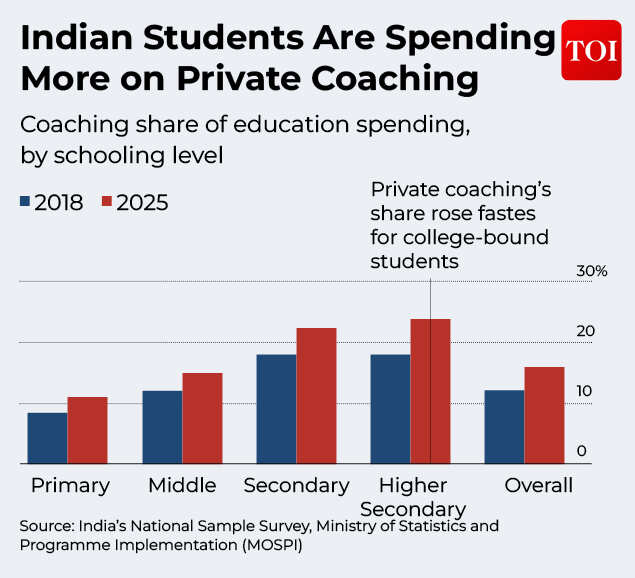
The employment crisis begins long before students enter the labour market. Competition for limited seats in prestigious colleges has transformed education itself into an expensive investment.Government survey data show that Indian households now spend a significantly larger share of their education budgets on private coaching than they did seven years ago.The sharpest increase has been among higher secondary students preparing for engineering, medical and university entrance examinations.Families now spend nearly one-fourth of their higher secondary education budgets on coaching, compared with about 18% in 2018.Private coaching expenses have also increased steadily across primary, middle and secondary education, reflecting a growing belief that classroom teaching alone is no longer sufficient to compete in high-stakes entrance examinations.The pressure becomes particularly visible in engineering education. India had around 4.4 million undergraduate engineering students during the 2023-24 academic year. Yet the country’s top 100 engineering institutions together offered only about 500,000 seats.
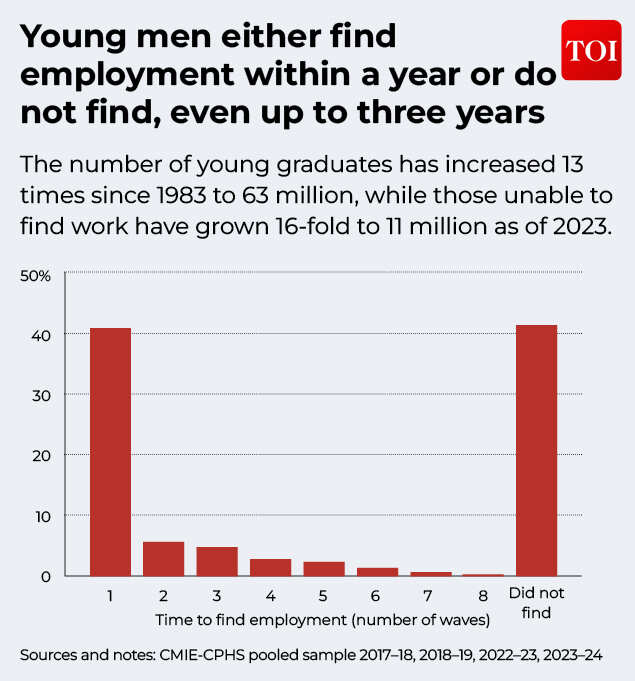
In effect, only one in nine engineering students can study at an institution widely regarded as offering strong placements and better career prospects.Students who fail to secure admission to elite institutions often graduate from colleges with weaker placement records, making it significantly harder to obtain well-paying jobs.The widening gap between educational aspirations and employment outcomes has created growing frustration among young people. The traditional promise that more education automatically leads to better employment is becoming increasingly uncertain.According to the State of Working India 2026 report, fewer than 7% of male graduates secure a permanent salaried job within one year of graduating. The figure is even lower, just 3.7%, when it comes to white-collar jobs.Using data from the PLFS and the earlier Employment-Unemployment Survey, the report estimates that 1.1 crore out of India’s 6.3 crore graduates aged between 20 and 29 were unemployed in 2023.Graduate unemployment itself is not a new phenomenon. The report estimates that unemployment among graduates below the age of 25 increased from 35.02% in 1983 to 39.33% in 2023.What has changed, however, is the scale of the problem. India now produces far more graduates than ever before, while simultaneously entering the most important phase of its demographic transition.The country’s median age currently stands at around 29 years and is expected to rise to 38 years by 2050.This is the period during which India’s working-age population is expected to drive economic growth. If the economy fails to generate enough productive employment during this demographic window, the much-discussed demographic dividend could gradually turn into a demographic challenge.
India’s employment paradox
India today is one of the world’s fastest-growing major economies. Even amid geopolitical tensions, volatile oil prices and slowing global trade, the country has continued to post robust GDP growth and position itself as a manufacturing and investment hub.The government has invested heavily in highways, airports, railways, ports and digital infrastructure. Global technology companies such as Apple have expanded manufacturing in India, electronics exports have surged and semiconductor investments are beginning to gather pace. Policymakers increasingly see manufacturing as the sector that can absorb millions of workers and turn India’s demographic advantage into sustained economic growth.Yet for many young Indians entering the labour market, this optimism feels distant. The central contradiction facing the Indian economy is that rapid economic growth has not translated into an equivalent expansion in quality employment. Economists often describe this phenomenon as “jobless growth”, an economy that continues to grow without creating enough secure and productive jobs.India’s challenge is especially daunting because nearly eight million graduates enter the labour market every year. Generating employment for such a large number of educated young people has become one of the country’s biggest economic challenges.This gap between economic growth and employment opportunities lies at the heart of the frustration that has fuelled recent youth protests.
Is India creating enough jobs?
Whether India is creating enough jobs depends largely on which dataset is examined. The Reserve Bank of India’s KLEMS database estimated that the economy generated 4.7 crore jobs during 2023-24, the highest annual increase in more than four decades.However, labour economists caution against looking at headline employment numbers alone.Employment estimates differ across official surveys because they use different methodologies. More importantly, the definition of employment itself often masks the underlying quality of jobs being created.For instance, India’s labour surveys classify a person as employed if they have worked even for a few days during the reference period. Likewise, unpaid family workers and subsistence self-employed individuals are counted as employed despite earning little or no regular income.As a result, headline employment figures may paint a healthier picture than what many young workers experience in reality. Increasingly, economists argue that the more important question is no longer how many jobs India is creating, but what kind of jobs they are.
The informal sector is slowing too
For decades, India’s informal economy acted as a safety valve for the labour market. Workers unable to secure formal employment often found opportunities in small businesses, family enterprises, retail trade or self-employment.However, even this safety net appears to be weakening.According to the ministry of statistics and programme implementation’s latest Annual Survey of Unincorporated Sector Enterprises (ASUSE), the informal sector generated around 74.5 lakh jobs in 2025, significantly lower than the 1.1 crore jobs created during the previous survey period ending September 2024.Wage growth has also slowed sharply. Average wage growth in the sector declined to 3.9%, compared with 13% previously, suggesting that even workers who manage to find employment are seeing slower improvements in earnings.The figures reinforce concerns that employment opportunities are weakening across both formal and informal sectors, making it increasingly difficult for young people to find stable livelihoods.
India’s employment quality lags behind peers
India’s labour market also differs from many comparable economies because of the quality of employment available.International comparisons reveal another structural weakness: the quality of employment. Labour market studies show that around 93% of employed workers in Russia hold regular jobs. The share is about 68% in Brazil, 54% in China and 42% in Bangladesh, the PLFS 2022-23 & Jan-Mar 2024 data reported.In India, by contrast, only about 23% of workers are in regular salaried employment.This means that nearly three-fourths of Indian workers remain outside the formal sector, without written contracts, paid leave, provident fund benefits or social security.The shortage of secure employment also explains the extraordinary demand for government jobs. Whether it is railways, banking, the armed forces, civil services or state recruitment examinations, millions of candidates compete for relatively few vacancies because government employment still offers something much of the private sector cannot consistently provide stability.A government job often brings predictable salaries, pensions, housing allowances, healthcare benefits and long-term security.For many young Indians, particularly those from middle- and lower-income households, these jobs represent far more than employment. They represent financial stability for entire families.According to Kumar, the desperation is visible in the jobs educated Indians are willing to apply for.
The real issue is the lack of decent employment opportunities. We saw this clearly in Uttar Pradesh in 2017, when more than two lakh people applied for peon posts. Many applicants held qualifications such as PhDs, MTech, BTech, MCom and BCom degrees. When highly educated people apply for peon jobs, it shows they are unable to find work that matches their qualifications.
Arun Kumar
AI adds a new challenge
Even as India grapples with creating quality jobs, technological change is reshaping the employment landscape. A government-backed research group estimates that artificial intelligence could displace around three million managerial and coding jobs by the end of this decade.Automation is expected to reduce demand for routine white-collar work at a time when India is producing record numbers of engineering and technology graduates.Overseas opportunities are also becoming more limited. Tighter immigration policies in countries such as the United States, the United Kingdom and Australia have reduced opportunities for skilled Indian professionals.For decades, migration acted as a safety valve for India’s educated workforce. That pathway is becoming increasingly uncertain.”Many young Indians even leave the country in search of better opportunities. Some spend lakhs of rupees to migrate, while others take illegal routes because they see very few prospects at home. In many cases, they still end up doing low-paying or menial jobs abroad. That reflects the level of desperation created by the lack of opportunities in India,”Kumar noted on the brain-drain situation in India.
India’s demographic dividend at a crossroads
India possesses one of the world’s youngest populations, a demographic advantage that economists have long viewed as one of the country’s greatest strengths.A growing working-age population has the potential to accelerate economic growth, boost productivity and expand domestic consumption.But demographic dividends are never automatic. They depend on whether an economy can generate enough productive employment for the millions entering the labour market every year.Research suggests that India’s employment intensity of growth, the ability of economic expansion to generate jobs has steadily declined over the past four decades.
When NEET became the tipping point
Against this backdrop, the NEET-UG 2026 paper leak became much more than an examination controversy. Millions of students spend months and often years preparing for the country’s most competitive entrance examinations.Families invest heavily in coaching classes, relocate to education hubs and, in many cases, students take gap years in pursuit of a medical seat.When allegations emerged that the examination paper had been leaked and sold before the test, the issue struck at the heart of a system that already demanded enormous financial and emotional investment.The government cancelled the examination, handed the investigation to the Central Bureau of Investigation and ordered a re-examination.For lakhs of aspirants, particularly those from middle- and lower-income households, the cancellation meant far more than repeating a test. It meant another year of uncertainty after months of preparation and considerable financial sacrifice.Some students performed worse in the re-examination. Others worried they had lost their best chance of securing admission. Reports of severe psychological stress and alleged student suicides linked to the controversy further intensified public anger.What began as protests against examination irregularities gradually evolved into a wider movement about education, unemployment and shrinking opportunities.It was in this atmosphere that the Cockroach Janta Party found resonance among young Indians. Initially known for satirical social media posts, the movement soon expanded into organised protests questioning paper leaks, unemployment, inflation and what participants described as the growing disconnect between educational aspirations and employment opportunities.The group’s unusual symbol, the cockroach, captured widespread attention.The insect represented resilience, survival and invisibility, mirroring how many young people felt overlooked despite years of education and preparation. Eventually, the protests became one of the biggest youth movements witnessed in recent years.The protests exposed far more than frustration over one examination. They revealed a widening disconnect between education, employment and economic expectations.Economist Arun Kumar says unemployment extends far beyond those who are officially counted as jobless. “Youth unemployment, particularly among those aged 15 to 29, is extremely high, and the situation is especially difficult for women. There are different forms of unemployment. First, there are those actively looking for work but unable to find it. Second, there are people who are technically employed but only in low-paid, part-time or menial jobs that do not provide a decent livelihood,” he said.”Third, there is disguised unemployment, where people appear to be working but contribute little to productive economic activity. Finally, there are those who have stopped looking for work altogether because they have lost hope. Women are disproportionately represented in this last category. Female labour force participation in India remains much lower than in many other major economies, which means many women are no longer even counted among active job seekers,” he added.Over the past few decades, India has dramatically expanded access to higher education, produced record numbers of graduates and remained one of the world’s fastest-growing major economies.But the growth in quality jobs has failed to keep pace with the growing pool of educated youth. For many young Indians, securing a degree no longer guarantees a stable career or upward social mobility.
Join conversation
Share your thoughts in the comments
Be respectful · TOI community guidelines
That gap between aspirations and opportunities lies at the heart of the growing frustration. For millions of students, the question is no longer just whether examinations are conducted fairly. It is whether years of education, expensive coaching, repeated attempts at competitive exams and immense financial sacrifices will eventually lead to a secure, well-paying job. Without that, the frustrations exposed by such protests are likely to persist long after the headlines fade. Go to Source