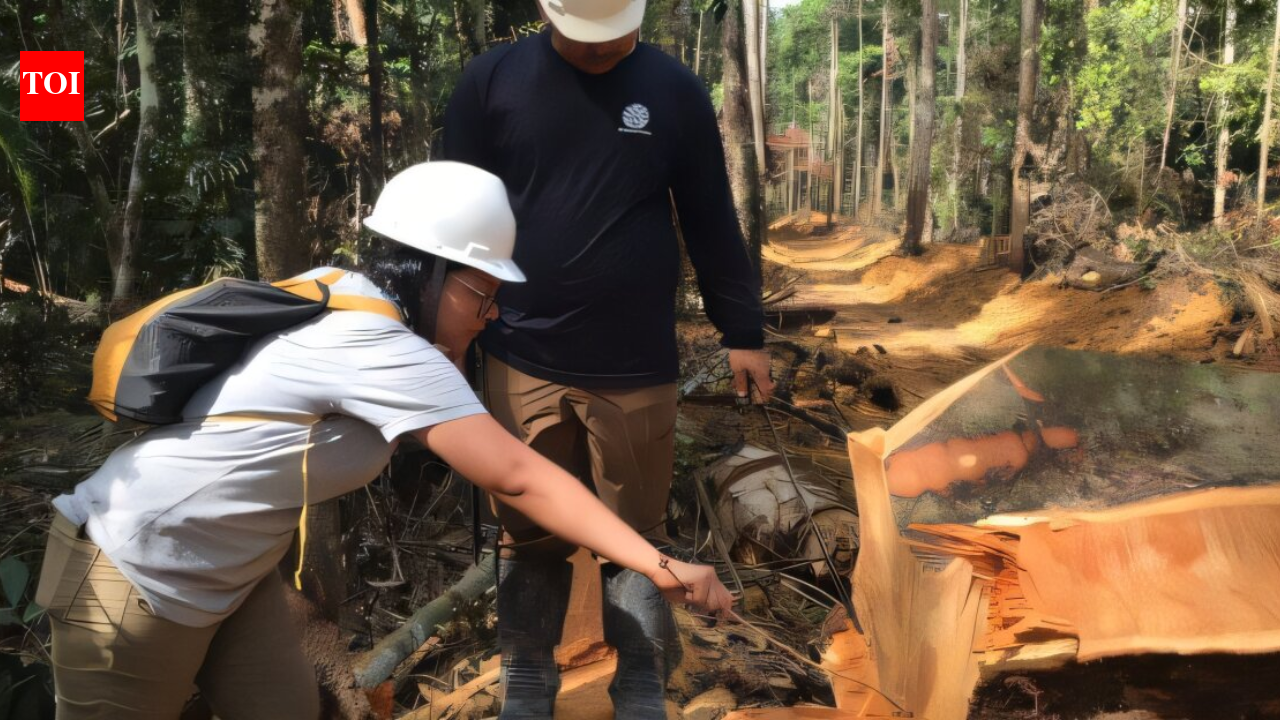

Wood samples being collected for cellulose isotope analysis. Credit: CENA-USP
By analyzing the atomic signatures of 800 trees collected from 63 locations across the Amazon, Brazilian researchers have developed an isotopic mapping model that can rule out 92% of the rainforest when tracing suspected illegal timber.The project, led by Professor Luiz Antonio Martinelli at the Center for Nuclear Energy in Agriculture (CENA-USP) at the University of São Paulo, uses stable isotope analysis to create a forensic tool for law enforcement. The research gives Brazil’s Federal Police a chemical fingerprinting method that cannot be forged or changed by loggers trying to fake harvesting permits.The team’s first findings were published in the journal Molecules in a paper led by Ana Claudia Gama Batista titled Isoscape of Oxygen Stable Isotopes in Woods of the Amazon.
How stable isotopes expose fake paperwork
Illegal logging is one of the main causes of deforestation in the Amazon. Brazilian environmental agencies and police currently use plant anatomy, species distribution data, and the Forest Origin Document (DOF) system to check timber shipments. However, fake paperwork still allows illegally cut wood to enter legal supply chains.Stable isotope analysis measures the ratio of different forms of elements in tree cellulose, such as oxygen-18 and oxygen-16. “Our goal is to provide the Federal Police with a tamperproof method. You can’t falsify stable isotopes,” Martinelli said. He added that once the map, known as an isoscape, is complete, investigators without specialist training should be able to use the testing methods outside research laboratories.The mapping is based on how air and rainfall move across South America. As moist air travels inland from the Atlantic Ocean, rain clouds gradually lose the heavier oxygen-18 isotope. By the time they reach the western Amazon, the rain contains more of the lighter oxygen-16 isotope. Trees absorb this water, leaving a lasting isotopic signature in their wood that changes across different parts of the rainforest.
Narrowing the search area
Although the model can eliminate most of the Amazon from an investigation, the researchers say oxygen isotopes alone cannot identify the exact place where a tree was cut because the rainforest is so large.”Our best model can exclude 92% of the Amazon’s forest area, which amounts to 3 million square kilometers (1.2 million square miles). The problem is that 8% is still too much. To give you an idea, that’s roughly 240,000 square kilometers (93,000 square miles),” Martinelli explained.The model is also less accurate in the “deforestation arc,” the heavily cleared region where illegal logging is most common.”Since the Amazon is so complex—a very large area—it isn’t possible to use just one isotope,” Martinelli added.To improve the model, PhD researcher Isabela Maria Souza Silva is adding carbon and nitrogen isotope data, with plans to include strontium isotopes in the future.
Expanding sample collection and chemical maps
To improve accuracy, the team is collecting more samples beyond the original 800 trees from 63 locations.”We’ve collected samples from 800 trees at 63 sites across the Amazon and found that if we want a more accurate model, we’ll need to collect from more trees in more locations,” Martinelli said.The researchers are also testing “elementalscapes,” which map regional differences in trace chemical elements found in wood. Combining these elemental maps with multiple isotope measurements is expected to reduce the remaining 240,000-square-kilometre uncertainty.
A growing tool against global timber crime
The researchers believe isotopic fingerprinting could help fight illegal timber trade beyond Brazil, especially as wood moves through complex international supply chains. Timber often passes through several traders, sawmills, and exporters before reaching buyers, making it difficult to confirm where it originally came from. A scientific method that links wood to its place of origin could give investigators reliable evidence instead of depending only on paperwork that can be forged.The technique also supports stricter international rules aimed at keeping products linked to deforestation out of global markets. Many importing countries now require companies to prove that timber and other forest products come from legal sources. Reliable origin testing could help authorities check those claims and strengthen criminal investigations.Scientists say isotopic analysis is not meant to replace existing enforcement methods but to work alongside them. Wood anatomy, DNA testing, satellite monitoring, and supply-chain records each provide different types of evidence. Together, these tools can build a stronger case than any single method alone. As researchers collect more samples and add new chemical markers, they expect the system to become even more accurate and useful for tracking illegally harvested timber. Go to Source