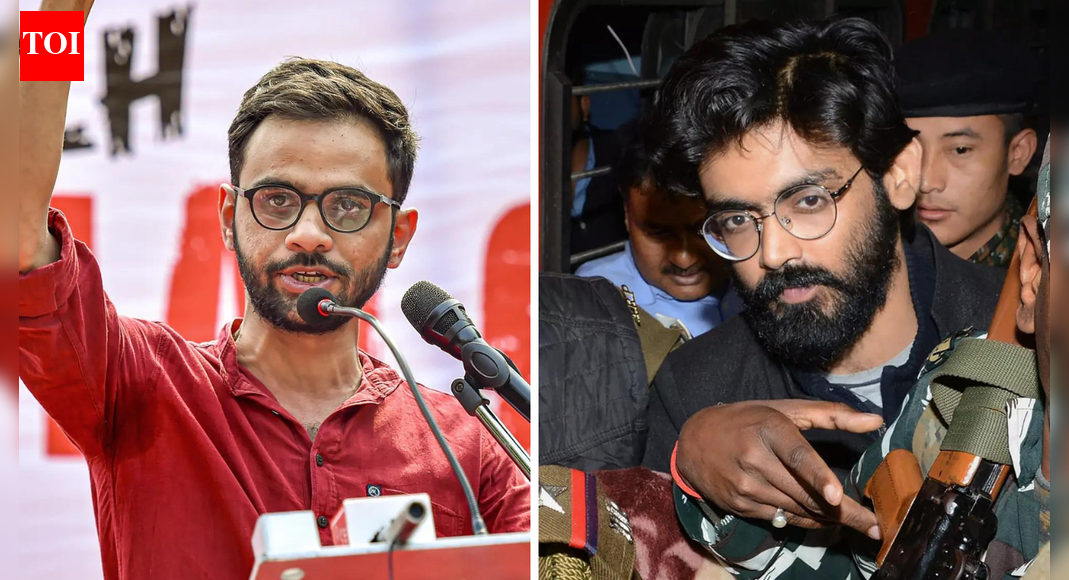

NEW DELHI: The Supreme Court on Monday rejected the bail pleas of Umar Khalid and Sharjeel Imam — lodged in Tihar jail under the Unlawful Activities (Prevention) Act (UAPA) linked to 2020 Delhi riots.The bench of justices Aravind Kumar and NV Anjaria said that prosecution material disclosed a prima facie case against Umar Khalid and Sharjeel Imam, thereby attracting the statutory bar to bail under Section 43D(5) of UAPA.The bench added that the Khaild and Imam can pray for bail after one year after the completion of examination of protected witnesses.Meanwhile, the top court granted bail to 5 other accused in the case, adding twelve strict conditions.All seven accused had challenged Delhi high court’s order denying them bail on September 2.Why SC rejected Umar Khalid and Sharjeel Imam bail?The top court said that not every accused involved in the case stands on same footing. It said that both Khalid and Imam had a “formative role” in the conspiracy .”Umar Khalid and Sharjeel stand on different footing and it can’t be ignored in terms of parity and culpability. It becomes a court to examine bail pleas individually to see whether pre-trial liberty is attracted. Liberty is of foundational importance at the same time, the constitution does not conceive liberty in isolation,” the top court said.”This court is satisfied that the prosecution material disclosed a prima facie allegation against the appellants Umar Khalid and Sharjeel Imam. The statutory threshold stands attracted qua these appellants. This stage of proceedings does not justify their enlargement on bail. Apart from death or destruction the provision encompasses acts that disrupt services and threaten the economy,” it added.The court said that in prosecutions under the UAPA, delay in trial does not operate as a “trump card” which automatically displaces statutory safeguards.”The UAPA as a special statute represents a legislative judgment as to the conditions on which bail may be granted in pre-trial stage. Delay serves as a trigger for heightened judicial scrutiny. The discussion has been confined to delay and prolonged incarceration. UAPA offences are rarely confined to isolated acts. The statutory scheme reflects this understanding,” it said.”Section 43D(5) of UAPA departs from general provisions for grant of bail. (But) it does not exclude judicial scrutiny or mandate denial of bail in default,” it added.Meanwhile, during the hearing, the advocates who appeared for them mostly argued on the delay and the unlikelihood of the commencement of the trial. It was also stated to the court that they have been under custody for over five years in a case in which they are facing serious allegations of committing offences under the UAPA.The contentions were also made that there is no proof of violence that they instigated the riots, even after five years have passed.What are the chargesKhalid along with several others have been charged in connection to an alleged conspiracy behind the communal riots which took place in Delhi in February 2020.Khalid was arrested in September 2020, charging him under several sections of the Unlawful Activities Prevention Act including terrorist activity and conspiracy.Additionally he was also charged under provisions of the Indian Penal Code including murder, rioting, sedition, conspiracy and promoting communal enmity.According to Delhi Police, 53 people died in the violence and more five hundred people were injured.On September 2, the Delhi high court denied bail to Imam, Khalid and seven others — Mohd Saleem Khan, Shifa Ur Rehman, Athar Khan, Meeran Haider, Shadab Ahmed, Abdul Khalid Saifi and Gulfisha Fatima. On the same day, another high court bench rejected the bail plea of co-accused Tasleem Ahmed.In its order, the high court observed that, prima facie, the role attributed to Imam and Khalid in the alleged conspiracy was “grave”, noting that they had delivered inflammatory speeches along communal lines to “instigate mass mobilisation of members of the Muslim community”.