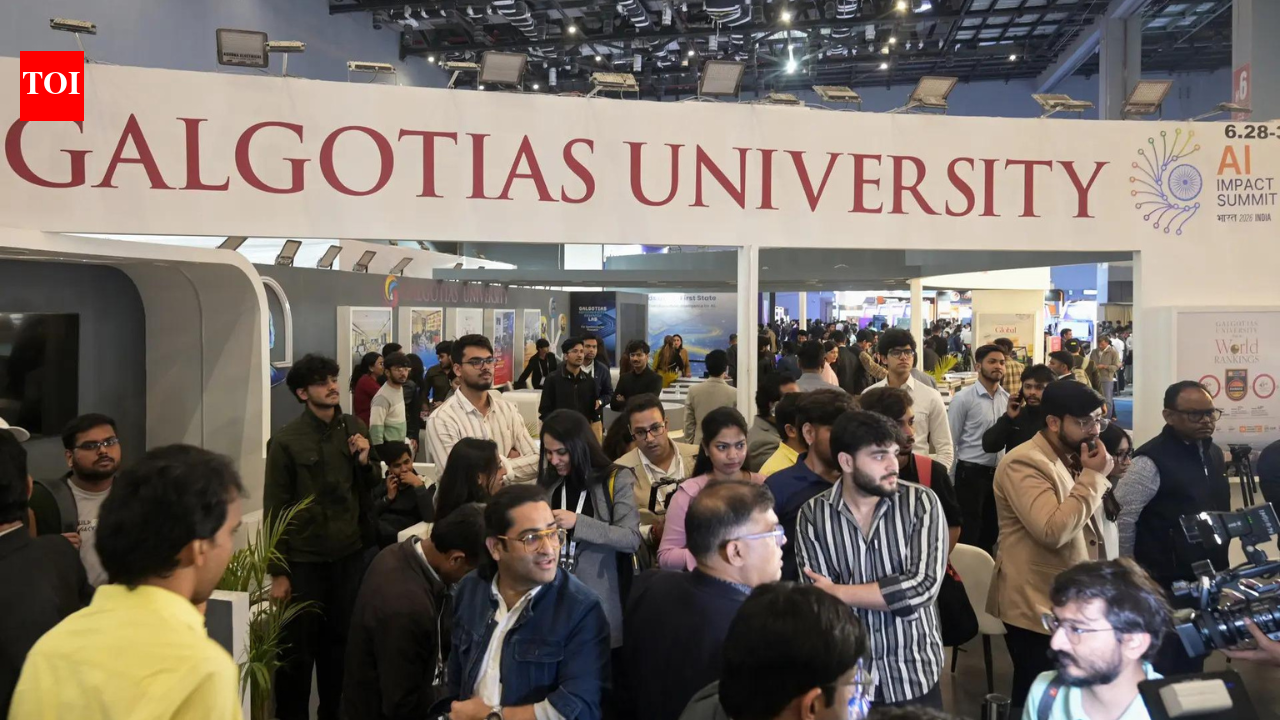

When a four-legged robot named “Orion” trotted onto the floor of the India AI Impact Summit, it was meant to showcase cutting-edge innovation from Greater Noida. Instead, within hours, it triggered a storm that forced Galgotias University to vacate its stall and issue a public apology — after social media users identified the machine as a Chinese-made product.
From ‘Orion’ to Unitree: How the controversy erupted
The row began when Professor Neha Singh, representing the university at the summit, introduced a robotic dog branded as “Orion” during a media interaction. In a clip aired by DD News, she said the robot “has been developed by the Centre of Excellence at Galgotias University” and described its surveillance and monitoring capabilities.
However, online users quickly pointed out that the robot appeared identical to the Unitree Go2, a commercially available quadruped manufactured by Unitree Robotics. The model is widely used in research and education globally and is available in India for roughly Rs 2–3 lakh. What followed was swift ridicule and political criticism. Critics alleged that an imported Chinese product had been presented as an in-house innovation at a summit designed to spotlight domestic AI capability.As scrutiny intensified, sources said that authorities asked the university to vacate its stall. Power supply to the pavilion was reportedly cut before the team cleared the premises.The Ministry of Electronics and Information Technology made its position clear. Secretary S Krishnan said the government wanted “genuine and actual work” to be reflected at expos and that “misinformation cannot be encouraged”. Without directly assigning blame, he added that organisers did not want controversy surrounding exhibits and that a code of conduct was essential.Additional Secretary Abhishek Singh said the intention was not to stifle innovation but that displays should not be misleading, and the episode should not overshadow the efforts of other participants.
Damage control and shifting explanations
Faced with mounting backlash, the university’s response evolved over the course of the day.In an initial statement, it maintained that it had not claimed to have built the robot, arguing that exposure to global technologies was central to student learning. It described criticism as a “propaganda campaign” and said robotic programming formed part of its effort to help students develop real-world AI skills using globally available tools.Registrar Nitin Kumar Gaur later sought to clarify what he called a “jumble” between the words “develop” and “development”. Speaking to ANI, he said the university did not develop the robot but had “worked on its development” for academic and research purposes. The machine, he said, had been purchased to support student research.Professor Singh also issued a clarification, saying there had been a “misinterpretation” and that the university never claimed the robot was manufactured by it. She accepted that she may not have conveyed her point clearly in the flow of the interaction.By evening, the tone shifted decisively. In a formal apology, the university said the representative manning the pavilion had been “ill-informed” about the technical origins of the product and had given “factually incorrect information” in her enthusiasm on camera, despite not being authorised to speak to the press. The statement insisted there was “no institutional intent to misrepresent this innovation” and said the university had vacated the premises in line with the organiser’s sentiment.Meanwhile, opposition leaders seized on the episode. Leader of opposition Rahul Gandhi described the summit as a “disorganised PR spectacle”, questioning why Chinese products were being showcased at an event meant to project India’s AI ambitions. Go to Source