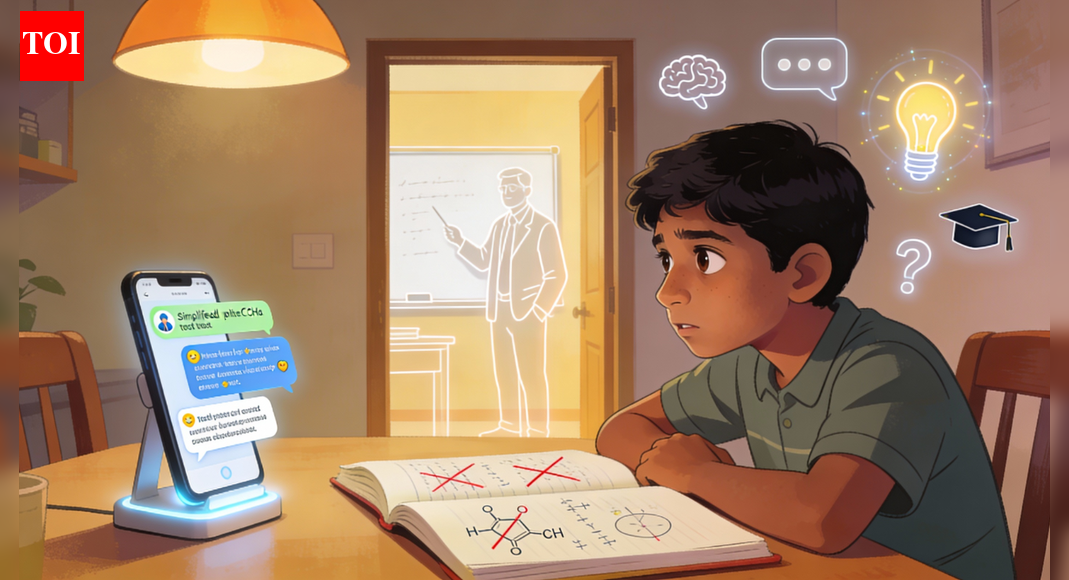

AI-generated image
On an evening in Bengaluru, 14-year-old Aarav sits at his dining table, staring at a chemistry problem. His notebook lies open. Half the page is crossed out. His next tuition class is two days away.Instead of waiting, Aarav picks up his phone. “Explain this like I’m new to chemistry,” he types into an AI chatbot.The reply appears within seconds. It explains the steps in simple terms. Aarav asks again, this time for a real-world example. The explanation changes. He asks a third time. The chatbot does not rush or judge. It explains again.The next morning, Aarav goes to school. His teacher does not ask for the answer. She asks him to explain the process.This quiet exchange between a student, a machine, and a teacher captures where education stands today. Artificial intelligence is no longer a future idea debated in policy rooms. It already shapes how students study and how teachers teach.Yet this instant access carries a risk. When explanations are always available, confusion does not linger. Without that pause, understanding may never fully form. The real question is no longer whether AI belongs in education. It is how it is used, where it fits, and who remains in control.
What AI in classrooms looks like
AI in education does not mean robots replacing teachers. In practice, it appears in ordinary and often invisible ways.Most students use generative AI tools such as ChatGPT, Gemini, Grammarly, QuillBot, Canva Magic Design, and Gamma. They use them to simplify textbook language, clear doubts, create summaries, practise answers, and plan essays. For many, AI now acts as a round-the-clock study companion.These tools rely on generative artificial intelligence, or Gen AI. These systems produce original content—text, images, audio, or code—based on user prompts. Powered by large language models (LLMs), they analyse large datasets to generate human-like responses. Unlike earlier education software that retrieved information, Gen AI constructs answers. Its fluency can hide errors, bias, or weak reasoning.Adaptive learning platforms form another layer. Schools and coaching centres use them to track how students respond to questions and adjust lessons in real time. When students struggle, the software revisits basics. When they perform well, it raises the level. The goal is personalisation in classrooms where individual attention remains limited.
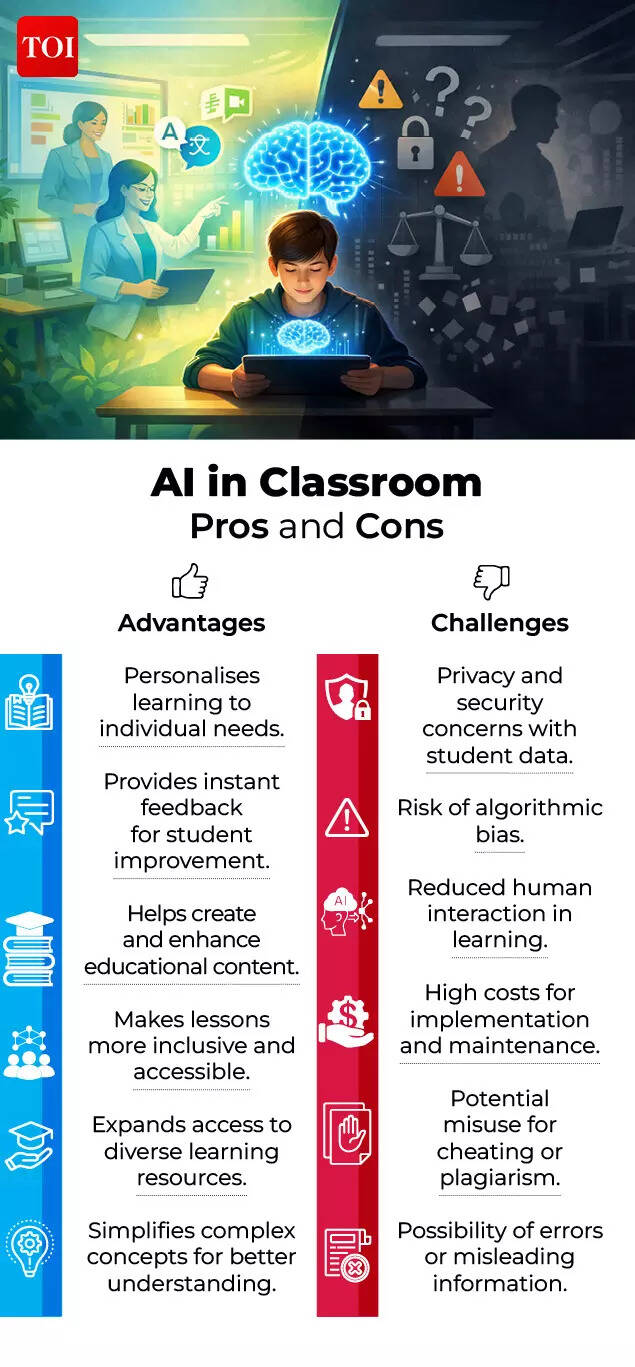
Teachers also use AI tools such as MagicSchool AI and Eduaide.AI. These help with lesson plans, worksheets, quizzes, and performance analysis. Used well, AI acts as a support system, not a substitute. It helps teachers focus their time where guidance matters most.Together, these tools respond to learners in real time. That marks a shift no earlier education software achieved.
Are students learning, or outsourcing thinking?
Students adopted AI faster than schools expected. Many now turn to AI before textbooks or teachers, especially for homework and exam revision. For some, AI has become the first step, not the last option.A 2024–25 report by the Center for Democracy and Technology found that 86 percent of students and 85 percent of teachers used AI during the school year. Students most often used it for tutoring and for college or career advice.This raises a harder question. Are students learning, or are they handing over the work of thinking?A Class 10 student preparing for board exams describes the change in her study habits.“Yes, AI has changed how I study. I often know the answer but struggle to write it well. AI tools help me phrase answers by giving templates and refining my responses.”Used with care, AI can support learning. It lets students revise at their own pace, return to hard topics without embarrassment, and practise independently. For students without access to personal academic support, AI can reduce gaps.
Is AI replacing critical thinking?
When answers arrive instantly, something subtle disappears. The struggle with confusion fades. That struggle is not a flaw. It is part of learning. Confusion forces students to pause, test ideas, and connect concepts. Without that pause, understanding stays shallow.Learning chess offers a clear example. An app that suggests the best move may help you win. It does not teach strategy. You follow instructions without knowing why they work. Real learning happens when players make mistakes and build intuition over time.Research from higher education signals concern. Studies show that students who rely on large language models for writing and research invest less mental effort. They often show weaker reasoning than peers who use traditional search methods. AI reduces effort, but it can also block deeper thinking.Other studies find that students using AI engage with fewer ideas. Their analysis becomes narrow and sometimes biased. When a clear answer appears quickly, students explore fewer alternatives and challenge fewer assumptions.Searching the internet still demands effort. Students must evaluate sources, interpret information, and decide how to use it. Generative AI often delivers finished responses. When used without reflection, it can replace the work of thinking.Critical thinking—the ability to question, weigh evidence, and form independent judgments—remains human. The risk lies not in using AI, but in letting it replace judgment.
“I’m not here to replace teachers or do the thinking for students. My purpose is to support learning—breaking down complex ideas, personalising practice, and helping students explore at their own pace. The real understanding still comes from human guidance, curiosity, and critical thinking.”
AI on it’s role in classrooms
AI in homeschooling: Help or hollow guidance?
AI has become a common tool in homeschooling. Many parents use it to save time on lesson planning, grading, and practice. AI tools can also explain topics and offer basic tutoring, which makes homeschooling more flexible and easier to manage.Homeschooling allows families to move at their own pace, but it also demands time and effort. AI can ease that burden by helping parents create lesson plans, explain ideas at different levels, and design worksheets or quizzes. If a child struggles with a topic, AI can repeat the explanation without strain. For working parents, this support helps maintain routine.But AI has clear limits.AI has no training in teaching methods. It does not understand how children learn or how skills develop over time. It pulls ideas from online sources but cannot judge their quality or suitability for a specific child.Parents do not need teaching degrees to homeschool. Still, when they face unfamiliar subjects, experienced teachers remain the better guide. Educators design curricula based on classroom experience and tested methods. That human judgment carries more weight than AI-generated material.AI also falls short in assessment. It gives broad feedback that ignores a child’s voice, effort, and progress. It cannot explain why a student struggles or recognise growth. In homeschooling, adults must stay in control. Children still need human guidance and care, that responsibility cannot belong to a machine.
The human cost: connection in the age of convenience
“Earlier, students came to me with doubts,” says a middle-school science teacher at a CBSE school in Pune. “Now they come with answers, and I have to check if they understand them.”Academic concerns are not the only issue. Connection is also at stake.The Center for Democracy and Technology report found that half of students felt less connected to teachers when AI entered the classroom. Many teachers worried about weaker peer interaction. Parents share this concern.In a country like India, where teachers are not merely instructors but are often revered as gurus who shape lives, this shift feels especially profound. The relationship between teacher and student has long carried emotional and moral weight, built on respect, guidance, and personal connection.Classrooms do more than transfer information. They teach collaboration, debate, empathy, and trust. If AI becomes the main link between students and knowledge, the human fabric of education may thin.For this reason, many experts stress one point: AI must remain a tool, not a teacher.
Why banning AI misses the point
Some schools tried to ban AI in response to plagiarism fears. These bans rarely work.Students continue to use AI outside school, often without guidance. Teachers end up enforcing rules that ignore reality.As researchers at the Harvard Graduate School of Education argue, denying AI’s presence does not protect learning. It avoids responsibility. Students already use these tools. What they need is direction.Across research and classrooms, a practical framework has emerged.
- AI should support, not replace: AI works best when it reduces routine work and supports different learning needs. Judgment and explanation should remain human.
- AI literacy must be taught: Students need to learn how to ask good questions, check accuracy, spot bias, and understand limits.
- Assessment must change: Schools should value reasoning, process, and application over polished answers. Oral exams, in-class work, and reflection matter more.
- Teachers should use AI with students: Examining AI responses together and questioning them in class shows students how to think critically.
As one educator puts it, the goal is not to stop students from using AI. It is to stop AI from doing the thinking for them.
A hybrid, human-centred future
The classroom of 2030 will not lack teachers. It will not revolve around AI. It will blend both.In this model, AI handles routine tasks and offers personal support. Teachers focus on discussion, creativity, ethics, and social learning. Students learn how to question AI, not just use it.Once students build healthy AI habits in school, higher education must continue that work. Universities can no longer treat AI as new. Curricula must reflect daily use.The workplace faces the same shift. Employers will need to invest in AI literacy to strengthen judgment and productivity. Every field will feel this change. How society responds will shape the next century.Back at his dining table, Aarav does not see AI as risky or radical. For him, it listens when he feels stuck. What matters is what follows—when a teacher asks him to explain, when thinking is required, and when learning becomes human again. Go to Source