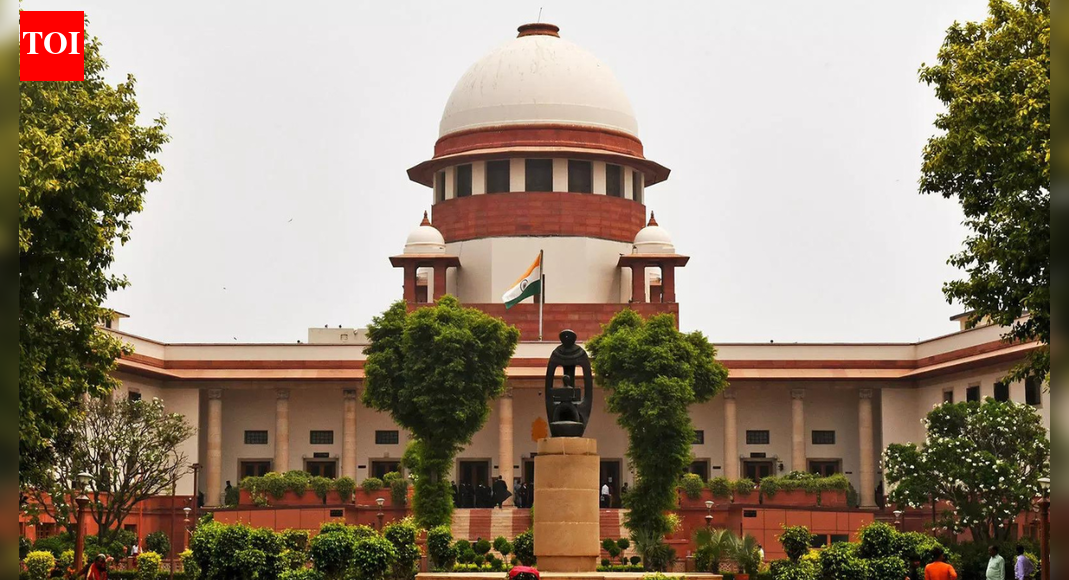

Supreme Court
NEW DELHI: Sometimes judicial proceedings are too slow and protracted to deliver justice in one’s lifetime.This is reflected in a case in which the three-tier judicial system took 34 years to decide the validity of an ITDC employee’s job termination. The litigant passed away a year before the final word was spoken on the litigation by the apex court, which delivered a verdict in his favour.D K Sharma was terminated in 1991 and the litigation started from the labour court. It then went before a single bench of Rajasthan HC, whose order was challenged before a division bench and the proceedings culminated in the Supreme Court. The labour court had passed an order in his favour and directed his reinstatement with 100% back wages after the management failed to lead evidence to prove the charges against him. It, however, passed the order in 2015, almost a quarter of century after his job was terminated.Aggrieved by the order, ITDC moved HC whose single bench modified the order to the extent that back wages awarded by the labour court were reduced to 50%. But a division bench of HC set aside the order of his reinstatement as well as payment of back wages. Sharma thereafter moved SC in 2020 which now directed the hotel to give 50% of back wages. Sharma had died last year and the litigation was pursued by his legal heir.”Insofar as the claim of the appellant for full back wages is concerned, having regard to the fact that there was no specific statement before the labour court that the appellant was not gainfully employed elsewhere in the interregnum as also the fact that Hotel Ashoka has changed hands, taking into account the long period that has elapsed since termination till passing of the award, we are of the view that award of 50% of back wages as directed by learned Single Judge of HC shall meet the ends of justice,” said a bench of Manoj Misra and Ujjal Bhuyan while allowing his appeal.Granting 50% back wages to his family, the court said he had filed an affidavit stating that he was not gainfully employed in the interregnum and there was no evidence placed before the court by the opposite party to rebut his claim.The top court said that the order of the single judge bench of the HC was just and proper as a workman who had served for long would not be able to get employment if one crosses the age bar. “No doubt, a person may do odd jobs to survive but that cannot be a ground to deny back wages, particularly when termination of his service is by way of punishment,” it said.