
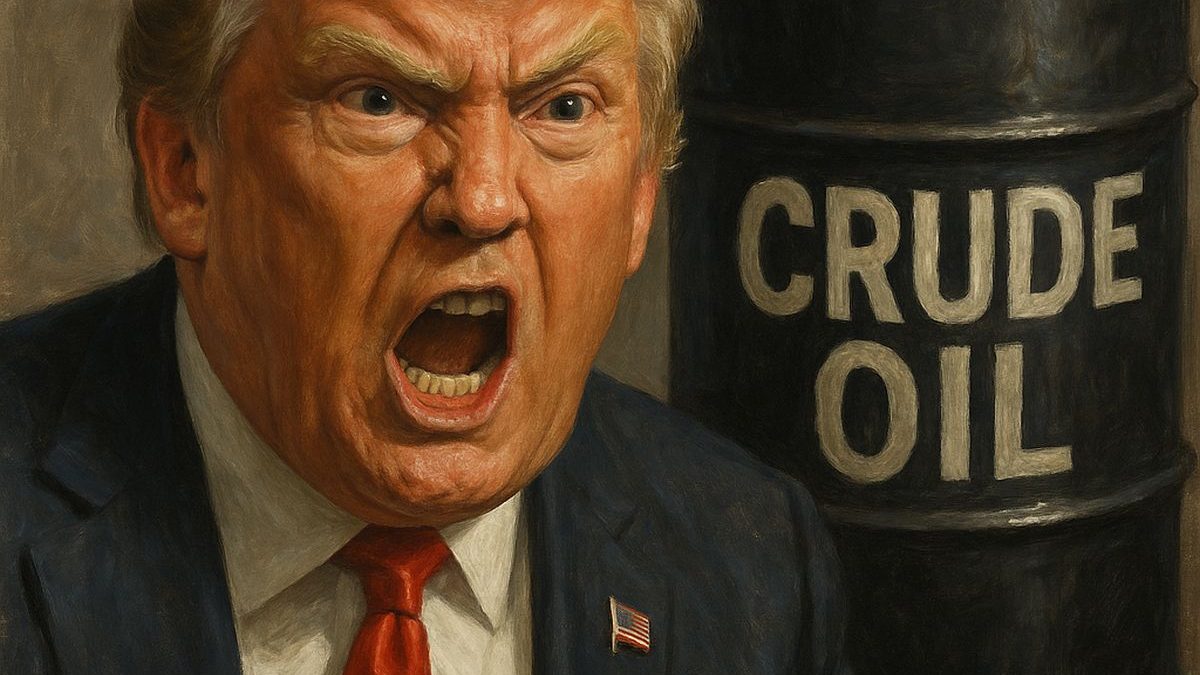
 "<div>Tariffs become sanctions: US switch shows it was never about trade, but politics</div>")

The Trump White House has begun to describe the additional 25 per cent levy on Indian goods not merely as tariffs but as “sanctions,” a shift in language that has carried significant political weight. White House Press Secretary Karoline Leavitt, addressing reporters in Washington, framed the penalties as part of President Donald Trump’s wider effort to press Moscow into ending the Russia-Ukraine war. She referred to the measure as “sanctions on India,” echoing Trump himself, who had earlier described the added penalty as “secondary sanctions.”
The linguistic change has blurred the traditional distinction between trade tools and foreign policy instruments, sending an unmistakable signal that Washington’s move was less about commerce and more about coercive diplomacy. For India, the rebranding of tariffs into sanctions has reopened old wounds, reminding New Delhi of an era when Washington’s punitive measures were not merely symbolic but devastating to bilateral relations.
Traditionally, tariffs have been imposed to raise government revenue and protect domestic industries from foreign competition by making imports more expensive. They serve as fiscal tools, allowing governments to shield home markets while discouraging dependence on foreign suppliers. Sanctions, however, operate in a different universe altogether. They are primarily foreign policy and national security measures, designed to compel countries, entities or individuals into changing their behaviour by creating political and economic pain.
The White House’s decision to recast tariffs as sanctions underscored that the penalties on India were not aimed at balancing trade accounts but at achieving foreign policy goals, particularly in relation to the Ukraine war. By characterising the move as part of the pressure campaign against Russia, the administration tied India’s economic fate to a geopolitical conflict in which New Delhi had sought neutrality.
India pulled into the Ukraine conflict
Leavitt suggested that the penalties were meant to apply “secondary pressure” on Moscow, indicating that Washington wanted to use India’s economic ties with Russia as leverage in its broader peace initiative. Trump himself reportedly told aides and allies that these sanctions were necessary to “move the dial” with Russian President Vladimir Putin.
The press secretary explained that Trump had expended significant political capital to bring the war closer to an end, citing his meetings with Ukrainian President Volodymyr Zelensky and subsequent discussions with European leaders. According to her, the decision to sanction India was a deliberate step in widening the circle of pressure around Moscow, even if the direct target was a US partner rather than an adversary.
Echoes of 1998: A sensitive history
For India, the invocation of sanctions revived sensitive memories of May 1998, when Washington had last imposed punitive restrictions after New Delhi’s nuclear tests. The sanctions at that time, mandated under the Glenn Amendment to the Arms Export Control Act, included cutting off military sales, suspending foreign assistance, blocking multilateral loans and denying exports of dual-use technologies. The episode created a deep diplomatic chill, forcing India into strategic isolation until the early 2000s.
It had then taken a decade of painstaking diplomacy to undo the damage of those sanctions culminating in the landmark nuclear agreement that reset relations.
A diplomatic setback
The new round of penalties—tariffs plus sanctions—has effectively doubled the cost of Indian exports to the United States, raising the total tax burden to 50 per cent. Trade talks that were scheduled for late August have already been postponed and there appears to be little immediate prospect of resolution. For New Delhi, which has sought to diversify its global partnerships and maintain strategic autonomy, the White House’s move has raised both economic concerns and questions of trust.
Politics behind the tariffs
Trump’s decision to label the penalties as sanctions also appeared calculated for domestic political effect. By portraying himself as tough on both Russia and its partners, he has sought to contrast his leadership with that of previous administrations, which he accuses of weakness. Leavitt told reporters that European leaders had rushed to Washington following Trump’s recent meeting with Putin, suggesting that they were grateful for his proactive role in seeking peace.
The administration has attempted to project the narrative that without Trump in office, the war in Ukraine would not have started, a claim Leavitt repeated in her exchanges with journalists. By tying the tariffs on India to a peace initiative in Europe, the White House reframed a trade dispute as a matter of global security and presidential leadership.
Secondary sanctions and global pressure
By calling the tariffs “secondary sanctions”, Trump positioned India alongside countries like China and Turkey, which have also faced pressure for their ties with Russia. The implication was that if India continued its close engagement with Russia, it could expect to bear economic costs imposed by Washington.
Such an approach has precedent in US foreign policy, particularly in relation to Iran, where secondary sanctions were used to deter third countries from engaging in trade or financial transactions with Tehran. By extending this model to India, the White House indicated that it was willing to treat even a strategic partner as a pressure point in its broader geopolitical contest.
For India, the experience has been a reminder that its relationship with Washington remains subject to political volatility. While New Delhi has expanded defence cooperation, signed major agreements and deepened economic ties with the US, it is also aware that strategic disagreements can quickly escalate into punitive action. The “sanctions” narrative has reinforced India’s determination to maintain independence in foreign policy, especially when it comes to Russia.
A return to pragmatism?
Whether the US ultimately walks back its sanctions language remains to be seen. What is clear, however, is that the White House has shifted the conversation from economics to geopolitics, turning a tariff dispute into a political confrontation. For India, this shift has brought back memories of 1998, raised the costs of doing business with its most important export market and complicated its balancing act between Moscow and Washington.
End of Article


&description=Tariffs+become+%E2%80%98sanctions%E2%80%99%3A+US+switch+shows+it+was+never+about+trade%2C+but+politics)