

Last Updated:
At the heart of PoK’s latest shutdown is the AAC’s 38-point charter, a mix of daily grievances and political reform that threatens Pakistan’s control

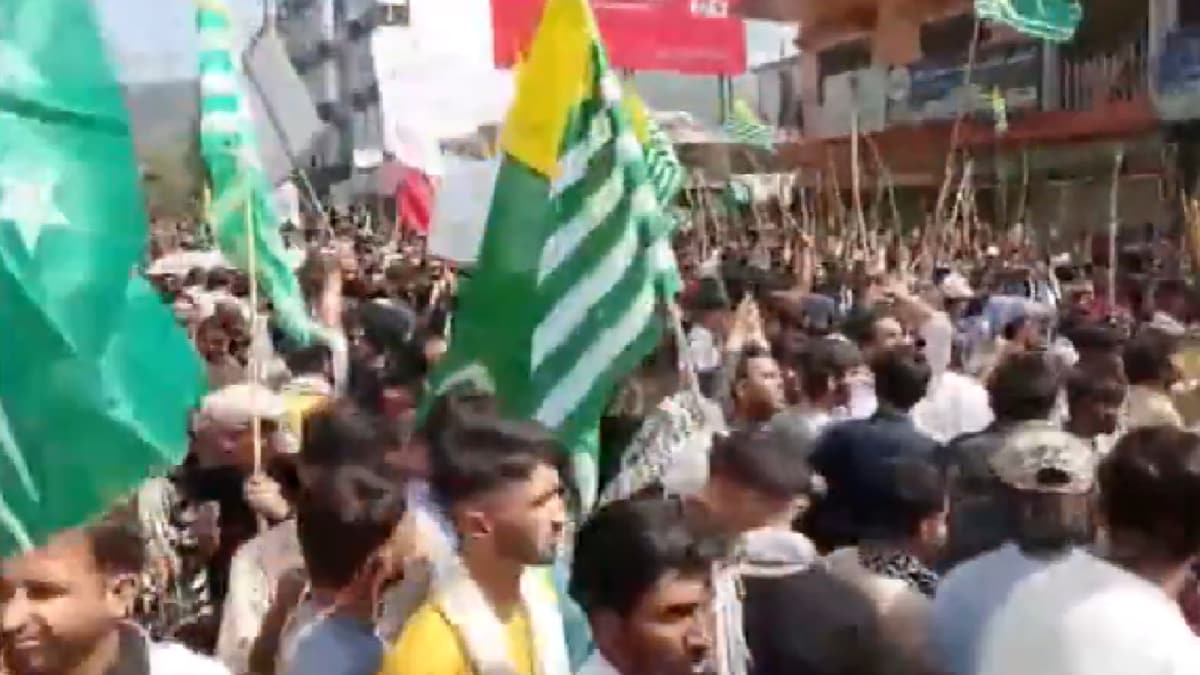
The Jammu Kashmir Awami Action Committee (JKAAC) seen leading the ongoing demonstrations in Pakistan-occupied Kashmir region. (IMAGE: ANI)
Pakistan-occupied Kashmir (PoK) witnessed one of its biggest waves of agitation in recent years as thousands of people across Muzaffarabad, Mirpur, Kotli, Rawalakot, Neelum Valley and other districts took to the streets. Shops and businesses were shut, public transport disappeared, and the region came to a standstill after the Awami Action Committee (AAC), an umbrella coalition of traders, lawyers and civil society groups, called for a “shutter-down and wheel-jam” strike.
The immediate spark was the collapse of marathon talks between the AAC, federal ministers, and the PoK administration. According to Firstpost, ministers told the AAC that constitutional changes such as scrapping refugee seats could not be decided “in a closed room.” Negotiations broke down soon after.
Recommended Stories
Within hours of the collapse, the AAC went ahead with the strike call. “Our campaign is not against any institution but for the fundamental rights denied to our people for over 70 years. Enough is enough,” AAC leader Shaukat Nawaz Mir said.
The 38-Point Charter Of Demands
At the centre of the protests lies a sweeping 38-point charter of demands, which the AAC says reflects decades of unmet promises and systemic neglect. While some demands focus on bread-and-butter issues, others go directly to the political structure of PoK and Islamabad’s hold over the region.
Key elements of the charter include:
- Subsidies on essentials: Protesters want cheaper flour, subsidised sugar and ghee, and fairer electricity tariffs. A central demand is access to electricity at cost from hydropower projects such as the Mangla Dam, which generates power locally but whose benefits, they argue, are diverted to Pakistan’s mainland.
- Abolition of refugee seats: Scrapping of 12 legislative assembly seats reserved for Kashmiri refugees living in Pakistan. Residents say these seats dilute their own representation and allow Islamabad to retain political control over Muzaffarabad.
- Rollback of elite privileges: Removal of perks, allowances and subsidised facilities for politicians, bureaucrats and judges that have long been criticised as symbols of inequality.
- Judicial and governance reforms: Calls for reforms in the judiciary to make it more accountable, along with structural changes in the administration to curb corruption and political patronage.
- Tax relief: Demands for cuts in local taxes that have risen sharply in recent years, including relief for traders and small businesses hit by inflation.
- Roads and infrastructure: Construction of delayed road projects to connect remote valleys and improve trade routes, as well as better transport facilities.
- Education and health: Free education and healthcare facilities for all residents, with improved access in rural and hilly areas where schools and hospitals are scarce.
- Employment and jobs: Ending job quotas reserved for refugees and ensuring more equitable employment opportunities for local youth. Protesters say recruitment is skewed in favour of outsiders, leaving PoK residents behind.
- Housing and relief projects: Rehabilitation and compensation for families affected by natural disasters, as well as more support for those displaced by conflict.
- Agriculture and water: Fairer policies to support farmers, along with measures to ensure local communities benefit from hydropower and water resources that currently flow to Pakistan’s national grid.
The breadth of the charter makes it unlike past agitation. It mixes immediate economic concerns with deeper political and structural reforms, making it far more challenging for Islamabad to address without conceding ground on its control.
Violence And Blackout
Although the AAC initially insisted its movement was peaceful, events in Muzaffarabad turned deadly. According to Hindustan Times, a clash at Neelum Bridge between AAC supporters and a rival rally led by Muslim Conference leader Raja Saqib Majeed resulted in the death of a shopkeeper, identified as Mohammad Sudheer. Eyewitnesses told Pakistani newspaper Dawn that participants of the rival rally, moving with police and paramilitary protection, opened fire on AAC demonstrators. Several others were injured as police lobbed tear gas and fired on protesters.
According to an India Today report, the government deployed armed convoys from Punjab and an additional 1,000 police personnel from Islamabad in anticipation of unrest. Authorities also imposed a sweeping communication blackout from Sunday noon, cutting internet, mobile, and even landline services across the region.
Why This Protest Feels Different
The latest agitation is part of a longer cycle of unrest in PoK, but the scale and substance this time set it apart. Protests in 2022 and 2023 were triggered by electricity tariff hikes and the withdrawal of flour subsidies, with demonstrators demanding access to resources generated locally. While those grievances remain, the current 38-point charter presses for structural changes that directly challenge Pakistan’s authority.
The AAC has signalled that this is not a one-off action. After temporarily suspending its agitation to avoid bloodshed, it has already announced 15 October as the next phase of mobilisation, an indication of sustained pressure rather than spontaneous outrage.
Protests in solidarity were also staged by PoK-origin communities in the United States, the United Kingdom and Europe, adding an international dimension.
The Political Stakes For Islamabad
For Islamabad, the unrest in PoK comes at a politically delicate moment. Prime Minister Shehbaz Sharif has been focused on courting international partners such as US President Donald Trump, but the scale of protests in PoK has underlined challenges in his own backyard.
Unlike previous episodes of unrest that remained confined to subsidies, this round has drawn global attention. The diaspora mobilisation in Western capitals complicates Pakistan’s longstanding narrative of championing Kashmiri rights abroad while failing to deliver governance in the territory it occupies.
The security response, thousands of personnel deployed from Punjab and Islamabad, road closures, and a sweeping communication blackout, shows Islamabad’s anxiety.
The stakes for Islamabad, therefore, are not only about meeting or rejecting the AAC’s 38 demands. They are about whether Pakistan can continue to project control over PoK without confronting rising dissent, both on the ground and on the international stage.
A History Of Broken Promises
The AAC insists its current movement is not new, but a continuation of past struggles. Protests in 2022 and 2023 highlighted electricity bills, wheat subsidies, and Islamabad’s diversion of resources. In 2022, opposition erupted against a proposed constitutional amendment, with demonstrators blocking highways and chanting slogans against joining Pakistan.
In May 2024, large protests again demanded flour and electricity subsidies, pressing for power at cost from Mangla Dam. At that time, the government promised relief and partial reforms, but protesters now say little has changed. The current agitation, they argue, is the result of years of neglect and repeated failure to implement agreements.
What Happens Next?
The AAC’s decision to resume protests on 15 October sets the stage for a prolonged confrontation. If Islamabad resists core demands such as abolition of refugee seats, the deadlock could persist. Meanwhile, continued blackouts, arrests of activists, and heavy troop deployment risk further inflaming anger.
About the Author

Karishma Jain, Chief Sub Editor at News18.com, writes and edits opinion pieces on a variety of subjects, including Indian politics and policy, culture and the arts, technology and social change. Follow her @kar…Read More
Karishma Jain, Chief Sub Editor at News18.com, writes and edits opinion pieces on a variety of subjects, including Indian politics and policy, culture and the arts, technology and social change. Follow her @kar… Read More
September 30, 2025, 15:05 IST
Loading comments…
Read More
 "US students share ‘Incredible India’ experiences at Montana State Capitol")
