

Last Updated:
As NATO allies explore a 40-kilometre demilitarised strip to separate Russian and Ukrainian forces, Kyiv has rejected the idea, calling it a threat to Ukraine’s sovereignty


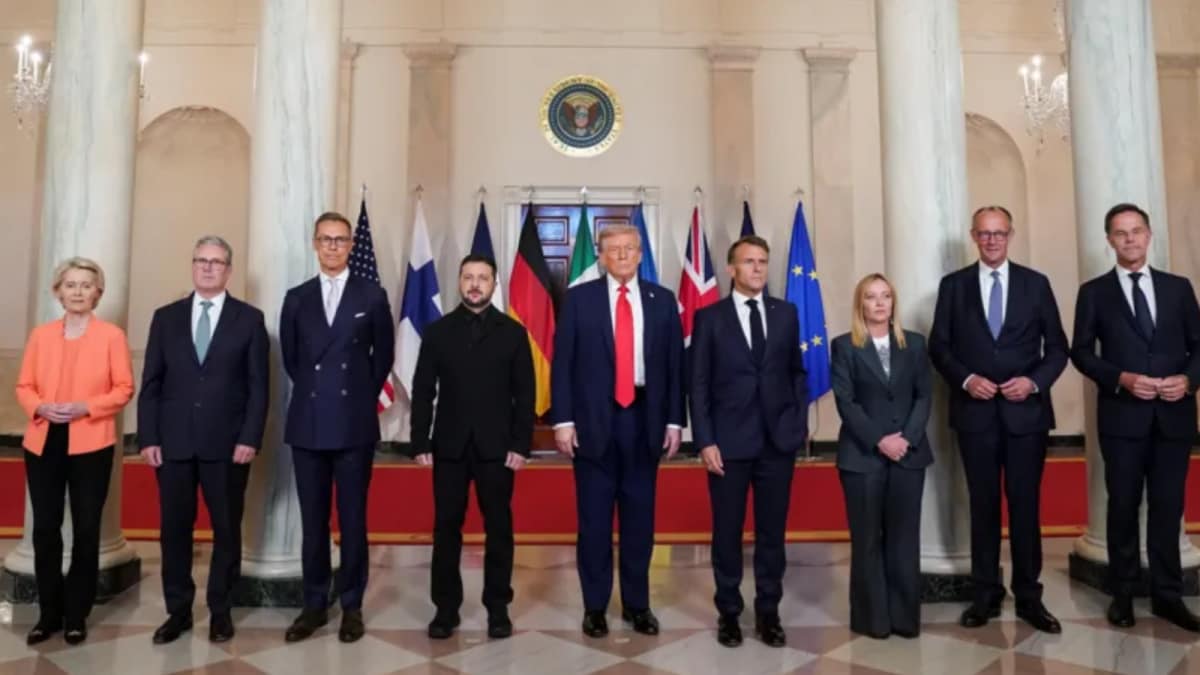
Trump and Zelenskyy with European Leaders | Image: AP
European leaders are considering a plan to establish a 40-kilometre buffer zone between Ukrainian and Russian forces. The proposal, first reported by Politico citing five European diplomats, would block off a stretch of Ukrainian territory to act as a demilitarised strip under international supervision.
The idea is being explored as part of a possible ceasefire or postwar agreement. It is one of several concepts under discussion among civilian and military officials in Europe. Russia has indicated support for creating buffer zones near its borders, but has not provided details. The plan has not been approved or accepted by Ukraine.
Recommended Stories
Who Would Patrol The Zone, And Have Troops Been Committed?
No country has officially committed troops to the proposal. France and the United Kingdom are expected to take the lead in providing a foreign presence, while other allies are being lobbied to contribute. Estimates for the number of troops needed range from 4,000 to 60,000.
Some NATO members, including Germany and Poland, have expressed concern. Officials quoted by Politico said Poland is worried that deploying forces to Ukraine could weaken NATO’s eastern flank and leave its own borders more vulnerable. Estonia has reportedly pledged a limited number of troops.
The proposal also raises questions about the rules of engagement for troops in the zone and how to respond in the event of a Russian escalation. Discussions are ongoing, but no operational details have been finalised.
What Is The United States’ Role In The Plan?
The United States is not directly involved in the buffer zone discussions. Politico reported that Washington is not planning to provide ground forces and has taken a minimal role in the proposal. US officials have indicated they may offer satellite intelligence and limited air support, but no more.
According to European officials quoted in the report, the US is allowing European countries to take the lead on this issue.
Ukraine’s Chief of Staff Andriy Yermak recently met in New York with Trump’s special envoy Steve Witkoff, US Secretary of State Marco Rubio and Vice President JD Vance. Yermak said after the meeting that Ukraine welcomed all peace initiatives, but added, “Unfortunately, each of them is being stalled by Russia.”
Why Has Zelenskyy Rejected The Proposal?
Ukrainian President Volodymyr Zelenskyy has firmly rejected the idea of a buffer zone, stating that it does not align with the current realities of warfare.
“Only those who do not understand the technological state of today’s war propose a buffer zone,” Zelenskyy told reporters on Friday.
He explained that the nature of the war has changed due to drone warfare. According to him, drones have already created what he calls a “dead zone” or “grey zone” near the front lines, where heavy weapons cannot be deployed safely.
“Today, our heavy weapons are located at a distance of more than 10km from each other, because everything is hit by drones,” he said. “This buffer – I call it a ‘dead zone’ – already exists.”
Would Ukraine Have To Give Up Territory Under The Plan?
Zelenskyy has also rejected any suggestion that Ukraine would be required to give up territory under a peace framework. He dismissed the idea that Ukraine should adjust its positions to make room for a demilitarised zone.
“If Russia wants to have a greater distance from us, they can retreat deep into the temporarily occupied territories of Ukraine,” he said.
He further stated that Russia is not ready for genuine diplomacy and is instead looking for ways to prolong the war.
What Prompted The Buffer Zone Discussions?
The buffer zone proposal comes as efforts to secure a negotiated peace show signs of stalling. A recent meeting at the White House between US President Donald Trump, Zelenskyy and European leaders had raised hopes of a possible summit involving Russian President Vladimir Putin. However, German Chancellor Friedrich Merz has said there would “obviously not” be a meeting, as Putin appears unwilling to take part.
On Thursday, Russia launched one of the largest aerial attacks of the war on Kyiv, firing 629 drones and missiles. At least 23 people were killed. Two missiles landed near the European Union’s offices in the city centre.
The strike was widely condemned by European officials. EU foreign policy chief Kaja Kallas called it a deliberate escalation that undermines peace efforts. Following talks in Toulon, French President Emmanuel Macron said that if Putin failed to respond to a Monday deadline for talks, “it will show again that President Putin has played President Trump.”
Are NATO Members United On The Proposal?
The buffer zone idea has divided NATO. While France and the UK are in favour and lobbying allies for support, others remain cautious. Germany and Poland have not shown interest in deploying troops inside Ukraine.
Some NATO members worry that such a move could reduce the alliance’s capacity to respond to other threats. NATO is already trying to assemble a 300,000-strong response force to protect its eastern flank, and a Ukraine deployment could draw resources away from that goal.
One European official told Politico that the proposal may not work because “it’s not very sensible against an adversary who is not negotiating in good will.”
How Has Russia Responded To The Western Peace Initiatives?
Russian foreign ministry spokeswoman Maria Zakharova said that Western proposals are “one-sided” and are aimed at containing Russia. She added that any security guarantees must include consideration of Russia’s interests and be based on mutual understanding.
Putin and his deputies have said they are working to create buffer zones along Russia’s borders, but they have not provided details of how such zones would function or be enforced.
What Happens Next?
As it stands, the buffer zone proposal has not progressed. With no consensus within NATO, rejection from Kyiv, and no sign of Russian cooperation, the idea appears unlikely to move forward in its current form.
European leaders have now turned their focus to developing “NATO-like” security guarantees for Ukraine. According to the BBC, Zelenskyy has said he expects talks on these guarantees to continue next week.
For now, Ukraine maintains that any peace framework must reflect modern warfare and preserve its territorial integrity. Zelenskyy’s message is clear: a Cold War-era buffer zone will not address the realities of a drone-driven conflict, and Ukraine will not accept any solution that risks rewarding invasion.
About the Author

Karishma Jain, Chief Sub Editor at News18.com, writes and edits opinion pieces on a variety of subjects, including Indian politics and policy, culture and the arts, technology and social change. Follow her @kar…Read More
Karishma Jain, Chief Sub Editor at News18.com, writes and edits opinion pieces on a variety of subjects, including Indian politics and policy, culture and the arts, technology and social change. Follow her @kar… Read More
Loading comments…
Read More
 "PM Modi, Shigeru travel in same car on way to Sendai, observe Alpha-X train | See pics")
 "J&K rain fury: 3 killed in Ramban cloudburst, 4 missing; rescue ops underway")
