

Last Updated:
Trump used emergency powers to impose sweeping tariffs on nearly every US trading partner, bypassing Congress and declaring trade deficits a national emergency


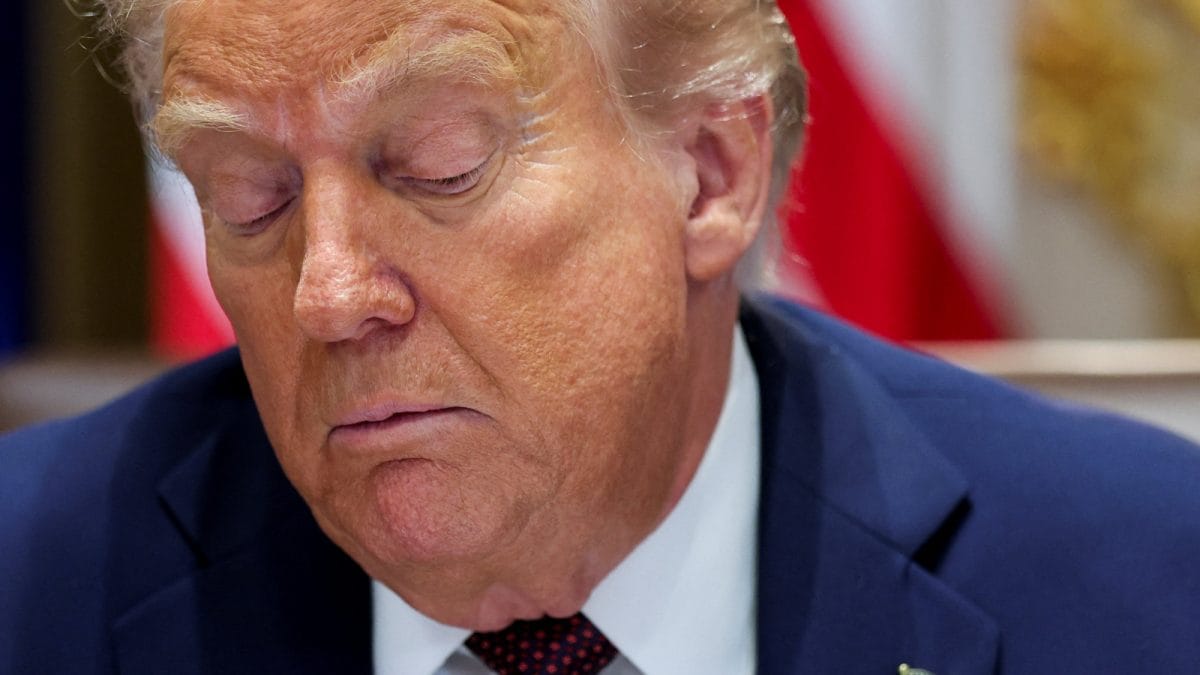
US President Donald Trump (Reuters Image)
US President Donald Trump’s most sweeping tariff move is now at risk of being undone, not by a trade partner, but by the US court system. In a decision that could ripple across global markets and domestic politics, a federal appeals court has ruled that Trump’s emergency tariffs were unlawful, raising the possibility that the US government may have to refund billions in collected duties.
As the case heads to the Supreme Court, it’s not just the legal boundaries of presidential power that are being tested, it’s also the financial limits of the US Treasury.
Recommended Stories
Why Are Trump’s Tariffs Under Legal Fire?
The latest court ruling challenges the legal basis of a sweeping tariff order signed by Donald Trump during his current presidency. On 2 April 2025, he introduced what he called “Liberation Day” tariffs, duties of up to 50 per cent on countries that export more to the US than they import, and a standard 10 per cent on most others. Nearly every US trading partner was affected.
Trump justified these tariffs using a rarely invoked law from 1977 called the International Emergency Economic Powers Act, or IEEPA. This law was designed to let the president take action during foreign policy emergencies such as war, terrorism, or hostile regimes, but Trump used it to declare that America’s trade deficits with other countries were themselves a “national emergency”.
That claim allowed him to bypass Congress and impose tariffs unilaterally.
But on 29 August, a US federal appeals court ruled that Trump had gone too far. The judges said the law does not give the president the power to tax imports, and reaffirmed that only Congress has the constitutional authority to impose tariffs. The court backed a similar verdict issued earlier this year by a New York trade court.
A Congressional report cited during the case also noted that no previous US president has ever used IEEPA to justify tariffs, making Trump’s move unprecedented.
Which Tariffs Does The Ruling Affect And Which Remain Untouched?
The ruling applies specifically to the “Liberation Day” tariffs and earlier duties imposed on China, Mexico and Canada under IEEPA. These were justified as emergency responses to trade deficits and, in some cases, to cross-border migration and narcotics concerns.
Other tariffs remain unaffected. These include those imposed under Section 232 of the Trade Expansion Act of 1962, covering steel, aluminium and auto imports. It also does not strike down Section 301 tariffs imposed on China during Trump’s first term, which were based on findings of unfair trade practices and remained in place under the Biden administration.
Why Has The US Government Warned Of Financial Consequences?
If the Supreme Court upholds the ruling and the tariffs are overturned, the US government may be required to refund a large share of the money it has collected. According to the Associated Press, tariff revenue had reached USD 159 billion by July 2025, more than double the amount collected at the same point the previous year.
In a filing cited by the AP, the Justice Department warned that reversing the tariffs could lead to “financial ruin” for the federal Treasury due to the scale of potential refunds. Officials have also raised concerns that trade deals negotiated under tariff pressure could face disruption if the legal foundation collapses.
Commerce Secretary Howard Lutnick warned of a broader strategic impact, including possible retaliation from foreign partners and the derailment of ongoing negotiations.
What’s The Political Fallout Of The Ruling?
The ruling undermines a central part of Trump’s trade legacy. The former president had relied heavily on unilateral tariffs to pressure trading partners, often bypassing Congress or multilateral forums. Countries like Japan, the UK and the EU signed deals to avoid higher tariffs. Others—such as Laos and Algeria—faced increased duties for non-compliance.
Now, with the legal foundation in question, these arrangements could be challenged. Some governments may delay or reverse prior commitments, while others could demand new terms. Legal experts say Washington’s negotiating leverage could weaken significantly.
Trump has responded by vowing to take the case to the Supreme Court. He claimed the ruling would “destroy the United States” if allowed to stand. His legal team argues that the president’s emergency powers are broad and should include the ability to act on foreign trade threats.
Attorney General Pam Bondi said the decision undermined the president’s role in foreign policy and pledged to appeal. Treasury and Commerce officials echoed the warning, calling the ruling a potential diplomatic embarrassment.
Is This The End Of Emergency Tariffs Or Does Trump Have Other Tools?
Even if the IEEPA route is shut down, future presidents, including Trump if re-elected, would still have options to impose tariffs.
One path is Section 301 of the 1974 Trade Act, which allows tariffs following an investigation into unfair practices. Another is Section 232, which requires the Commerce Department to establish a national security basis. There is also an obscure provision, Section 338 of the 1930 Tariff Act, which allows the president to impose tariffs of up to 50 per cent on specific countries. Though never used in modern trade policy, it remains on the books as a potential fallback.
The key difference is speed and flexibility. The IEEPA allowed Trump to act almost unilaterally and impose duties within days. Other statutes involve procedural steps, investigations, and inter-agency reviews that slow things down and limit the scale of tariffs.
What Happens Next?
The appellate ruling has been stayed until 14 October, giving the administration time to appeal. If the Supreme Court takes up the case and rules against Trump, it could become a landmark precedent limiting presidential authority over trade policy.
A dissenting opinion from judges in the August ruling noted that IEEPA was not an unconstitutional delegation of legislative power, suggesting that future challenges may hinge on how much leeway Congress intended to give the executive.
While existing tariffs remain in place for now, the legal and financial uncertainty is significant. Businesses are unclear whether duties will be refunded. Trading partners are reassessing commitments. And Washington faces the risk of losing a key tool in future negotiations.
About the Author

Karishma Jain, Chief Sub Editor at News18.com, writes and edits opinion pieces on a variety of subjects, including Indian politics and policy, culture and the arts, technology and social change. Follow her @kar…Read More
Karishma Jain, Chief Sub Editor at News18.com, writes and edits opinion pieces on a variety of subjects, including Indian politics and policy, culture and the arts, technology and social change. Follow her @kar… Read More
Loading comments…
Read More

 "Europe condemns US visa denial to Palestinian leaders ahead of UNGA")
