
BBC News Climate and Science

 James Wakibia/Getty Images
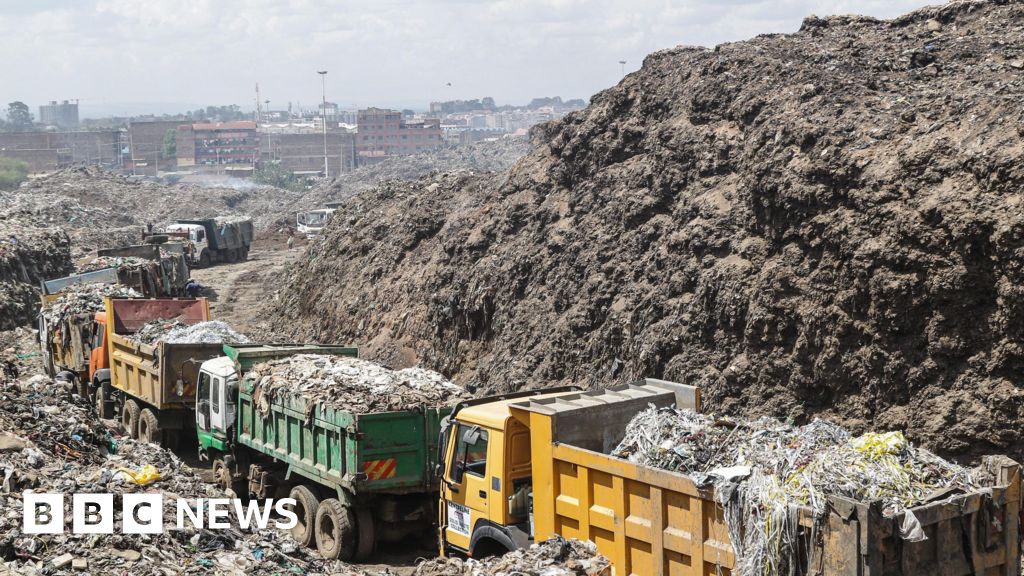
Global talks to develop a landmark treaty to end plastic pollution have once again failed.
The UN negotiations, the sixth round of talks in just under three years, were due to end on Thursday but countries continued to negotiate into the night in the hopes of breaking a deadlock.
There remained a split between a group of about 100 nations calling for curbs on production of plastic, and oil states pushing for a focus on recycling.
Speaking in the early hours, Cuban delegates said that countries had “missed a historic opportunity but we have to keep going”.
“I’m hugely disappointed that an agreement wasn’t reached,” said the UK’s Marine Minister Emma Hardy.
“Plastic pollution is a global crisis that no country can solve alone, and the UK is committed to working with others at home and abroad to protect the environment and pave the way to a circular economy,” she added.
The talks were convened in 2022 in response to the mounting scientific evidence of the risks of plastic pollution to human health and the environment.
Despite the benefits of plastic to almost every sector, scientists are particularly concerned about potentially toxic chemicals they contain, which can leach out as plastics break down into smaller pieces.
Microplastics have been detected in soils, rivers, the air and even organs throughout the human body.
Countries had an original deadline to get a deal over the line at the end of December last year, but failed to meet this.
The collapse of the latest talks means they fall further behind.
Speaking on behalf of the island states, the northern Pacific nation of Palau said on Friday: “We are repeatedly returning home with insufficient progress to show our people.”
“It is unjust for us to face the brunt of yet another global environmental crisis we contribute minimally to,” it added.
The core dividing line between countries has remained the same throughout: whether the treaty should tackle plastics at source – by reducing production – or focus on managing the pollution that comes from it.
The largest oil-producing nations view plastics, which are made using fossil fuels, as a vital part of their future economies, particularly as the world begins to move away from petrol and diesel towards electric cars.
The group, which includes Saudi Arabia and Russia, argue that better waste collection and recycling infrastructure is the best way of solving the problem, a view shared by many of the producers themselves.
“Plastics are fundamental for modern life – they go in everything,” said Ross Eisenberg, president of America’s Plastic Makers, a trade association for the plastic production industry in the United States.
“Focusing on ending plastic pollution should be the priority here, not ending plastic production,” he added, warning that attempts to substitute plastics with other materials could lead to “unintended consequences”.
But many researchers warn that this approach is fundamentally flawed. Global recycling rates are estimated at only about 10%, with limits on how far that can rise.
“Even if we manage to boost that over the next few decades to 15, 20, 30%, it would remain a substantial amount that is polluting the environment and damaging human health,” said Dr Costas Velis, associate professor in Waste and Resource Engineering at Imperial College London.
“Therefore, we do need to improve recycling… but we cannot really hope that this is going to solve all the aspects of plastic,” he added.
Plastic production has already risen from two million tonnes in 1950 to about 475 million in 2022 – and it is expected to keep rising without extra measures.
About 100 countries, which include the UK and EU bloc, had been pushing for curbs to production in the treaty and more consistent design globally to make recycling easier.
This could be as simple as requiring plastic bottles to be one colour – when dyes are used the products only fetch half the value of clear bottles.
This approach was supported by major plastic packagers, including Nestle and Unilever, who are part of the Business Coalition headed up by the Ellen McArthur Foundation.
The Coalition also said countries should better align their schemes to add a small levy on plastic products to help pay for recycling efforts, known as extended producer responsibility.
The group estimates that could double revenues for countries to $576bn (£425bn) between now and 2040.
 Reuters
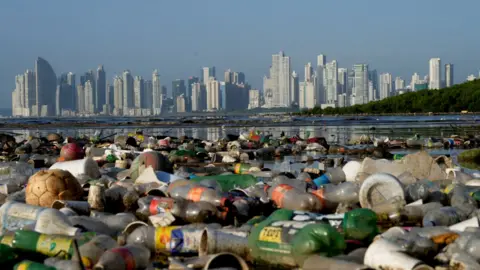
Talks were due to end on Thursday but countries continued to negotiate into the night in the hopes of breaking a deadlock.
The chair, Luis Vayas from Ecuador, did produce a new text which seemed to align more closely with the request of the UK group.
The text did not call for curbs to plastic production.
But it did include reference to nations taking their own steps to tackle other issues like dangerous plastic chemicals and the design of plastics to make them easier to recycle.
Speaking at the final meeting, the EU delegation said: “We see the outcome of this session as a good basis of future negotiations.”
However, the oil states remained deeply unhappy. Saudi Arabia said it found the process of negotiating “problematic” whilst Kuwait said its views were “not reflected”.
But many environmental groups, reacting to the collapse, railed against what they see as prioritisation of profit by oil states over the health of the planet.
Graham Forbes, Greenpeace head of delegation to the Global Plastics Treaty negotiations, said: “The inability to reach an agreement in Geneva must be a wakeup call for the world: ending plastic pollution means confronting fossil fuel interests head on.
“The vast majority of governments want a strong agreement, yet a handful of bad actors were allowed to use process to drive such ambition into the ground.”
The chair announced that the talks will resume at a later date.