


Mark SavageMusic correspondent


 Royel Otis
Aussie guitar duo Royel Otis show up to our interview looking artfully crumpled, beers in hand – but all is not quite what it seems.
The band – made up of twenty-somethings Royel Maddell (guitar) and Otis Pavlovic (lead vocals, guitar) – are on a rare day off. Last night, they played the last of three sold-out concerts at London’s Brixton Academy. It was their 81st gig of the year.
They’re dishevelled because they’ve just got off a bus to Glasgow, ahead of show 82. The beers are alcohol-free Guinness.
“We’re learning how to look after ourselves [on tour],” says Maddell. “We just try to stay healthy and hit the saunas. Try to stay sober. Hence the Guinness.”
It’s a new level of professionalism for a band that never really intended to become a major touring act.
But Royel Otis’s cosmic, sun-kissed indie anthems (and a viral cover of Murder On The Dancefloor) have put them on the map – and earned them fifth place on BBC Radio 1’s Sound of 2026.
They were voted onto the list, which highlights the emerging artists who could make a mainstream breakthrough in the coming year, by an international panel of more than 170 DJs, producers and artists – including Sir Elton John, who has championed the band on his radio show.
In previous years, fifth place has gone to the likes of Rosalía, Central Cee and George Ezra – putting Royel Otis in rarified air.
“We feel honoured,” says Maddell, while admitting that, as Australians, “it’s the first we’ve heard of the list”.
“We’re learning about it as we go. But it seems amazing. We’re in good company.”
 Getty Images
Royel Otis formed in 2019 but, by all accounts, should have started years earlier.
Both musicians lived and worked in Byron Bay, New South Wales. They hung out on the same beaches, stayed in the same holiday homes, and Maddell’s dad was friends with Pavlovic’s uncle.
In the end, however, they were introduced by their girlfriends.
“Roy was working at a bar that we’d go to sometimes and [we] just ended up playing pool, talking about music. It was pretty straightforward,” says Pavlovic.
“Otis had a demo of a song, and I said, ‘Send it to me’,” says Maddell, picking up the story.
“I thought it was going to be horrible, because they usually are – but the next morning, I played it while I was in the shower, and I was like, ‘Oh, this is sick’.”
Maddell sent back some music of his own and the pair quickly started exchanging ideas. For the elder of the two musicians, it marked an abrupt change of plans.
“I wanted to be behind the scenes, writing music for someone else,” confesses Maddell.
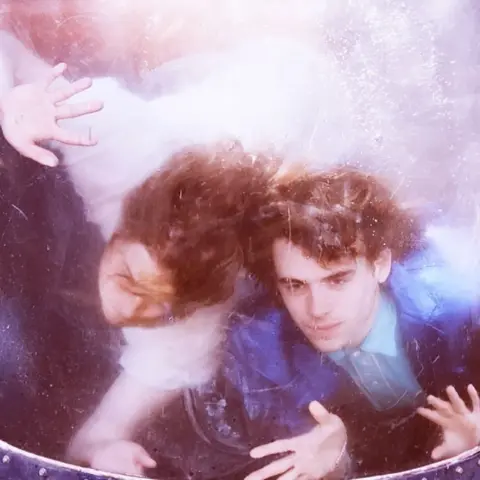 Royel Otis
Instead, they went straight to the studio, riffing on their shared love of The Cure, Oasis and – rather brilliantly – the Alessi Brothers’ 1976 soft rock classic Seabird.
They quickly found a sound of their own. Summed up by Pavlovic as “jangly guitars and chanted layered vocals”, it’s both richly harmonic and somewhat ramshackle – born of a decision to embrace spontaneity and leave studio mistakes intact.
They finessed the formula on 2021 single Bull Breed – “the story of a reckless night out”, gambling away their pay cheques and smoking “all the cigarettes… like Courtney Love.”
“I don’t know if it’s celebrating those nights or taking the piss,” laughs Maddell.
“Like betting on horses – we don’t do that stuff, but we know the kind of lairy groups that do.”
Breakthrough single Oysters In My Pockets is equally rambunctious.
Described on release as “our way of showing appreciation to the bivalve molluscs that put some boost in our juice and some fire in the libido”, the duo literally wrote the song over “a barbecue and a few beers” after visiting the local supermarket to stock up on shellfish.
It’s one of a number of songs in their discography – see also Fried Rice, Egg Beater, Kool Aid and Jazz Burger – seemingly inspired by food.
“We just try to be honest,” laughs Pavlovic. “If there’s food on our minds, there’s food on our minds.”
‘A sexy sword’
Those early singles built significant buzz, but the duo weren’t ready to commit to a career.
“We just wanted to record music. We didn’t want to be a touring band,” says Maddell, who credits their manager, Andrew Klippel, with pushing them to think bigger.
“We needed a bit of persuading,” agrees Pavlovic. “I think if we had it our way, we probably wouldn’t be where we are.”
Even today, Maddell does his best to keep his identity hidden, permanently hiding his face behind his tousled, neon pink fringe.
“I still feel a bit nervous,” he says, despite selling more than 100,000 concert tickets last year (60,000 in the US alone).
Many of those fans got their first taste of Royel Otis through two viral radio sessions.
The first, recorded in January 2024, put a nostalgic indie spin on Sophie Ellis Bextor’s Murder On The Dancefloor.
Four months later, a cover of The Cranberries’ Linger for Sirius XM entered the US Top 100 and became the band’s biggest song on Spotify, with 223 million plays.
The song choice “was a spur of the moment thing”, says Maddell.
“I remember our drummer at the time was like, ‘You can’t do that. There are just certain songs you don’t touch’.”
Adopting the time-honoured tradition of ignoring anything your drummer says, they pushed ahead.
Even so, says Pavlovic, “it took us three attempts to get it right”.
“We were terrified,” says Maddell. “We thought it was going to be horrible.”
Instead, Linger has become a permanent fixture of their live shows. Last month, they even got to perform it with Cranberries guitarist Noel Hogan in London.
“He was such a gentleman,” says Maddell. “He wanted to do our version of the song more than he wanted to do his own.”
How does it feel to have the covers eclipse their own material?
“They’re kind of like our biggest songs, which is bittersweet,” says Maddell. “But we’re just appreciative that so many people who would never have heard our band discovered us with those covers.
“So it’s a double-edged sword, but it’s a sexy sword.”
 Getty Images
Anyone who digs further will discover more musical treasures. Since 2024, Royel Otis have recorded two albums at breakneck speed.
Their full-length debut, Pratts & Pain (named after a London pub), saw the band experiment with “crazy, makeshift instruments” and “weird open tunings” without sacrificing their wavy guitar sound and feel-good melodies.
The follow-up, 2025’s Hickey, was written as their careers took off – and their relationships suffered.
“Because we toured the whole of 2024, there were a few people that both of us had to say goodbye to,” says Pavlovic.
“I had to break up with my girlfriend because she just wasn’t handling being always alone while I was off travelling the world,” adds Maddell.
“But I also had some family members pass, so a lot of goodbyes happened at the start of this year and last year [2025 and 2024]. You just miss so much of your personal life when you tour so much.”
They admit they had to be talked into making a second album so soon.
“In this day and age, there’s a pressure to keep going and constantly release new stuff,” says Pavlovic. “Everyone has their own opinions about that [but] I don’t think that’s necessarily the best thing to do.”
Perhaps as a result, the album campaign got off to a shaky start, with the band issuing an apology for the seemingly misogynistic lyrics of the lead single, Moody.
But after acclaimed debuts at the Glastonbury and Reading festivals (where Sophie Ellis Bextor made a guest appearance), Hickey gave the band their first UK chart entry, and earned Royel Otis nominations for best group and best rock album at Australia’s Aria Awards.
Starting the year on Radio 1’s Sound of 2026 list suggests there won’t be much let-up, no matter how frazzled the band seem to be.
“We’ve been on the bus, basically, for the last two years,” says Pavlovic. “We’ve got January off, then I want to start work on writing new music and stuff.
“But I think I’d like to take a little bit longer. Live a little bit, so I’m not just writing about being on the road.”
By our estimates, that means we can expect the band’s musical tribute to low alcohol beer by about October.
