
Ian YoungsCulture reporter

 PA Media
English flags, Korean spirits, reams of VHS tape and apocalyptic war zones all feature in works by the artists whose installations are going on show in this year’s Turner Prize exhibition this weekend.
Nnena Kalu, Mohammed Sami, Zadie Xa and Rene Matić have been nominated for the annual contemporary art award.
They have each taken over a gallery at Cartwright Hall in Bradford – the current UK City of Culture – to display their art in the Turner Prize exhibition, which opens on Saturday.
They are “four very different artists offering an intriguing snapshot of contemporary art”, the Times’ art critic Nancy Durrant wrote, while the Telegraph’s Alastair Sooke said they show “a bewildering medley of materials and approaches”.
The winner will be announced on 9 December.
Find our more about the nominees and their work below:
Understanding Britishness (or not)
 Getty Images
At 28, Rene Matić, from Peterborough, is the second-youngest nominee in Turner Prize history (after 1995 winner Damien Hirst).
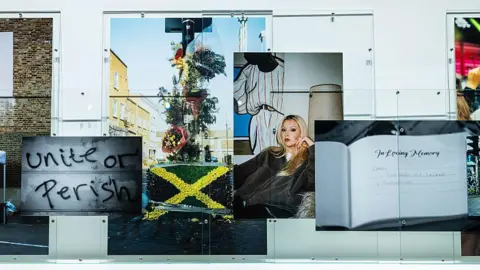
Mixed-race and non-binary, Matić has assembled photos, banners, dolls and sounds that illustrate the artist’s grapples with their place in modern Britain, as modern Britain grapples with its own identity. As Matić puts it, an “obsession with understanding Britishness, or not understanding it”.
The first thing visitors see is a photo of a St George’s flag hanging in a London pub window above a sign saying “Private party”. It sends an unintentional but unwelcoming message that encapsulates a bigger picture, in Matić’s eyes.
The artist “primarily works with photography and their work talks about identity, society and a sense of belonging”, exhibition curator Jill Iredale says.
There is a jumble of more snapshots from Matić’s life – Gaza and Black Lives Matter protests, sweaty clubbers, kissing couples, graffiti, parties. Meanwhile, a giant flag says “No room” on one side and “for violence” on the other – a wry reference to the hypocrisy the artist feels can be present in politicians’ words.
 EPA
EPAThere’s also a cabinet holding 45 second-hand black dolls that Matić has collected.
“It makes you think about the way that they’re depicted, and about the representation of black people,” Iredale says. “The really startling ones struck me when we were installing them, like the really bright red lipstick that you get on what are essentially babies, and some with bright red or orange eyes.”
The Guardian’s art critic Adrian Searle said of Matić’s work: “Peace and protest, friendship and family are all mixed together, along with contested ideas of nationhood and belonging.”
Matić’s exhibits “express Gen Z’s spirit with panache”, wrote the Telegraph’s Alastair Sooke.
Floating fantasy kingdom
 EPA
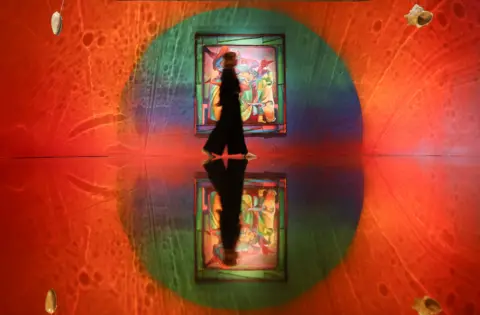
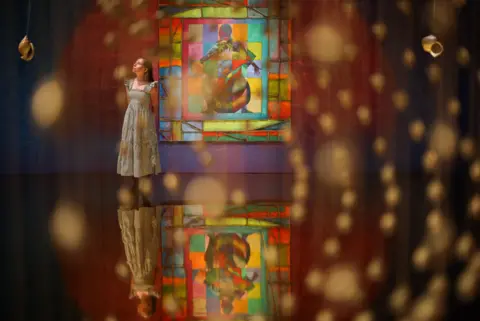
EPAYou must take off your shoes (or put on shoe coverings) to step onto the reflective, shiny gold floor in Zadie Xa‘s gallery – heightening the feeling that you’re walking into an otherworldly fantasy kingdom.
The London-based Canadian-Korean artist has created cloth patchwork paintings using the bojagi technique – resulting in stained glass-style pictures showing scenes inspired by Korean folk art and ocean creatures.
There are also shells hanging from the ceiling, as well as 665 small traditional bells arranged in a shell shape.
Combined with the coloured, shimmering floor and walls, and a soundtrack of muffled voices, gongs and bird calls, it all creates a powerful if unnerving feeling of floating in another realm.
 EPA
EPAIt is “the most sensually alluring” of the four nominees’ exhibitions, Durrant wrote.
Sunday Times critic Waldemar Januszczak told BBC Radio 4’s Front Row it was an “extraordinary installation”.
“It’s a sort of new-age empire. You walk in and you’re not sure if you’re going into space or underwater or what,” he said. “It genuinely is transportative. You wander into there and you go to another world.”
Bursts of energy and colour
 PA Media
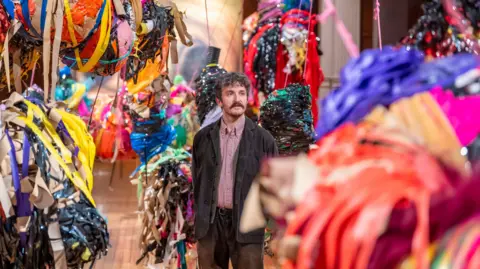
Large multi-coloured sculptures – haphazardly wrapped in brightly-coloured layers of ribbons, string, cardboard strips and shiny VHS tape – hang in mid-air in Nnena Kalu‘s room. Some take animalistic forms, looking like out-of-control piñatas.
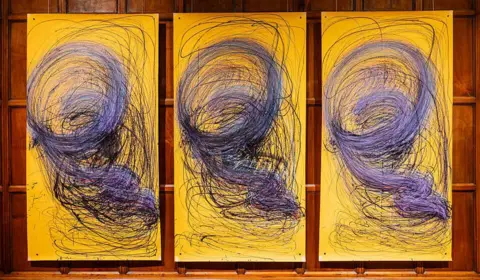
Meanwhile, on the walls are large sheets of colourful paper covered in swirled patterns, some like tornados or whirlpools. They all come in pairs or trios, with the images in each set similar but not exactly the same.
Kalu is a learning disabled artist with limited verbal communication, and has been a resident artist with Action Space, which supports artists with learning disabilities, for more than 25 years.
Her “bursts of energy and colour” were made after a period of being unable to work on her art during Covid, Iredale explains. “So you get these big vortexes, it’s quite intense, with these outbursts of activity.”
 Getty Images
The sculptures and drawings are both made up of seemingly endless loops of swirls, squigles and strands.
“The sculptures are very much the same as the shapes that you get on the drawings,” Iredale says. “They’re kind of 3D embodiments of the drawings, but they’re produced independently.”
The Guardian’s Searle wrote about the drawings: “They are riotous and rhythmic, purposeful and compelling. There’s no fudging. Kalu deserves to win this year’s Turner Prize.”
Haunting war zones
 PA Media
Baghdad-born Mohammed Sami, who began his career painting official portraits of Iraqi dictator Saddam Hussein, is favoured by other critics.
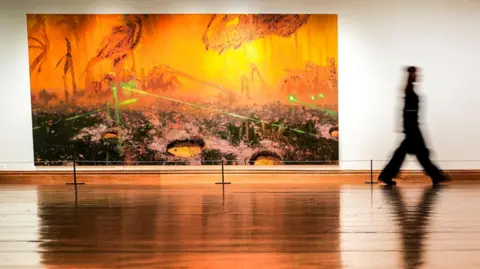
“To my mind, only Sami deserves to win – in large part because of a single, remarkable new painting,” said the Telegraph’s art critic Alastair Sooke.
The Hunter’s Return, he said, is “an instant-classic contemporary history painting that perfectly expresses the dark, disoriented zeitgeist of our age of perma-conflict”.
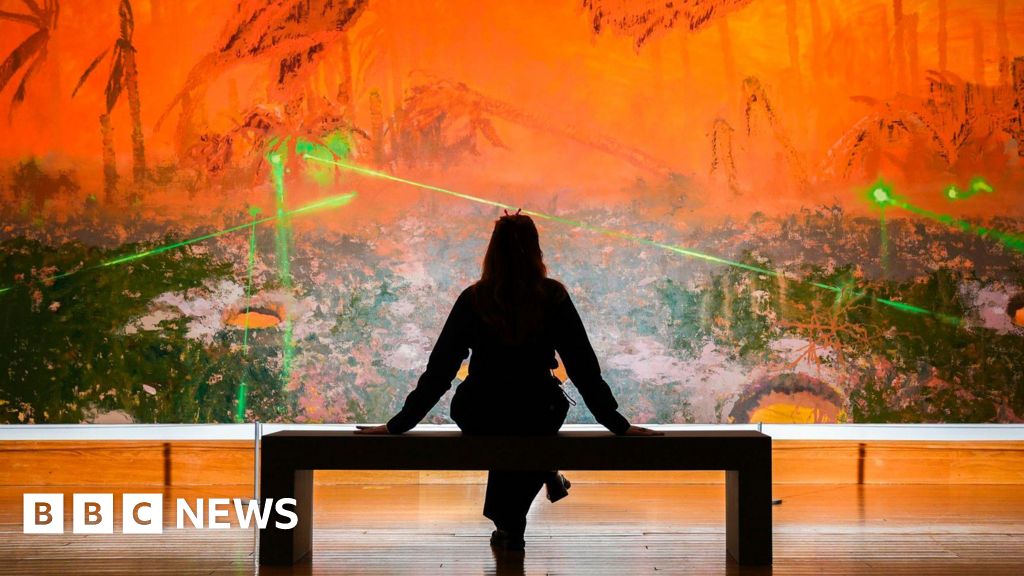
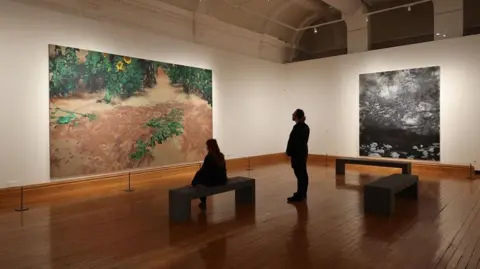
The Hunter’s Return is a vast canvas depicting a war zone, with toppled trees and craters lit up by a fiery sky, and with green military laser beams emerging from the smoke.
 EPA
EPAMost of Sami’s other paintings are also striking and huge, and give a visceral sense of the aftermath of destruction without actually including any people or identifying which battlefield they intend to show.
“They’re always hung quite low as well, so the idea is that you could step into the pictures,” says Iredale.
Another picture shows horses’ hoofmarks that have churned up a sunflower field; one is full of shards of flying crockery frozen in mid-explosion; and a third features a shadow of helicopter blades (or are they?) over empty palace chairs.
The Sunday Times’ Januszczak also judged Sami to be the best of the bunch. His exhibition “creates a feeling of tension, of disturbance, of unease, but it doesn’t spell anything out”, the critic said. “I found it absolutely gripping and very powerful.”
The Turner Prize exhibition is at Cartwright Hall in Bradford until 22 February.