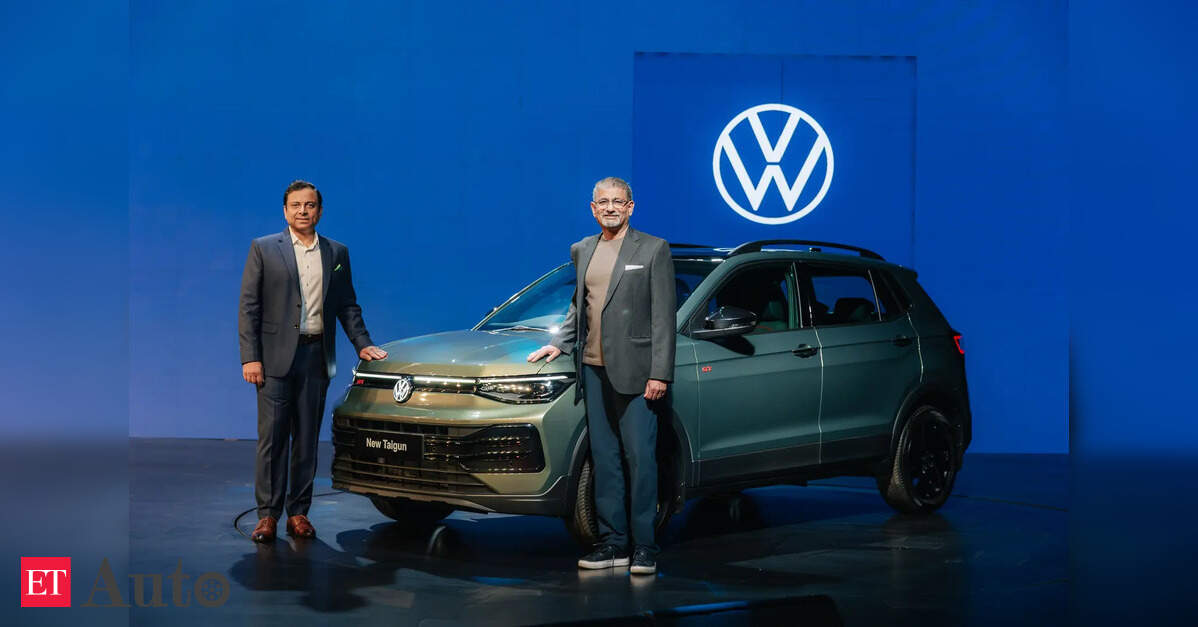

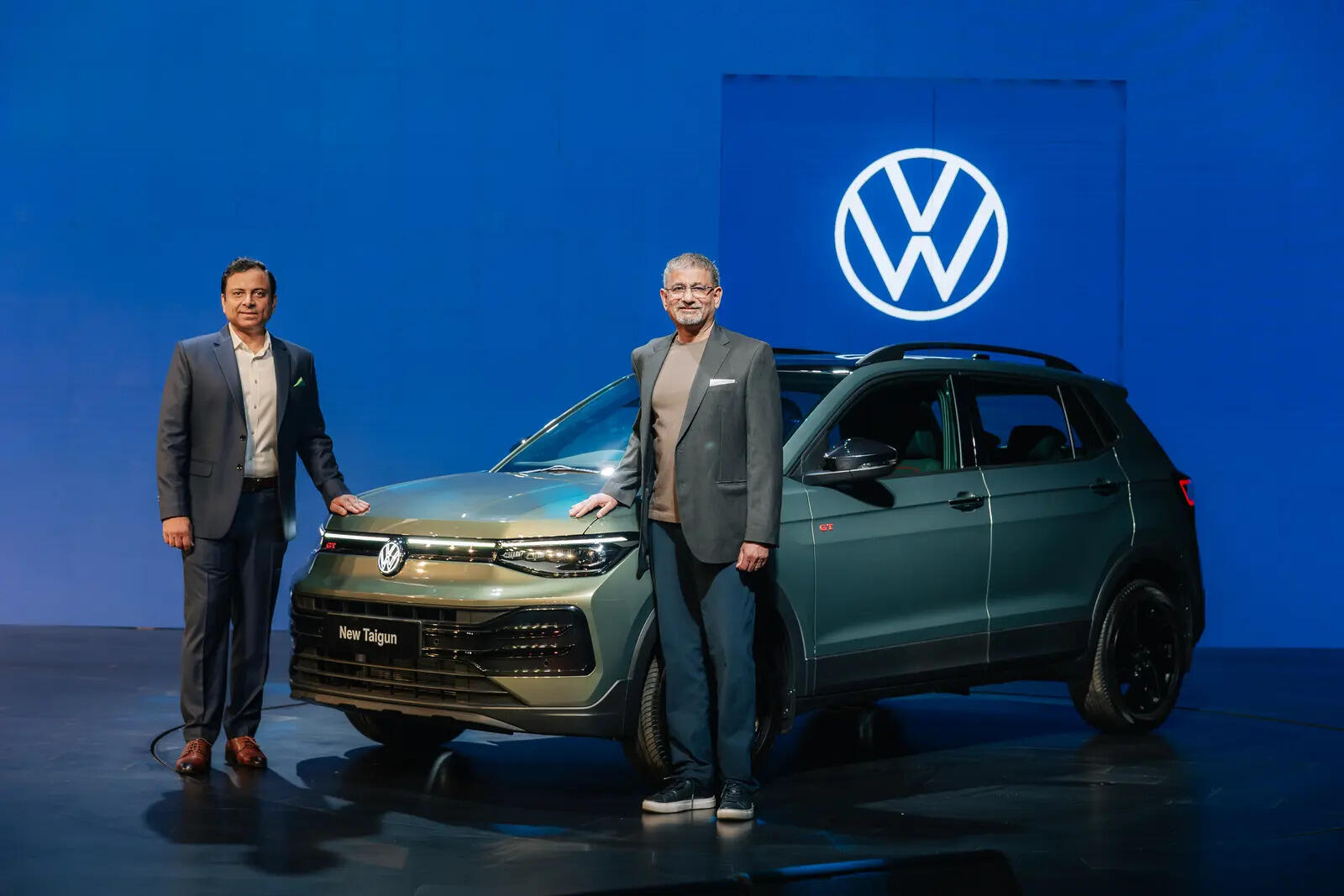
 Nitin Kohli- Brand Director at Volkswagen Passenger Vehicle and Piyush Arora Managing Director & CEO at Volkswagen India
Volkswagen India is betting big on its facelifted Taigun, with the company expecting to surpass the industry’s usual 18–22 per cent sales bump from model updates even as competition intensifies in the already crowded mid-SUV segment.
“Any model interventions that happen in the market, the sales numbers go up from 18 per cent to about 22 per cent. The new Taigun should be doing higher than about 22 per cent over the earlier one, we should be beating this number,” said Nitin Kohli, Brand Director, Volkswagen India, at the sidelines of the model launch.
Kohli, however, refrained from sharing absolute numbers.
The group is also planning 18–19 product interventions this year, with at least four coming from the Volkswagen brand.
“Every quarter you will see one action from our side, we remain committed on that,” Kohli added.
Performance over powertrain diversity
As the current scenario of passenger vehicles in India increasingly defined by multiple powertrain options—petrol, diesel, CNG, hybrids, and EVs—Volkswagen’s India portfolio remains petrol-led, a decision tied closely to brand identity.
Kohli emphasised this positioning, saying, “from the Volkswagen customer’s perspective, it is the performance that drives the business for us.” He highlighted that variants like the GT+ and GT Line contribute nearly 60 per cent of total sales, reinforcing the brand’s performance-first approach.
However, CEO Piyush Arora hinted at the move towards electrification, stressing that timing will depend on scale and localisation viability.
“The future is electrification, it is not a matter of if, but when we introduce the EVs,” Arora said, adding that EVs would make the most sense when manufactured locally.
He also highlighted the role of transitional technologies, noting, “there might be transitional needs, hybrids, mild, strong, plug-in, ethanol blending will play a role.” However, regulatory clarity remains a key prerequisite before scaling these solutions.
On CAFE norms, Arora acknowledged that “regulation clarity still needs to come, there have been a lot of deliberations, but there is not really a clarity.” In the absence of firm guidelines, Volkswagen is keeping its options open, evaluating multiple pathways while aligning its long-term strategy with electrification.
External headwinds and strategic resilience
Amid the ongoing West Asia turmoil triggering macroeconomic uncertainties, Volkswagen India has not yet faced direct operational disruptions, however, the management said risks are being closely monitored.
“The turmoil has not impacted our operational business so far, but some cascading effects can come, Arora said” He pointed to potential challenges such as rising commodity prices and supply chain delays, adding that prolonged disruptions could eventually influence pricing decisions.
However, he also highlighted improved preparedness post-pandemic: “our supply chain resilience has increased substantially, we have learnt a lot.”
Exports and global linkages
Exports continue to play a crucial role in Volkswagen India’s business model, accounting for roughly 30 per cent of production.
Looking ahead, the company is exploring new geographies. “North Africa is something which we are looking at more, Egypt can be one opportunity,” Arora noted, framing exports as both a growth and risk-diversification strategy.