
 The vehicle comes with an 8-year battery warranty, flexible ownership programs (Assured Buy Back & Battery as a Service), and an expanding charging ecosystem.
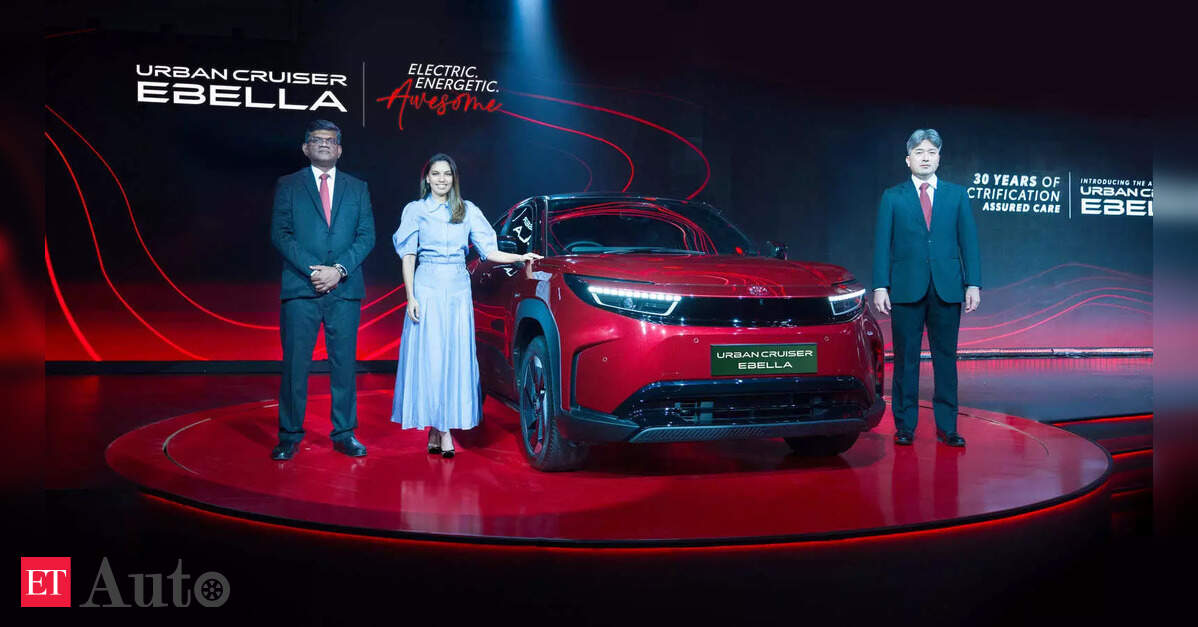
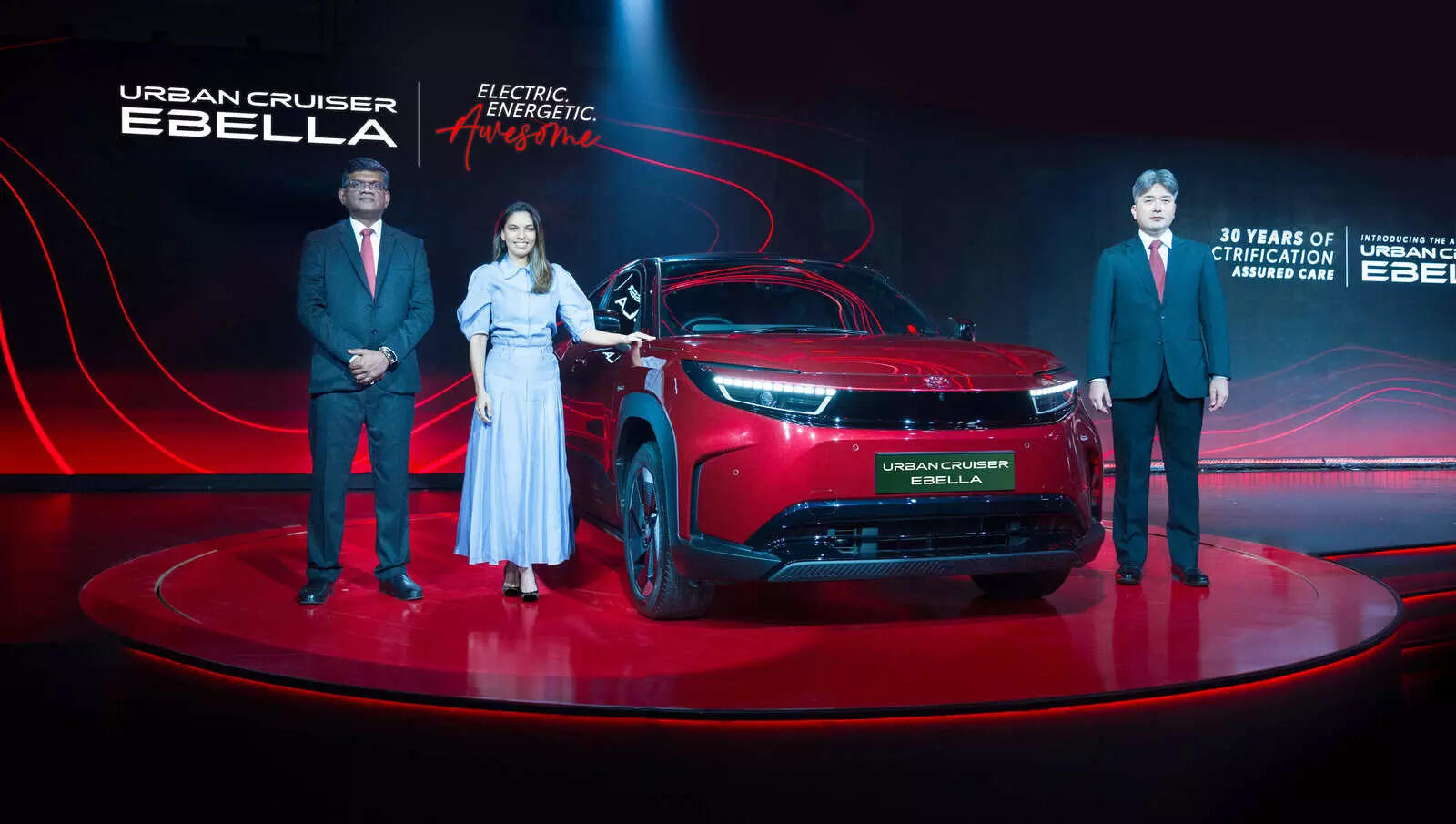
“We are not late in launching electric vehicles (EVs) in India, the market is just starting,” said Tadashi Asazuma, deputy MD of Toyota Kirloskar Motors. The world’s biggest carmaker on Tuesday unveiled its first battery electric, Urban Cruiser Ebella, in India.
Ebella has been jointly developed under the global Toyota-Suzuki alliance. While many think Toyota has been a laggard to the EV party, the company has remained steadfast to its oft touted, multi-powertrain approach.
“Our multi-powertrain pathway is best to meet each market’s reality. We operate in 190 markets globally …we are not late in India, we saw a market opportunity…the Indian market’s point of view on electrics is still at the beginning,” Asazuma said.
The Ebella, which is a rebadged eVitara, was unveiled during the day but price and variants will be announced in a few weeks.
The Ebella launch comes after a year of some success for Toyota in India, with market share jumping almost two percentage points to over 7 per cent in calendar 2025, the highest-ever. Vikram Gulati, Country Head and Executive VP, said the company sold nearly 3.88 lakh vehicles in 2025, with domestic sales growing by nearly a fifth and exports (at about 27,000 units) up by over 40 per cent.
Does Toyota have a double-digit market share target anytime soon? Gulati shrugged off the question, saying the company does not share any target on sales number nor on market share. “We just want to delight customers,” he said.
We wanted to use technology as a means to accelerate the pace of EV adoption, make an impact at scale now instead of in the futureVikram Gulati
Multi-powertrain approach
Gulati referred to Toyota’s three-decade old journey in the world of electric vehicles, saying consumer reluctance to accept battery electrics then spurred the company to look for alternatives without halting the progress of technologies which could propel the world to a future beyond fossil fuels. “We wanted to use technology as a means to accelerate the pace of EV adoption, make an impact at scale now instead of in the future. As range anxiety, etc, made consumers hesitate in EVs, we innovated and came up with hybrids, etc, to bring the consumer back”.
Toyota has sold 38 million electrified vehicles in 30 years and strong hybrids have given us a lead in electric powertrain paths, he said. Now, Toyota is doing pilots with ethanol-based hybrids in India.
With the All-Electric Urban Cruiser Ebella, we remain firmly committed to advancing our support towards India’s transition to greener mobilityMasakazu Yoshimura
Global alliance
The global alliance between Toyota Motor Corporation and Suzuki Motor Company was forged as a strategic partnership to leverage the former’s leadership in electrification and autonomous technology and Suzuki’s expertise in compact vehicles.
It involves mutual shareholdings. Some reports suggest that in 2026, the alliance has transitioned from simple rebadging to deep technological integration, particularly in EVs. The Ebella is proof of this deepening, a product which has been jointly developed and which is based on a shared platform.
The Ebella comes in two battery options – 48 kWh and 61 kWh, and a certified range of up to 543 km. It is built on a dedicated BEV platform and supports both AC and CCS2 DC fast charging.
Masakazu Yoshimura, Chairman, MD & CEO, TKM said, “The introduction of All-Electric Urban Cruiser Ebella is a key enabler towards furthering our multi-pathway approach, where our aim is to contribute towards carbon neutrality while leaving no one behind. With the All-Electric Urban Cruiser Ebella, we remain firmly committed to advancing our support towards India’s transition to greener mobility.”
The vehicle comes with an 8-year battery warranty, flexible ownership programs (Assured Buy Back & Battery as a Service), and an expanding charging ecosystem.
Capacity expansion
TKM has an installed capacity of 3.42 lakh units per annum at two plants in Bengaluru, a third facility should come on stream by the beginning of next calendar year, which will add another one lakh units. A greenfield manufacturing facility is also upcoming at Chhatrapati Sambhaji Nagar , which will add installed capacity in phases beginning 2029.
Gulati said that the alliance with Suzuki provides TKM a “fair number” of vehicles per year but declined to give details. The Ebella is also expected to be supplied by the Maruti Suzuki plant in Gujarat.
No IPO
On reports of the Japanese parent considering an initial public offer, Gulati rubbished them, saying there was no truth to these reports.