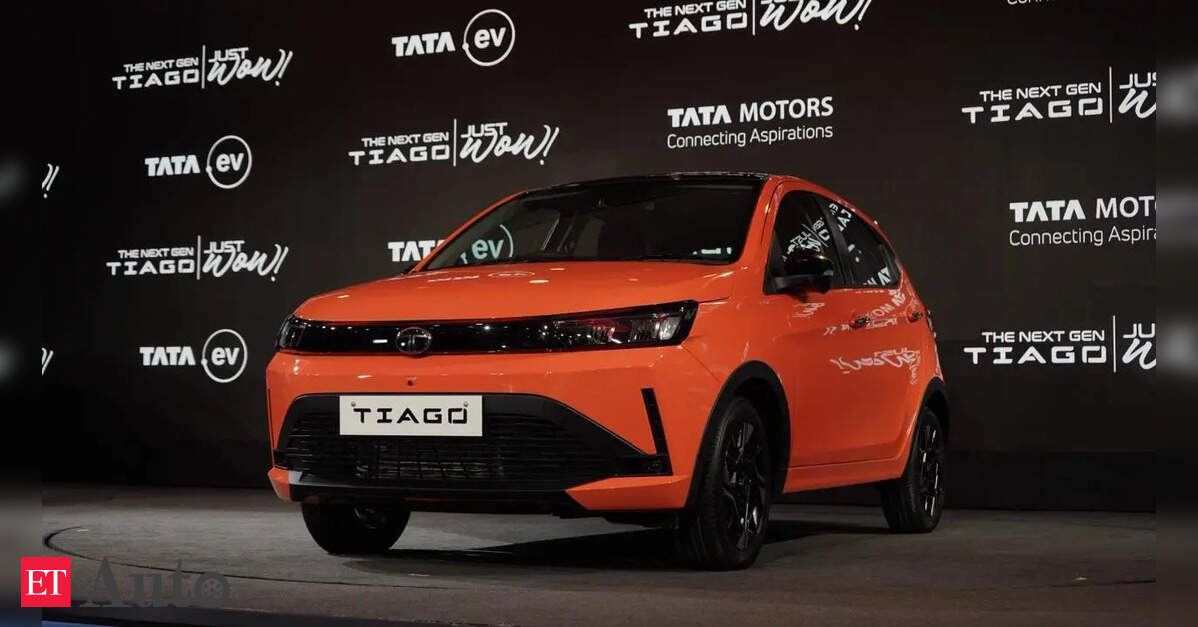

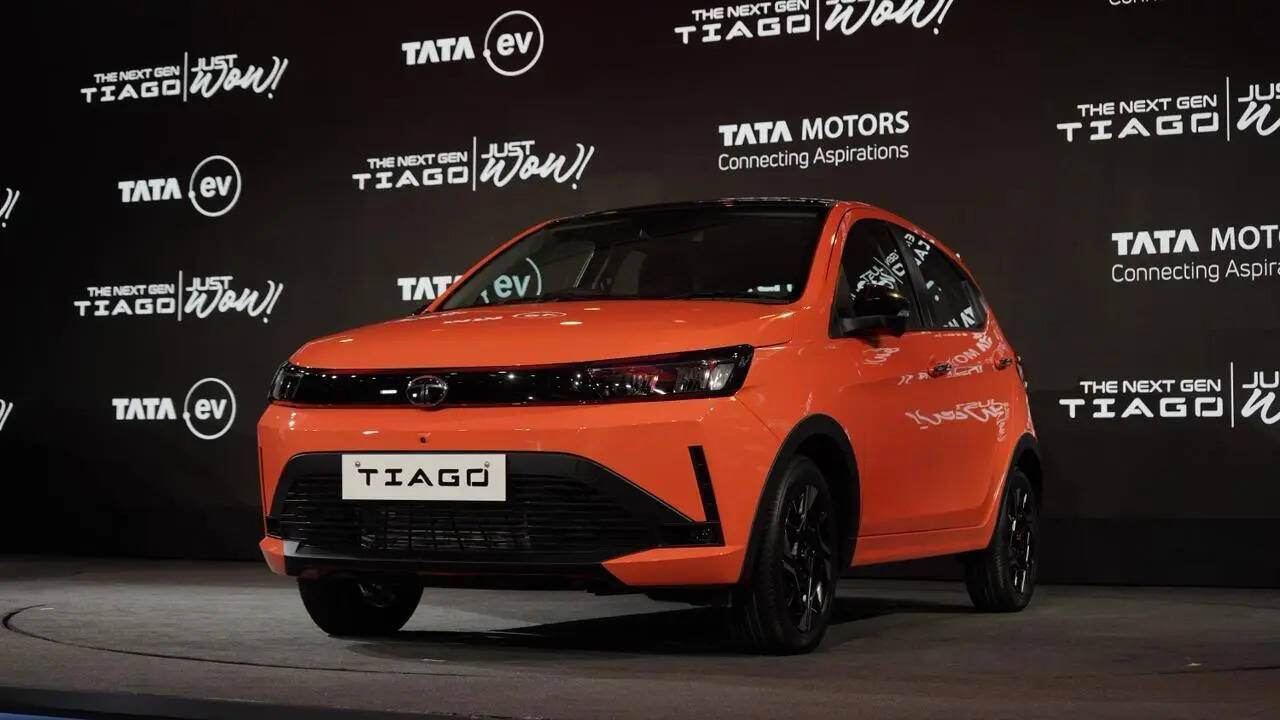
 Tata Motors sees the refreshed Tiago as a key entry-level car that blends affordability with a more premium design and interior experience.
At a time when hatchbacks are steadily losing ground to SUVs and crossovers in India, Tata Motors is attempting something few automakers are willing to do, reinvest meaningfully in the segment. The refreshed Tiago aims to be more than a cosmetic update for the homegrown automaker.
For Martin Uhlarik, Vice-President and Head of Global Design at Tata Motors, the Tiago occupies a far more strategic space than its pricing may suggest. Sitting at the entry point of Tata’s portfolio, the hatchback often becomes a customer’s first interaction with the brand and increasingly, their first exposure to premium automotive design.
“Even if people have a fixed budget, it doesn’t mean they have lower expectations,” Uhlarik told ETAuto in an exclusive interaction. “Their aspirations are the same as anyone else’s. They’re only limited by what they’re willing to spend.”
That philosophy appears to underpin Tata Motors’ broader design reset, one that began with the Sierra concept revival and now trickles down even into its most affordable products.
The ‘Sierra effect’ on Tata’s design language
The last time ETAuto met Uhlarik was at the Bharat Mobility Expo, where Tata Motors had showcased the Sierra prototype alongside the Avinya concepts, vehicles that signalled a dramatic evolution in the company’s design direction. According to Uhlarik, the Sierra represents more than a nostalgic revival. Internally, it functions as a new benchmark for the brand.
“The Sierra was almost like a reset for us in terms of design,” he said. “Every product after the Sierra has to meet that same benchmark and consistency.”
That consistency, however, does not imply uniformity. Tata’s challenge now lies in building a cohesive family identity while ensuring each product retains its own character.
In the Tiago’s case, that meant creating a car that visually feels larger, more modern, and more sophisticated without significantly altering its fundamental footprint or affordability equation.
The redesign focuses heavily on proportions and visual presence. A flatter nose, sharper corners, revised lighting signatures, and a wider stance attempt to elevate the hatchback’s road presence, a crucial factor in an Indian market increasingly dominated by SUV-inspired aesthetics.
Why the cabin became the priority
Uhlarik admits that the interior became the focal point of investment during the Tiago refresh.
“We completely redesigned the interior. Nothing was carried over from the previous car,” he said.
This decision reflects a larger industry trend: Indian consumers are now evaluating value through experience rather than just specification sheets.
The modern Indian buyer even in the entry-level segment expects soft-touch materials, larger screens, refined interfaces, and premium tactile quality. The cabin is no longer merely functional; it has become emotional territory.
“There has to be the right balance between technology, visual richness, and quality,” Uhlarik explained. “If a cabin looks too empty, people immediately perceive it as cheap.”
The comment is particularly relevant at a time when automakers globally are rethinking minimalist interiors. Over the past few years, the industry aggressively moved towards touchscreen-dominated cabins inspired by smartphones and Tesla-style interfaces. But customer fatigue is beginning to surface.
Interestingly, Tata Motors appears to be reassessing that approach.
“We’re now exploring a hybrid philosophy,” Uhlarik revealed. “Some functions need physical tactility. Physical controls also act as jewellery elements inside the cabin.”
The acknowledgment is significant because it reflects a growing shift within automotive design departments globally: the realisation that digital-first interiors may not always translate into intuitive user experiences.
‘Designing a budget car Is harder than designing a premium one’
One of the more revealing moments during the interaction came when Uhlarik described affordable car design as “one of the hardest products to design.”
Unlike premium vehicles where designers often have greater flexibility, affordable products operate under rigid cost structures where every design decision competes for financial justification.
“Designing under tighter restrictions actually forces greater creativity,” he said. “You constantly evaluate where the money creates the most value for the customer.” That balancing act becomes even more complex when a product supports multiple powertrains — petrol, CNG, and EV, simultaneously.
While Tata’s EV lineup is gradually developing its own visual identity, Uhlarik believes the differentiation must remain purposeful rather than performative.
“I don’t want products to look different just for the sake of being different,” he said. “Design should honestly reflect what the product is.”
This explains why the Tiago EV retains much of the ICE version’s architecture while introducing subtle EV-specific elements, particularly at the front fascia where cooling requirements are reduced.
EVs are no longer an experiment
Perhaps the clearest shift visible in the conversation was Tata Motors’ confidence regarding electric mobility. A few years ago, EV adoption in India was largely driven by early adopters willing to overlook infrastructure and range anxiety. Today, according to Uhlarik, the conversation has fundamentally changed. “EVs are becoming mainstream now,” he said.
The reasons, he believes, are layered. Economics remains the strongest driver. Rising fuel prices and improving battery efficiencies are making EV ownership increasingly practical for urban consumers. Simultaneously, the visibility of charging infrastructure has begun creating
psychological reassurance.
“People now see chargers around them, in public spaces, residential areas, workplaces. That changes confidence levels,” he noted. Then comes the driving experience itself.
Despite calling himself “a petrolhead,” Uhlarik admits he increasingly prefers driving an EV for daily commuting. “It gets me to work more relaxed,” he said with a laugh. “There are fewer distractions.”
That comment perhaps captures the broader emotional proposition EVs are beginning to offer not just sustainability or lower running costs, but a calmer, less fatiguing urban driving experience.
Why Tata still believes in hatchbacks
Even as hatchback market share continues to decline in India, Tata Motors sees strategic value in maintaining a strong foothold in the segment. For the company, the Tiago functions as a “capture product”, an entry point into long-term brand loyalty.
“The Tiago often becomes a customer’s first Tata car,” Uhlarik explained. “If that relationship starts positively, there’s strong potential for them to move up the portfolio later.”
That portfolio now spans everything from compact hatchbacks to electric SUVs and upcoming lifestyle products like the Sierra. The stakes, therefore, extend beyond Tiago sales numbers alone.
Still, Uhlarik hinted at ambitious expectations for the refreshed hatchback, suggesting that the new versions could potentially double sales volumes compared to the outgoing model.
Whether that optimism materialises remains to be seen. India’s market momentum currently favours SUVs overwhelmingly. But Tata Motors appears convinced there is still room for a well-designed, aspirational urban hatchback, particularly one that democratizes premium design.
And perhaps that is the larger shift Tata Motors is betting on: in today’s India, aspiration is no longer segmented by price.
Or as Uhlarik summed it up through an old automotive industry principle: “Give customers what they want for the price they can afford.”