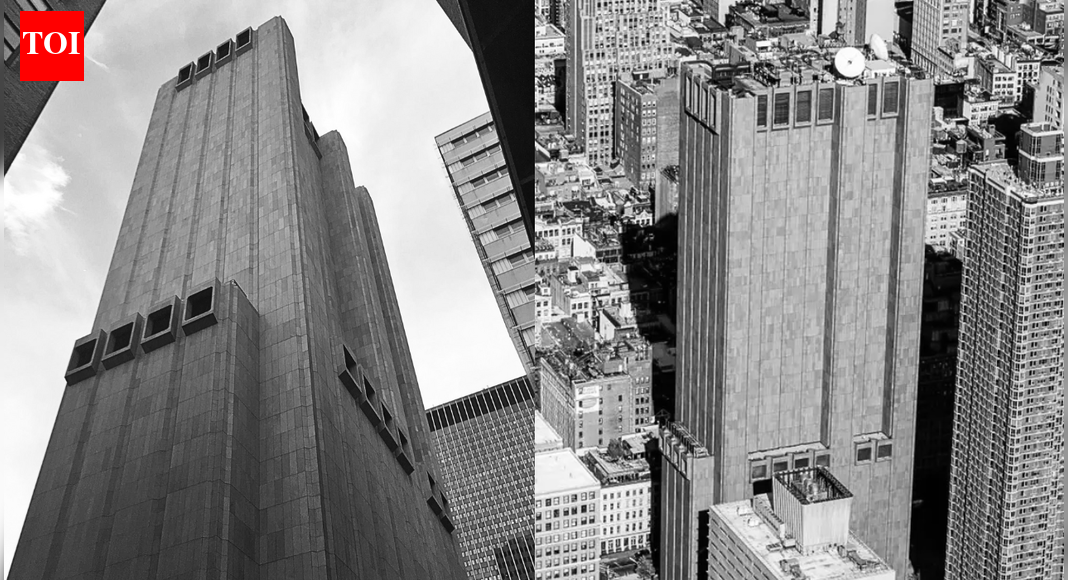

33 Thomas Street/ Image:X
In a city obsessed with views, one of Manhattan’s tallest towers has none. At 33 Thomas Street in Lower Manhattan, a 550-foot concrete block rises above the Civic Center with no windows, no visible life, and no obvious explanation. When a recent video of the building resurfaced on Reddit, the old question came back with force: what exactly is going on inside this thing? Even celebrities have joined in the curiosity. Back in 2017, Tom Hanks posted a photo of the structure on X and wrote: “This is the scariest building I’ve ever seen! WTF goes on inside?” Years later, the tower still offers no clues from the pavement – just blank granite walls and a handful of ventilation openings.
What 33 Thomas Street was actually built for
The building is not an abandoned relic or an art project. It was built in the 1970s for a very specific purpose: to carry phone calls. Known as the AT&T Long Lines Building, 33 Thomas Street was designed to house massive switching equipment for long-distance telephone traffic. In the pre-internet era, those systems needed floors that were far taller than offices and strong enough to support extremely heavy machinery. Each storey inside is around 18 feet high, which is why the tower looks more like a 40-storey skyscraper but technically contains 29 floors. According to historical accounts of its construction, AT&T asked architect John Carl Warnecke to design it like a fortress. The brief included the ability to withstand a nuclear blast and keep operating for up to two weeks afterwards. To achieve that, the building was constructed with thick concrete walls, internal fuel and water reserves and its own power supplies. Windows, in that context, were a liability: no use for machines, and one more structural weakness in a doomsday scenario. For decades, 33 Thomas Street functioned as a core long-distance telephone switching hub. Around 1999, AT&T shifted most of its long-distance traffic management elsewhere, but the building did not fall out of use. It still hosts telecommunications infrastructure and high-security data-centre space, and is now commonly referred to simply by its address.
The TikTok explanation: A hub in a much bigger hidden network
The latest wave of interest came after TikTok creator Eric Guidry (@e.guidry) posted a video about the tower and similar windowless buildings across the US. In his clip, he points to 33 Thomas Street in New York, a windowless structure in San Francisco, others in Chicago and Austin, and says they belong to a wider pattern. Guidry describes them as part of AT&T’s historic “long lines” network – central switching and routing hubs placed in big, populous cities. Before digital infrastructure, he explains, phone calls had to be physically switched at these locations, using vast racks of electromechanical or early solid-state equipment. Because the sites were built for machines rather than people, they didn’t need windows or natural light. He also describes 33 Thomas Street as one of the “most secure towers in the world”, noting that it is designed to run independently for up to two weeks and was built with survivability in mind, including in the event of a nuclear strike “within reason”. Much of the old telephone gear has since been upgraded to digital equipment, but the core function – moving enormous volumes of communications traffic – remains. Guidry makes one more point that underlines how central these buildings still are: if you are watching a video online in the US, there’s a decent chance some part of that traffic has passed through a facility like this on the way to your screen.
AT&T’s other windowless fortresses across the US
33 Thomas Street isn’t a one-off oddity. AT&T operates multiple windowless or semi-windowless telecommunications buildings across the United States, often in the centre of major cities. Internally, they are known as “central offices” or “switching centres”. While there is no single public list, reporting and property records have identified at least eight heavily fortified sites that share similar design features and functions. Online investigations and business reporting have linked facilities in Atlanta, Chicago, Dallas, Los Angeles, New York City, San Francisco, Seattle and Washington DC to this network. Many of them were constructed or expanded during the Cold War and are designed to survive disasters, with thick walls, limited or blacked-out windows, and large towers or antenna structures on the roof that once handled high-capacity microwave or radio links. According to material cited in those reports, these buildings originally handled long-distance telephone switching and now also serve as major hubs for internet and data traffic. That means emails, calls, and web traffic can route through them as part of normal network operations, even if the average person has no idea the building exists.
The surveillance allegations – and why the mystery never quite goes away
The air of secrecy around these sites has inevitably attracted attention from journalists and civil liberties groups. Online news outlet The Intercept, drawing on documents and interviews, has previously reported that several AT&T facilities in cities including Atlanta, Chicago, Dallas, Los Angeles, New York, San Francisco, Seattle and Washington DC have played a role in US National Security Agency (NSA) surveillance programmes. Those reports, based on material linked to whistleblower disclosures and unnamed sources, describe AT&T as a key private-sector partner in large-scale data collection efforts. According to those accounts, AT&T’s central offices have been used as locations where data is filtered, mirrored or routed in ways that allow intelligence agencies to review vast quantities of communications. The Intercept has argued that the volume of traffic flowing through 33 Thomas Street and similar hubs makes them particularly valuable, because they sit at choke points where phone calls and internet connections converge. AT&T, for its part, has historically said it complies with lawful requests from authorities but does not comment in detail on security partnerships. The NSA does not publicly confirm the identity of specific sites. As a result, much of what may or may not happen inside 33 Thomas Street and its sister buildings remains opaque. What is confirmed is the long-standing cooperation between major telecoms providers and national security agencies; what remains in the realm of reporting and inference is the precise role of each individual structure.
Why this particular building keeps haunting people’s imaginations
Part of the enduring fascination with 33 Thomas Street is visual. In a city where almost every tower markets its views, this one refuses to show anything at all. There are no office workers at the windows, no visible lights in the evenings, no hints of daily human routine. It looks like infrastructure, not workplace; a machine housing, not a corporate HQ. But the other part is psychological. The building sits at the intersection of three things people are increasingly anxious about: mass surveillance, critical digital infrastructure, and the feeling that much of modern life runs on systems we never see. It is both completely banal, a big telecoms box, and a plausible symbol of something larger and more secretive.No one expects perfect answers anytime soon. Much like the information flowing through it, whatever 33 Thomas Street does is mostly invisible. And whether it’s simply a relic of old telephone architecture, a key artery of American data routing, or a discreet organ of national surveillance infrastructure, one thing is unavoidable: it’s one of the few skyscrapers in New York that invites speculation simply by refusing to reveal anything at all. Go to Source