
Lucy WilliamsonMiddle East correspondent, Jerusalem

 Yasser Abu Shabab/Facebook
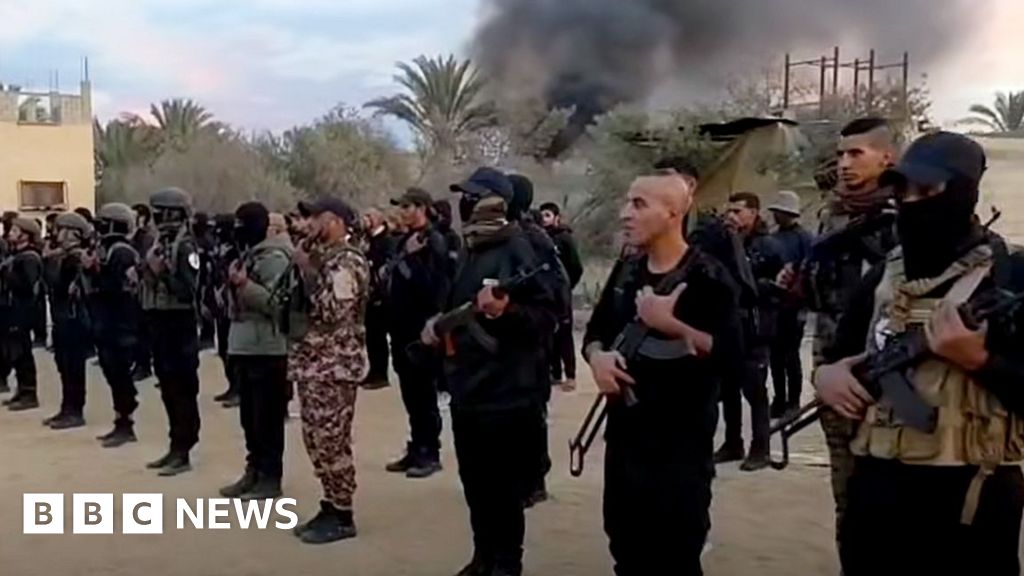
Urgent questions are being raised over a patchwork of armed groups that have emerged to fight Hamas in Gaza over recent months.
They include groups based around family clans, criminal gangs and new militia – some of which are backed by Israel, as its prime minister recently admitted.
Elements within the Palestinian Authority – which governs parts of the occupied West Bank and is a political rival to Hamas – are also believed to be covertly sending support.
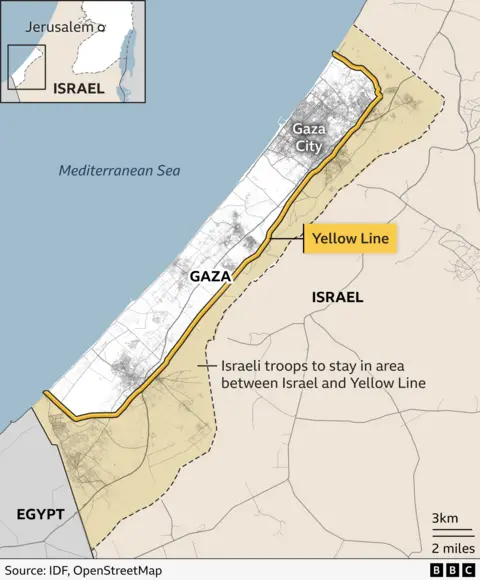
But these militia – each operating in its own local area inside the 53% of Gaza’s territory currently controlled by Israeli forces – have not been officially included in US President Donald Trump’s peace plan, which calls for an International Stabilisation Force and a newly-trained Palestinian police force to secure Gaza in the next stage of the deal.
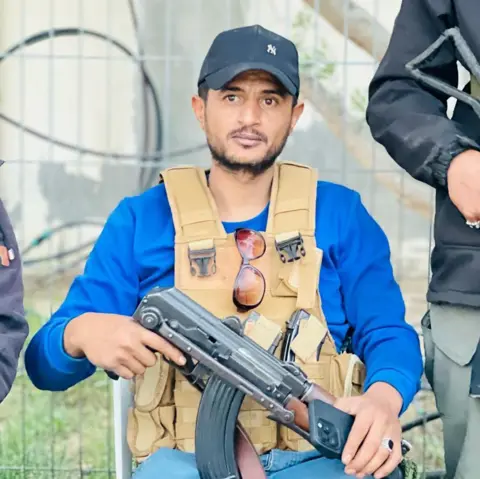
One of the largest militia is headed by Yasser Abu Shabab, whose Popular Forces operate near the southern city of Rafah.
In one recent social media video, his deputy talks about working in co-ordination with the Board of Peace – the international body to be tasked with running Gaza under the plan.
 Hossam al-Astal/Facebook
Hossam al-Astal, who leads a militia called the Counter-Terrorism Strike Force near the southern city of Khan Younis, told Israeli media this week that “US representatives” had confirmed his group would have a role in Gaza’s future police force.
A US official said they had nothing to announce at this time.
Earlier this month, Astal grinned when I asked if he had spoken to the Americans about the future, and told me he would share the details soon.
I asked if those conversations left him happy.
“Yes,” he said, with a big smile.
 Hossam al-Astal
Hossam al-Astal once worked for the Palestinian Authority. His group is small – maybe tens of fighters – but is increasingly confident, and runs a well-supplied tent city near Khan Younis.
“Let’s say it’s not the right time for me to answer this question,” Astal smiled when I asked if Israel was supplying him. “But we co-ordinate with the Israeli side to bring in food, weapons, everything.”
I asked how he paid for them.
“People all over the world are supporting us,” he replied. “It’s not all from Israel. They claim Israel is the only one supporting us and that we are agents of Israel. We are not Israel’s agents.”
He told me tens of families had come to live in his new site, just inside the Yellow Line that marks the territory currently controlled by Israel under the ceasefire deal – and that more people were arriving every week.
“We are the next day for the new Gaza,” he told me. “We have no problem co-operating with the Palestinian Authority, with the Americans, with anyone who aligns with us. We are the alternative to Hamas.”
But many Gazans – including those disillusioned with Hamas – are unhappy with the new power given to these small and fragmented armed groups.
“Only a small number of men who have no religion, faith, or ethics have joined these criminals,” said Saleh Sweidan, who is currently living in Gaza City. “Gaza’s government was ruling us, and although there were many burdens on civilians, any government is better than gangs.”
“These groups that co-operate with the occupation [Israel] are the worst thing that the war has produced,” said Zaher Doulah, another Gaza City resident. “Joining them is not only dangerous, it is a great betrayal.”
 Ashraf al-Mansi
Thirty-one year old Montaser Masoud told me he had joined al-Astal’s new tent city two months ago with his wife and four children, crossing the Yellow Line at night to avoid Hamas, and after coordination with Israeli forces.
But he said relatives who had stayed behind in Hamas-controlled areas were critical of the move.
“They’ve been harassing us, saying what we’re doing it wrong and has no future,” he told me. “I tell them that they’re the ones we worry about, because they live outside the Yellow Line and anyone from Hamas could hide next to them, and they could be bombed.”
As we spoke by phone, the sound of heavy gunfire around him repeatedly punctured our conversation.
“It’s the [Israeli] army nearby,” he explained. “But it’s not a problem because we know we’re not the target.”
 Yasser Abu Shabab/Facebook
Several armed groups are now ranged against Hamas, with complex and overlapping ties.
Abu Shabab’s group, for example, is accused of looting aid trucks sent into Gaza during the war, and reports in Israel have also suggested that two of its members have previous links to the Islamic State group (IS).
“What’s wrong with it?” Israel’s Prime Minister, Benjamin Netanyahu, said last month in response to the news that his country had secretly backed militia groups. “It’s a good thing. It saves soldiers’ lives.”
Disclosing the information, he said, had “only helped Hamas”.

Netanyahu has insisted Gaza will not be run by either Hamas or its rival, the Palestinian Authority. Under the US peace plan, a non-political, technocratic committee of Palestinians will run Gaza in the short term under international oversight, until the PA reforms are complete.
But a senior Palestinian official has rejected Astal’s claims that his fighters will form part of the future police force there.
Maj-Gen Anwar Rajab, spokesman for the Palestinian Authority’s security forces, told the BBC that there could be no blanket integration of men from Gaza’s armed groups, some of which are backed by Israel.
“Israel might demand the integration of these militia, due to Israel’s own specific political and security considerations,” he said in an interview in the West Bank city of Ramallah. “But Israel’s demands don’t necessarily benefit the Palestinians. Israel wants to continue imposing its control in one way or another in the Gaza Strip.”
 ab.kaser/TikTok
The question of what will happen to Gaza’s new militia under a durable peace still remains unanswered.
Israel’s decision to back the enemies of their enemy in Gaza is a sign they have not learned from history, according to Michael Milshtein, formerly the head of Palestinian affairs for Israel’s military intelligence.
“This is the same risk the Americans took in Afghanistan 30 years ago,” he said. “They supported the Taliban against the Soviets, then the Taliban took the weapons they got from the Americans and used them against the Americans.”
He said Israel was now relying on groups with dubious pasts in the hope they would provide a political social and ideological alternative to Hamas.
“There will be a moment when they will turn their rifles – the rifles they got from Israel – against the IDF [Israeli Defence Forces],” he said.

Aside from helping to weaken Hamas, Israel’s support for armed groups could make it easier to divide Palestinian opposition to Israel, and maintain influence inside Gaza once its forces withdraw.
Some critics say that arming disparate local groups will make it harder to persuade Hamas to disarm, and for international forces to step into the role of securing Gaza.
But the risk for Israel is that the same groups it is helping to arm will one day become the new enemy it faces.
Forty years ago, it encouraged a hardline Islamist organisation in Gaza to offset the growing power of Palestinian leader, Yasser Arafat.
That organisation became Hamas.
Additional reporting by Naomi Scherbel-Ball, Samantha Granville and the Gaza freelance team