
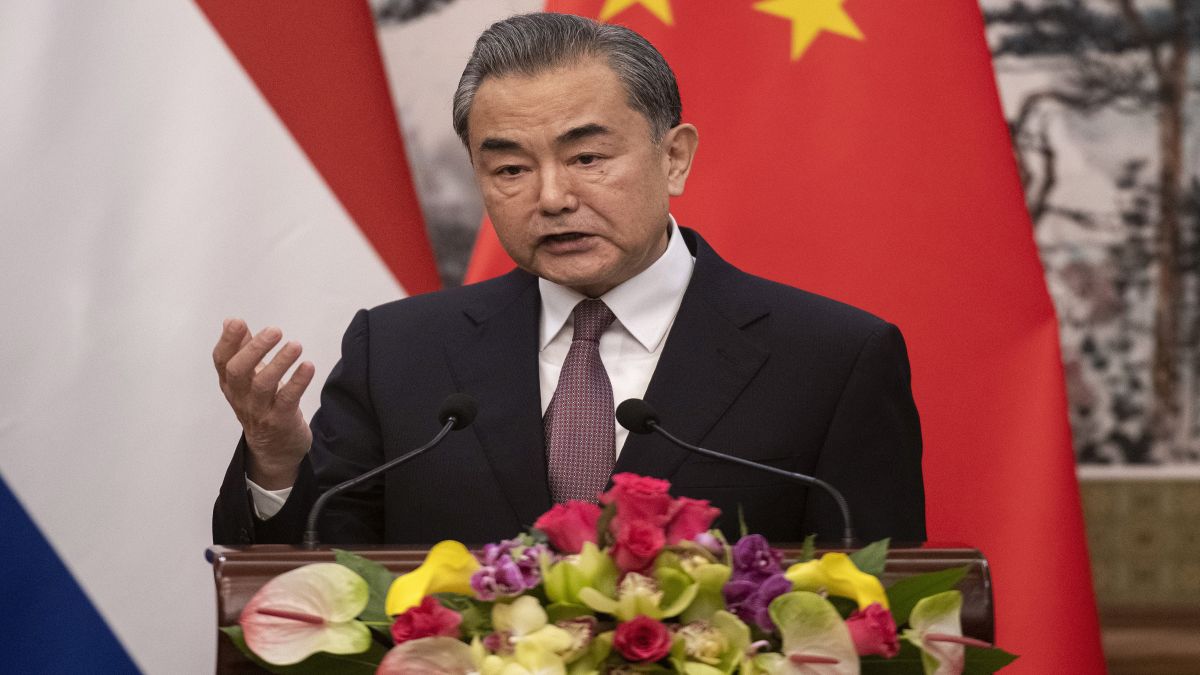
 "China’s Wang Yi in India: Why this visit is crucial amid Trump’s tariff wars")

Chinese Foreign Minister Wang Yi will begin a three-day official visit to India on Monday (August 18, 2025). His visit will focus on resuming high-level talks on the long-disputed border, strengthening bilateral channels of dialogue, and reviewing stalled economic engagements.
Wang Yi will meet External Affairs Minister S Jaishankar today (August 18). He will hold a fresh round of Special Representatives (SR) dialogue on boundary issues with National Security Advisor Ajit Doval tomorrow (August 19). The Chinese foreign minister will meet Prime Minister Narendra Modi at his 7 Lok Kalyan Marg later.
The timing of this trip is especially notable, as it coincides with heightened trade frictions between New Delhi and Washington under United States President Donald Trump, whose steep tariff measures have altered India’s strategic outlook.
The visit is expected to prepare the ground for Prime Minister Narendra Modi’s planned journey to China at the end of August, where he is likely to meet President Xi Jinping on the sidelines of the Shanghai Cooperation Organisation (SCO) summit in Tianjin — his first such trip in seven years.
How India-China ties are slowly thawing
Boundary talks set to resume
The Ministry of External Affairs has confirmed that Wang Yi will hold the 24th round of Special Representatives’ (SR) Talks on the India-China boundary issue with National Security Advisor Ajit Doval.
These talks were last held in December 2024, when Doval travelled to Beijing for discussions with Wang.
That meeting followed the decision by Modi and Xi in Kazan, Russia, to revive long-dormant mechanisms of engagement.
Editor’s Picks
This time, Wang Yi will also meet External Affairs Minister S Jaishankar to review broader aspects of the bilateral relationship.
These dialogues are only the second of their kind since the June 2020 clashes in Galwan Valley, which left soldiers dead on both sides and plunged relations into their lowest point in decades.
The military standoff in eastern Ladakh, which began in May 2020, had dragged on for years until an agreement in October 2024 was reached to disengage troops from the last friction points at Demchok and Depsang.
That agreement formally ended the prolonged standoff. Since then, both sides have cautiously pursued measures to reduce friction, ranging from renewed diplomatic dialogue to steps easing restrictions on people-to-people exchanges.
The latest SR-level talks will thus be watched closely, as they aim to consolidate the fragile thaw that has emerged since late last year.
Visas, pilgrimages, and trade
Last month, India began issuing tourist visas to Chinese nationals once again, a significant step in restoring travel and exchange.
Beijing, for its part, reopened two pilgrimage routes in western Tibet for Indian nationals for the first time in five years.
Efforts are also underway to restore border trade across three Himalayan passes — Lipulekh in Uttarakhand, Shipki La in Himachal Pradesh, and Nathu La in Sikkim.
“We have remained engaged with the Chinese side to facilitate the resumption of border trade through all the designated trade points, namely Lipulekh Pass in Uttarakhand, Shipki La Pass in Himachal Pradesh, and Nathu La Pass in Sikkim,” Ministry of External Affairs spokesperson Randhir Jaiswal said on August 14.
Air connectivity is also in focus. Passenger flights between India and China, which were suspended during the Covid-19 pandemic, may restart as early as September.
According to officials familiar with the discussions, the two countries are in the advanced stages of negotiations to resume direct flight services, reported Bloomberg.
Indian airlines have reportedly been asked by the government to be ready to launch services at short notice.
The resumption of flights would be particularly symbolic, as travellers between the two countries have, for years, been forced to transit through third-country hubs such as Hong Kong or Singapore.
Trump’s tariffs on India
While India and China cautiously rebuild ties, relations between New Delhi and Washington have soured in recent weeks.
Trump has imposed a steep tariff regime on Indian exports, raising duties to 50 per cent earlier this month. He justified the move as retaliation against India’s purchase of Russian oil, which now makes up 36 per cent of the country’s crude imports.
Trump has not held back in his criticism of New Delhi, describing India’s economy as “dead” and calling its tariff barriers “obnoxious.” His administration first introduced a 25 per cent base tariff rate on Indian goods, later escalating it to 50 per cent.
The decision has shocked Indian policymakers, who argue that the move is unjustified given the relatively low duties India imposes on many American exports.
India has countered that it maintains zero to low tariffs on products such as coal, pharmaceuticals, aircraft parts, and machinery.
While New Delhi does levy higher tariffs on some agricultural imports, officials point to research from the Indian Council for Research on International Economic Relations which shows that India’s agricultural tariffs average 39 per cent compared to the United States’ average of just 5 per cent.
Indian officials have described the US tariffs as “unfair” and “unjustified,” highlighting what they see as a double standard given that both the US and Europe continue to purchase Russian fertilisers and chemicals even as Washington penalises India for importing Russian crude.
Chinese support in a time of pressure
China, which has faced its own battles with Trump’s trade wars, has stepped forward to express support for India against the tariffs.
Xu Feihong, China’s ambassador to India, took a strong stance on social media: “Give the bully an inch, he will take a mile.”
Give the bully an inch, he will take a mile. pic.twitter.com/IMdIM9u1nd
— Xu Feihong (@China_Amb_India) August 7, 2025
He was responding to a statement by Wang Yi, who had earlier denounced the use of tariffs “as a weapon to suppress other countries.”
Beyond rhetoric, Beijing has also taken modest trade-related steps, such as easing restrictions on urea exports to India earlier this year.
India is the world’s largest importer of the fertiliser, and although the initial shipments are small, the decision to resume supplies marks a symbolic gesture of goodwill.
Concerns in Washington over India’s strategic drift
Observers in the US have raised alarms that Trump’s approach could push India closer to China and Russia, undermining long-standing American strategy in Asia.
Former US National Security Advisor John Bolton issued a sharp warning in an interview with CNN. “Trump’s tariffs against India are intended to hurt Russia but they could push India closer to Russia and to China to oppose these tariffs,” he said.
Bolton added, “Trump’s leniency on the Chinese, and heavy-handed tariffs on India, jeopardise decades of American efforts to bring India away from Russia and China.”
Bolton is not alone in voicing such concerns. Analysts have also noted that Trump’s tariff policy mirrors his confrontational approach toward China, thereby creating a shared interest between India and Beijing.
Modi for the SCO summit in Tianjin
Modi is expected to visit Japan on August 29, before travelling onward to Tianjin for the Shanghai Cooperation Organisation summit on August 31 and September 1.
If the trip goes ahead as planned, it will be his first visit to China since June 2018, when he attended the SCO summit in Qingdao.
Although there has been no official confirmation from New Delhi, Beijing has welcomed the possibility of Modi’s attendance.
“We believe that with the concerted effort of all parties, the Tianjin summit will be a gathering of solidarity, friendship and fruitful results,” Chinese Foreign Ministry spokesperson Guo Jiakun told CNN recently.
Xi Jinping last visited India in October 2019 for an informal summit, while Modi’s last direct meeting with the Chinese leader was at the BRICS summit in Russia in October 2024, where both leaders agreed to restart dialogue mechanisms frozen since 2020.
The US-India-China triangle
India’s relationship with the United States has undergone dramatic swings over the past two decades. During the Cold War, New Delhi and Washington were distant.
Over the past 20 years, however, ties deepened significantly, especially in the wake of China’s growing influence. Under Joe Biden’s administration, the US identified India as a cornerstone partner in its Indo-Pacific strategy and played down criticism of India’s domestic politics.
Trump’s re-election however marked a dramatic shift. His “America First” agenda has expanded tariffs beyond China to include India and even longstanding allies in Europe.
Analysts caution that by treating India as a transactional partner, the US risks eroding the very Indo-Pacific strategy it spent decades building.
The irony, according to Bolton, is that Trump’s secondary sanctions against India, aimed at weakening Russia, may have the unintended effect of driving New Delhi closer to both Moscow and Beijing. “It could be the worst outcome for the United States,” he said.
Trump’s tariff escalation has altered India’s foreign policy calculus, creating room for closer — if cautious — coordination between two of Asia’s biggest powers.
With inputs from agencies
End of Article


&description=China%E2%80%99s+Wang+Yi+in+India%3A+Why+this+visit+is+crucial+amid+Trump%E2%80%99s+tariff+wars)