
It may seem surprising to ask which country is closest to space, since no part of Earth’s surface crosses the boundary into the atmosphere beyond. Yet from a scientific standpoint, one location can be identified as physically nearer to outer space than any other. This has nothing to do with national borders or sea-level elevation but everything to do with the planet’s true shape. The Earth is not a perfect sphere, and that slight distortion affects how far different places are from the planet’s centre. As a result, the country hosting the highest mountain above sea level is not necessarily the one closest to space. According to geophysical evidence, that honour belongs to Ecuador.
Why Earth’s real shape changes how we measure height and puts Ecuador’s Mount Chimborazo on top
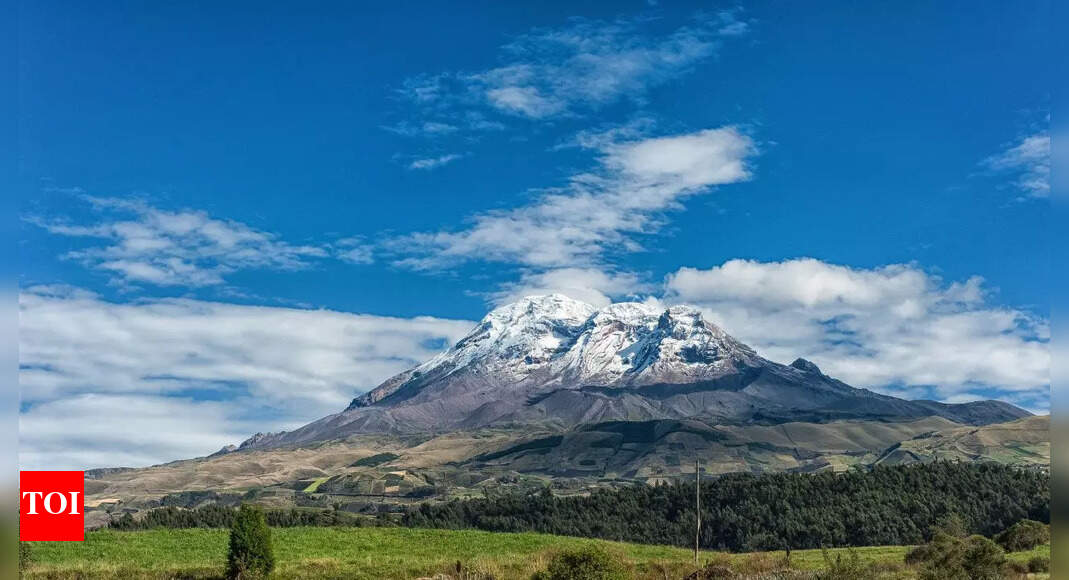
Earth’s rotation causes it to bulge slightly around the equator, forming what scientists call an oblate spheroid. The equatorial radius is about 21 kilometres greater than the polar radius, meaning the planet is wider at the middle than at the top and bottom. This equatorial bulge affects measurements of height depending on what reference point is used.Mount Everest, which sits between Nepal and China, is the world’s highest peak above sea level at 8,848 metres. However, measuring height by sea level does not account for the bulged shape of the Earth. When measured from the planet’s centre instead of the sea-level baseline, points near the equator actually extend farther outward.According to the National Ocean Service, Ecuador’s Mount Chimborazo rises higher from the Earth’s centre than any other point on the surface. Although its elevation above sea level is only 6,263 metres, its near-equatorial position gives it a geophysical advantage of roughly 2,000 metres over Everest when distance from the Earth’s centre is considered. This means that anyone standing at the top of Mount Chimborazo is, technically, closer to space than someone standing at the summit of Mount Everest.
How Ecuador’s Mount Chimborazo became the point closest to space
Mount Chimborazo, a dormant stratovolcano in the Ecuadorian Andes, is located about 150 kilometres south of Quito and stands just one degree south of the Equator. Its broad, snow-covered summit has long drawn scientists, geographers, and mountaineers. Because the Earth’s equatorial bulge lifts the surrounding surface outward, Chimborazo’s base begins at a point already elevated by this natural curvature.Geodetic calculations indicate that Chimborazo’s summit lies approximately 6,384.4 kilometres from the Earth’s centre, while Everest’s peak is about 6,382.3 kilometres away. The 2.1-kilometre difference confirms that Chimborazo’s summit is the most distant point from the planet’s core. In other words, it is the surface point physically closest to outer space, even though it is over 2,500 metres lower above sea level than Everest.This difference arises because elevation above sea level and distance from the Earth’s centre are two distinct forms of measurement. Sea level is an average reference based on ocean height, while geocentric distance measures how far a point extends outward from the planet’s central mass. In regions near the equator, the bulge effectively raises the starting point for measuring distance from the core, giving mountains there a natural edge over those at higher latitudes.
What “closest to space” really means in scientific terms
In scientific terms, describing a location as “closest to space” does not imply that it touches or nears the vacuum beyond Earth’s atmosphere. The recognised boundary of space, known as the Kármán line, lies about 100 kilometres above sea level, far higher than any mountain. Instead, scientists use the expression to identify the surface point farthest from the planet’s centre.This approach is based on geodesy, the science that measures Earth’s geometric shape, gravitational field, and spatial orientation. By this definition, the concept of “closest to space” depends entirely on the Earth’s equatorial bulge. Points along or near the equator are physically farther from the core than those near the poles, regardless of their altitude above sea level.Ecuador’s Mount Chimborazo exemplifies this principle perfectly. Its location on the equator and considerable height combine to make it the peak that protrudes farthest into space from the planet’s centre. Other volcanoes such as Huascarán in Peru or Kilimanjaro in Tanzania come close but do not surpass Chimborazo’s advantage in geocentric height. The difference is modest on a human scale yet significant in scientific measurement, revealing how planetary geometry shapes our perception of “height” and “distance.”
How this discovery changes our view of geography and height
Recognising that Ecuador hosts the point closest to space challenges long-held ideas about the world’s highest locations. It demonstrates that what we call “highest” depends on the chosen measurement method. By sea-level elevation, Everest remains the undisputed tallest. By geocentric distance, Chimborazo wins. This duality reveals that even fundamental geographical definitions can vary with perspective.For scientists, this finding highlights the importance of precise measurement systems. Geodesy, supported by satellite data and global positioning networks, allows for highly accurate calculations of Earth’s surface and shape. These measurements refine navigation, improve climate models, and help track tectonic shifts and sea-level changes.For Ecuador, this scientific fact has become both a symbol of national pride and a source of fascination for travellers. Climbers are drawn to Chimborazo not only for its natural beauty but also for the unique distinction of standing at the point on Earth physically nearest to space. It is a reminder that scientific insight can transform our understanding of geography, revealing unexpected connections between natural form and spatial perception.Also Read | Why is the Moon slowly moving away from Earth every year and what does it reveal about our planet’s future Go to Source