

 Getty Images
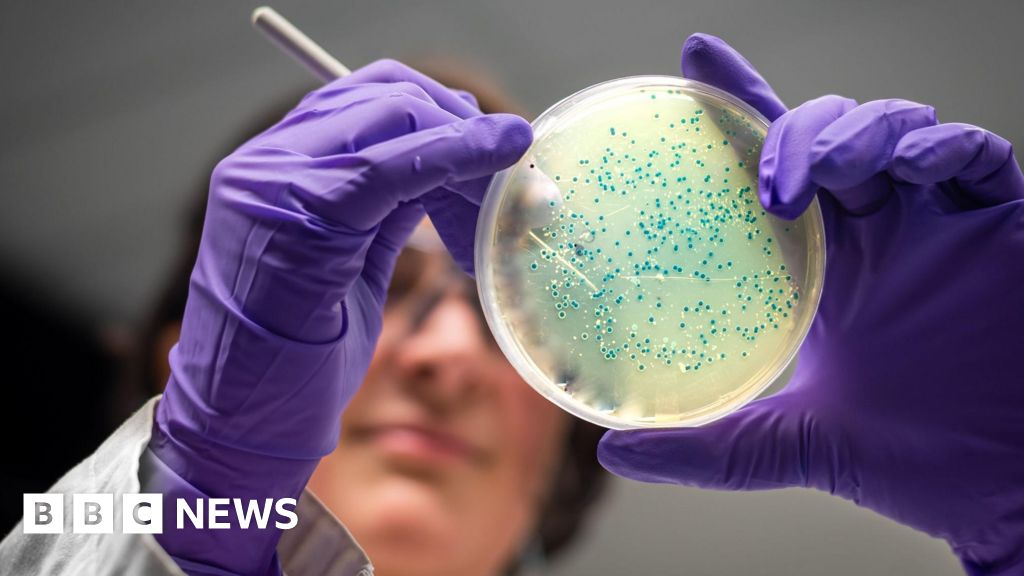
Artificial intelligence has invented two new potential antibiotics that could kill drug-resistant gonorrhoea and MRSA, researchers have revealed.
The drugs were designed atom-by-atom by the AI and killed the superbugs in laboratory and animal tests.
The two compounds still need years of refinement and clinical trials before they could be prescribed.
But the Massachusetts Institute of Technology (MIT) team behind it say AI could start a “second golden age” in antibiotic discovery.
Antibiotics kill bacteria, but infections that resist treatment are now causing more than a million deaths a year.
Overusing antibiotics has helped bacteria evolve to dodge the drugs’ effects, and there has been a shortage of new antibiotics for decades.
Researchers have previously used AI to trawl through thousands of known chemicals in an attempt to identify ones with potential to become new antibiotics.
Now, the MIT team have gone one step further by using generative AI to design antibiotics in the first place for the sexually transmitted infection gonorrhoea and for potentially-deadly MRSA (methicillin-resistant Staphylococcus aureus).
Their study, published in the journal Cell, interrogated 36 million compounds including those that either do not exist or have not yet been discovered.
Scientists trained the AI by giving it the chemical structure of known compounds alongside data on whether they slow the growth of different species of bacteria.
The AI then learns how bacteria are affected by different molecular structures, built of atoms such as carbon, oxygen, hydrogen and nitrogen.
Two approaches were then tried to design new antibiotics with AI. The first identified a promising starting point by searching through a library of millions of chemical fragments, eight to 19 atoms in size, and built from there. The second gave the AI free rein from the start.
The design process also weeded out anything that looked too similar to current antibiotics. It also tried to ensure they were inventing medicines rather than soap and to filter out anything predicted to be toxic to humans.
Scientists used AI to create antibiotics for gonorrhoea and MRSA, a type of bacteria that lives harmlessly on the skin but can cause a serious infection if it enters the body.
Once manufactured, the leading designs were tested on bacteria in the lab and on infected mice, resulting in two new potential drugs.
 MIT
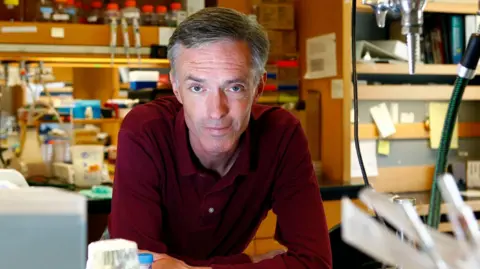
MIT“We’re excited because we show that generative AI can be used to design completely new antibiotics,” Prof James Collins, from MIT, tells the BBC.
“AI can enable us to come up with molecules, cheaply and quickly and in this way, expand our arsenal, and really give us a leg up in the battle of our wits against the genes of superbugs.”
However, they are not ready for clinical trials and the drugs will require refinement – estimated to take another one to two year’s work – before the long process of testing them in people could begin.
Dr Andrew Edwards, from the Fleming Initiative and Imperial College London, said the work was “very significant” with “enormous potential” because it “demonstrates a novel approach to identifying new antibiotics”.
But he added: “While AI promises to dramatically improve drug discovery and development, we still need to do the hard yards when it comes to testing safety and efficacy.”
That can be a long and expensive process with no guarantee that the experimental medicines will be prescribed to patients at the end.
Some are calling for AI drug discovery more broadly to improve. Prof Collins says “we need better models” that move beyond how well the drugs perform in the laboratory to ones that are a better predictor of their effectiveness in the body.
There is also an issue with how challenging the AI-designs are to manufacture. Of the top 80 gonorrhoea treatments designed in theory, only two were synthesised to create medicines.
Prof Chris Dowson, at the University of Warwick, said the study was “cool” and showed AI was a “significant step forward as a tool for antibiotic discovery to mitigate against the emergence of resistance”.
However, he explains, there is also an economic problem factoring into drug-resistant infections – “how do you make drugs that have no commercial value?”
If a new antibiotic was invented, then ideally you would use it as little as possible to preserve its effectiveness, making it hard for anyone to turn a profit.