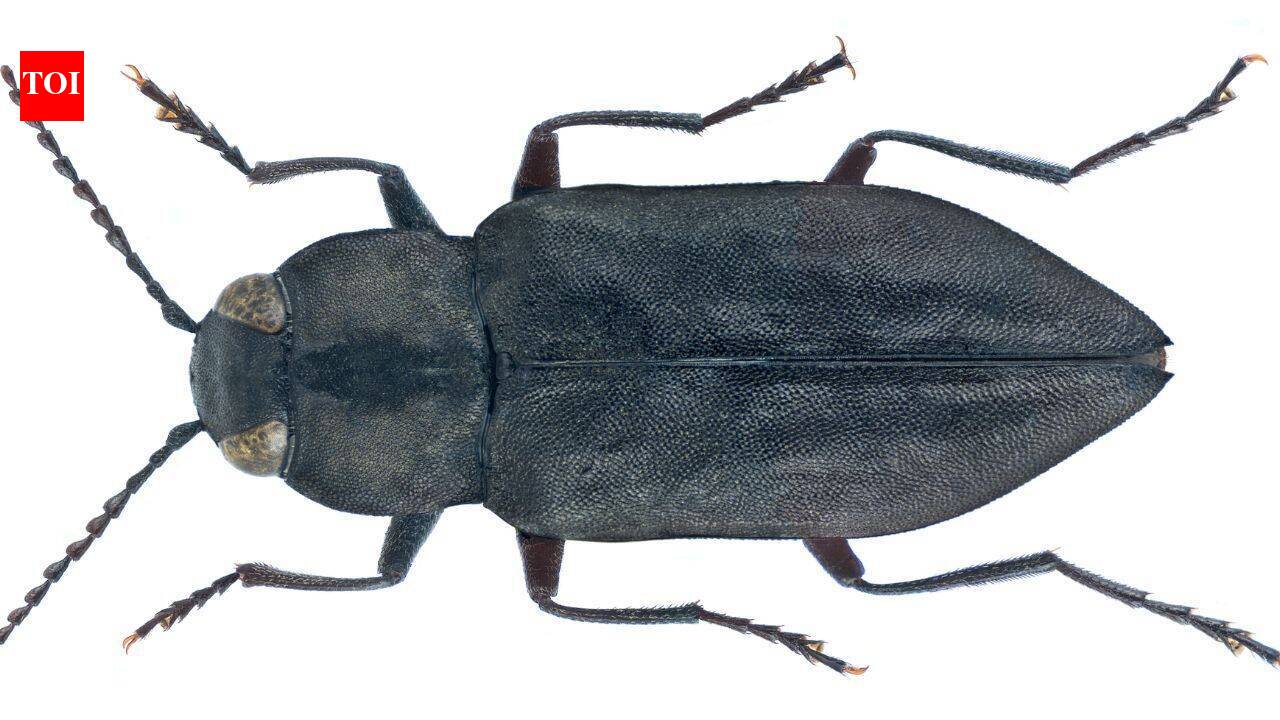

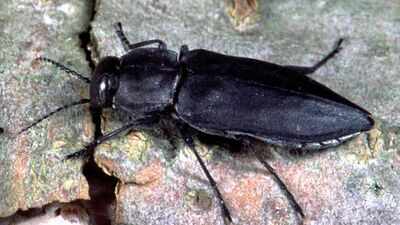
 Black fire beetle, Melanophila acuminata. Image Credit: Prof. Schmitz/Wikipedia
Black pine jewel beetles, scientifically named Melanophila acuminata, belong to a unique group of insects that exhibit pyrophilous behaviour, which means they are naturally attracted to forest fires. These beetles are primarily found across boreal and temperate forests of the north, where they play a vital role in the ecosystem’s renewal process.Unlike most animals that run away from heat and smoke of a blaze, these beetles fly directly towards the ash remains of trees. This behaviour is essential for their survival because their larvae can only develop within the wood of trees that have been recently killed by fire. To reach towards the wildfire events, the beetles have evolved sophisticated sensory equipment, including smoke receptors on their antennae and a pair of infrared organs located on their midsection, which allows them to detect heat from long distance.
How do these beetles detect fires from immense distances
According to the study published in Frontiers titled ‘Concept of an Active Amplification Mechanism in the Infrared Organ of Pyrophilous Melanophila Beetles,’ Melanophila beetles have been observed swarming around massive oil tank fires from distances as far as 130 kilometres. However, early lab tests on non-flying beetles showed a much lower sensitivity, suggesting they could only detect large fires from about 12 kms away.The authors of the study propose a theory to explain this discrepancy which says that the beetles may use their own body movements to increase the incoming signal. By using the energy from their flight muscles, the beetles might vibrate their heat sensors at a specific frequency. This ‘active amplification’ would allow them to pick out very weak heat signals.
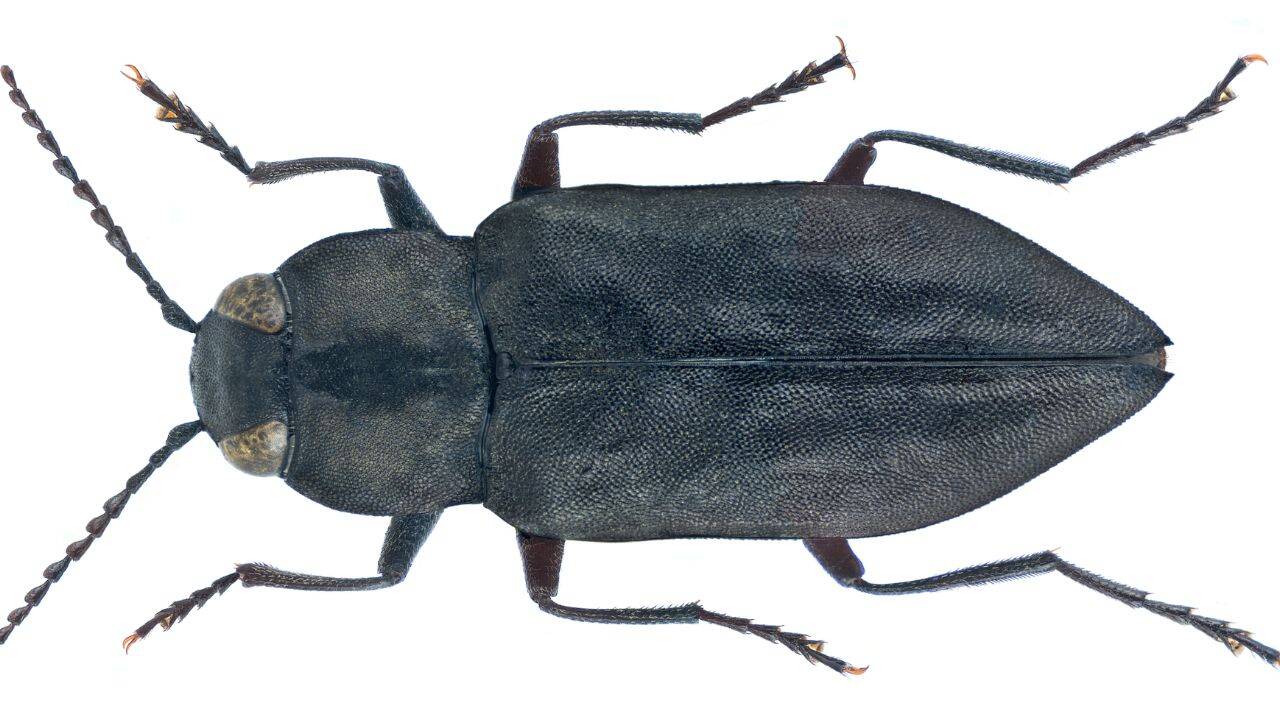
Melanophila acuminata. Image Credit: Udo Schmidt from Deutschland
Why do these Black pine jewel beetles seek out burnt forests
As per the study, the primary reason for this attraction is the lifecycle requirements of the insect. Both males and females approach forest fires because the wood of freshly burnt trees provides the only suitable environment for their larvae to grow successfully.Without the unique conditions provided by a forest fire, such as the lack of other insects and the specific chemical state of the timber, the next generation of beetles would not survive. This necessity has led to the development of sensors that are incredibly fine-tuned to the specific signatures of a fire. While they can use scent to detect smoke, the study explains that smoke plumes are often narrow and can be blown away by the wind, making them unreliable for navigation over very long distances. Therefore, the beetles rely heavily on their ability to perceive infrared radiation (the heat emitted by flames).
Where are the infrared organs of these beetles located
The infrared organs of the Melanophila beetle are remarkable. As detailed in the study, these organs are found in pairs on the underside of the beetle’s middle segment, known as the ‘metathorax.’ Each organ consists of a small pit containing a group of dome-shaped sensors called ‘sensilla.’These are not simple heat sensors, they are actually modified mechanoreceptors, which are usually used by insects to detect touch or vibration. Each individual sensor contains a tiny, fluid-filled sphere attached to a nerve cell. When infrared radiation hits the sphere, it causes a physical change that the nerve cell detects as a mechanical signal. This conversion of light energy into mechanical movement is the reason scientists describe these as ‘photomechanic’ sensors.
What role does flight play in heat detection
The study highlights that the infrared organs are positioned right next to the hinges of the beetle’s wings. This location is important because it connects the sensors to the vibrations of the flight motor. The researchers suggest that when the beetle is in a ‘search flight,’ it can control how its flight muscles interact with these sensors.By adjusting a damping system (a biological cushion) the beetle can fine-tune the sensitivity of its organs to an extreme degree. This allows the beetle to compare the heat signals coming from both sides of its body simultaneously. If the sensor on one side detects a slightly stronger pulse of heat than the other, the beetle knows exactly which direction to turn to find the fire. This method is very similar to how some insects use their two ears to locate the source of a sound.
How do different species of these beetles compare
The study notes that Melanophila acuminata appears to have more specialised organs than its Mediterranean counterpart, ‘Melanophila cuspidata.’ In M. acuminata, the infrared organs contain more sensors, and these sensors are more clearly separated from other structures, which allows for clearer vibrations. Furthermore, M. acuminata possesses a damping cushion that has not been found in M.cuspidata.Scientists believe this may be due to the different environments they live in. Since fires are more frequent in the Mediterranean, M. cuspidata may not need the extreme sensitivity required by M. acuminata, which lives in northern forests where fires are rare and much farther apart. The reason that Black pine jewel beetles developed a more complex sensory system is because they face greater challenges in finding their breeding grounds.The study of the Melanophila beetle proves how evolution solves complex engineering problems through biology. By repurposing touch-sensitive cells to detect electromagnetic radiation, nature has created a highly efficient ‘fire-chaser.’ Whether these beetles are navigating through the smoke-filled air of a Mediterranean forest or the vast boreal regions of the north, their reliance on sophisticated sensors depicts the adaptations found in the natural world. Go to Source