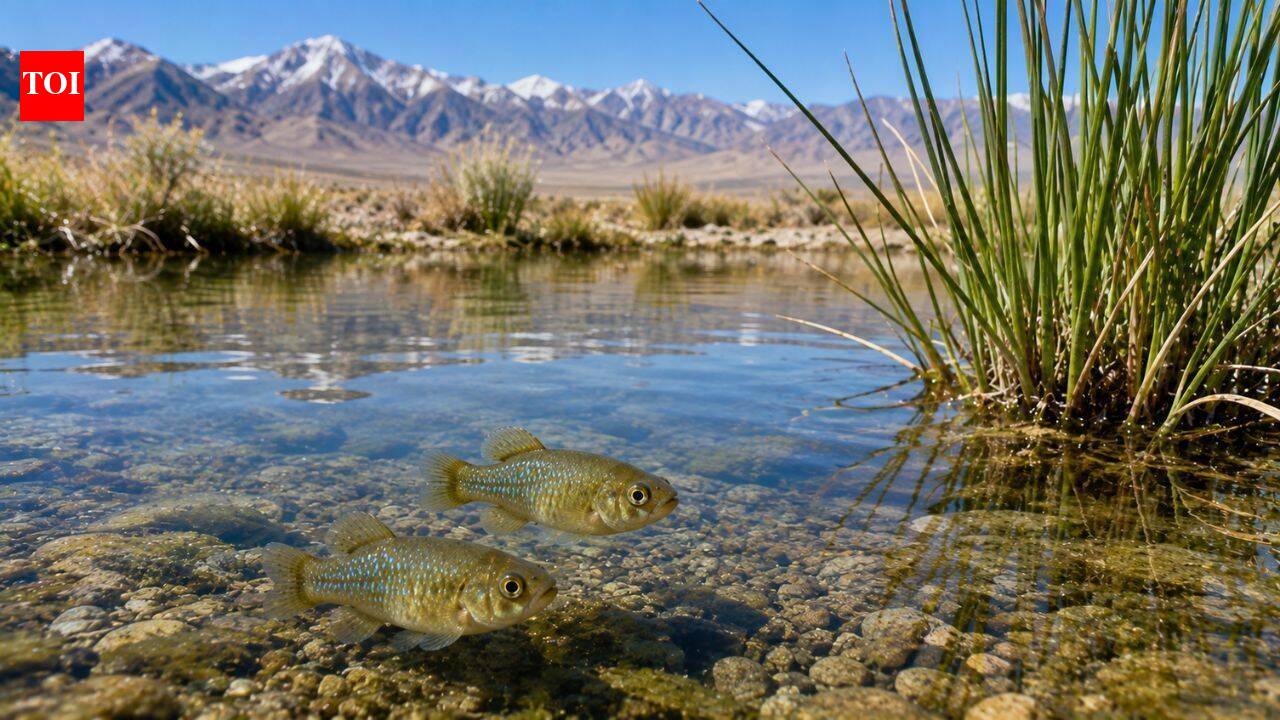

Image AI generated
For most people, conservation is associated with large mammals, forests or national parks. Phil Pister spent his life proving that the survival of tiny desert fish could matter just as much. The California fisheries biologist became known for an extraordinary moment in 1969 when he realised that the last remaining Owens pupfish were in immediate danger. With no time to spare, he carried two heavy buckets containing the species across rough desert ground to a safer refuge. For a short distance, the future of the fish depended entirely on one person. Pister died in January 2023 at the age of 94, leaving behind a conservation legacy that continues to shape efforts to protect some of North America’s rarest freshwater fish.
How Phil Pister rescued the last Owens pupfish in 1969
Phil Pister worked for the California Department of Fish and Game, later renamed the California Department of Fish and Wildlife, where he focused on desert fisheries across the Owens Valley and eastern Sierra.His defining moment came on 18 August 1969 after colleagues discovered that the pond holding the world’s last known Owens pupfish population was drying rapidly. The team began preparing the fish for relocation, but while others briefly left the site, Pister noticed the fish were already beginning to die inside transport cages. Realising there was no time left, he filled two buckets with the remaining fish and walked roughly a quarter of a mile across uneven desert terrain in darkness. Each bucket weighed around 30 pounds. In later interviews, Pister recalled being fully aware that every surviving member of the species was in his hands. Had anything gone wrong during that walk, the Owens pupfish would almost certainly have disappeared forever. That rescue became one of the defining stories in American wildlife conservation. The Owens pupfish survived, and new populations were later established through continued recovery work.
Phil Pister’s conservation legacy after saving the Owens pupfish
The bucket rescue was only one chapter in Pister’s work. Five years earlier, in 1964, he had helped rediscover the Owens pupfish in California’s Owens Valley after the species had been presumed extinct since the 1940s. That discovery marked the beginning of decades of conservation efforts focused on desert fish that many people had barely heard of.As per the U.S. Fish and Wildlife Service, Pister’s actions inspired recovery programmes for other isolated desert species, including the Long Valley speckled dace. The agency describes how his determination became an example for biologists working across California’s desert springs, where small populations often survive in isolated pockets of water separated by thousands of years of geological change.Scientists now compare these scattered desert waterways to islands, where fish have evolved independently over long periods. Such isolation has produced genetically distinct populations that require careful management if they are to survive.The Service also notes that protecting these species depends on cooperation between government agencies, researchers, private landowners and local communities. Habitat restoration, creating new refuge sites and relocating vulnerable fish remain central parts of that work.
How Phil Pister mentored young conservationists and scientists
Pister’s influence reached well beyond the field. According to National Public Radio, University of Arizona biologist Michael Bogan remembered Pister as “an amazing force of nature.” Bogan also said Pister understood conservation was work that had to continue across generations, which is why he mentored others, including Bogan, to carry the effort forward.Bogan first contacted Pister while still an undergraduate after writing about his research. Rather than dismissing the request, Pister replied personally and invited the student to meet him. That willingness to encourage younger scientists became a recurring part of his reputation throughout his career.Environmental writer Elizabeth Kolbert recalled one response Pister often gave when people questioned the value of protecting tiny desert fish. Instead of defending the species directly, he would ask, “What good are you?” The remark reflected his broader belief that every species has its own place within an ecosystem, regardless of how small or overlooked it may seem.
How Phil Pister’s conservation work continues to save rare desert fish
More than half a century after the Owens pupfish rescue, many of the challenges facing desert fish remain. Habitat loss, drying water sources and the introduction of non-native fish continue to threaten isolated populations across the American West.Current conservation projects still draw on the approach Pister helped establish. Recovery work for the Long Valley speckled dace has included habitat restoration, creating new refuge populations and moving fish to suitable streams before existing populations disappear. These efforts rely on partnerships between federal agencies, the California Department of Fish and Wildlife and private landowners. The agency also encourages the public to play a simple but important role by never releasing unwanted pet fish, turtles or frogs into natural waterways, where introduced species can quickly damage fragile ecosystems. Go to Source