
Wednesday, August 5, 2026
33.5 C
New Delhi

Scientists prove Charles Darwin’s 150-year-old theory right with the help of an insect-eating plant

Scientists identify an insect-eating plant that just proved Charles Darwin's 150-year-old theory right

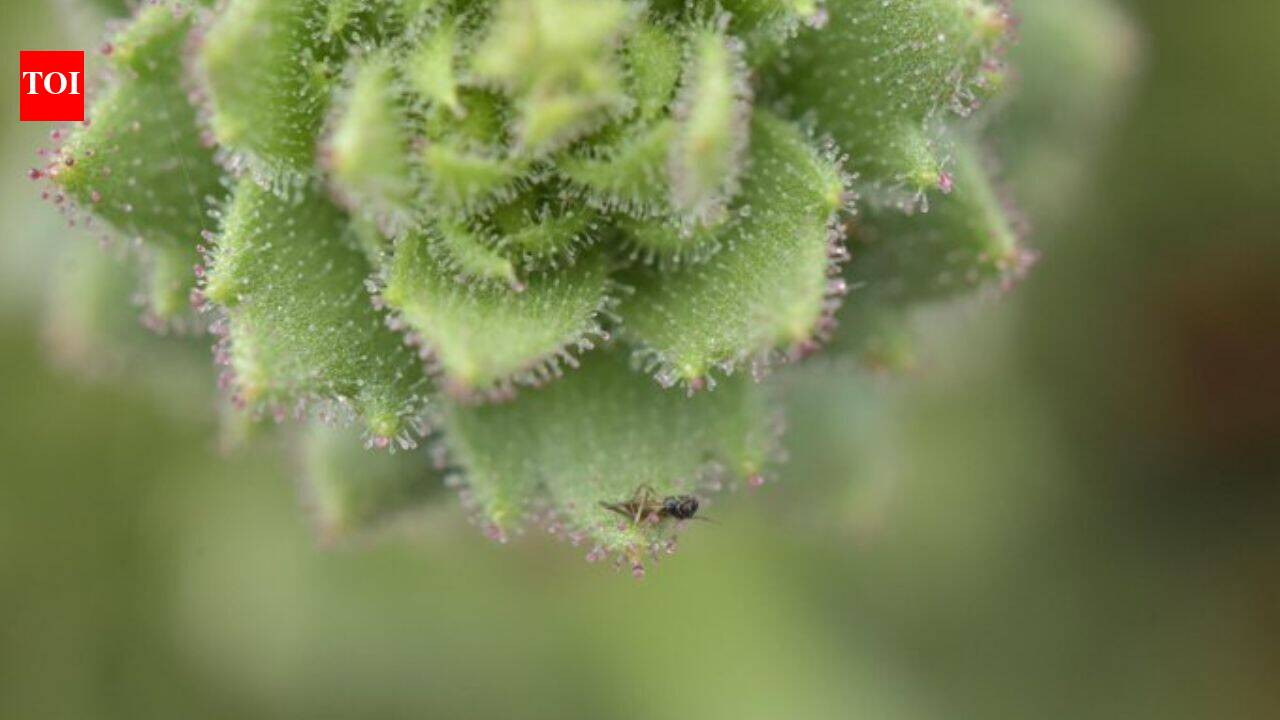
A breakthrough in plant science has validated Charles Darwin’s historic conjecture surrounding carnivorous Saxifraga species. Researchers discovered that these plants ensnare small gnats with sticky hairs, emitting fragrances that lure their prey. Chemical tests confirmed that insects provide essential nutrients upon capture, as showcased by isotope labeling. This pivotal finding sheds light on the complex interactions and nutritional strategies of plant carnivory in mountainous regions.

About 150 years ago, famous British naturalist Charles Darwin observed the sticky “hairs” on two plant species in the Saxifraga genus and wondered if some plants in the genus could be carnivorous. While he was unable to prove it then, more than a century later, scientists have shown that Darwin’s suspicions were correct.It was in 1875 that Darwin proposed that Saxifraga rotundifolia and S. umbrosa were insect eaters. The plants’ hairlike structures called glandular trichomes ooze a sticky goo and resemble hair found in other carnivorous plants. However, to be carnivorous, a plant must lure, trap and consume insects, and Darwin’s experiments with Saxifraga plants couldn’t conclusively demonstrate that the plants fit the bill.In a study published on Tuesday in the journal Nature Communications, researchers tested Darwin’s hypothesis by experimenting with Saxifraga candelabrum, a flowering mountain plant that grows at high altitudes on the southern part of the Qinghai-Tibet Plateau and in the Hengduan Mountains in China’s Yunnan and Sichuan provinces.

A surprising study

A surprising study

” msid=”132895378″ width=”” title=”The plants attracted tiny gnats with enticing odours and then digested trapped prey using an enzyme called phosphatase.” placeholdersrc=”https://static.toiimg.com/photo/83033472.cms” imgsize=”” resizemode=”4″ offsetvertical=”0″ placeholdermsid=”47529300″ type=”thumb” src=”https://static.toiimg.com/photo/83033472.cms” class=”” data-src=”https://static.toiimg.com/photo/msid-132895378/a-surprising-studybrbr.jpg” data-api-prerender=”true”/> </p>
<p> The plants attracted tiny gnats with enticing odours and then digested trapped prey using an enzyme called phosphatase.</p>
</p></div>
</p></div>
<p> Through chemical analysis, scientists showed how the plants attracted tiny gnats with enticing odours and then digested trapped prey using an enzyme called phosphatase.  Isotope labelling, a technique for tagging forms of an element with different atomic weights, highlighted the transfer of the nutrient nitrogen-15 from insect prey to the plants that dissolved them, indicating a direct path from trapping to digestion.Next, genetic analysis confirmed S. candelabrum’s relationship to other sticky carnivorous plants, revealing shared genes linked to traits such as prey attraction, digestion and nutrient absorption. When the scientists expanded their investigation to include other types of traps, they found dozens of genes across different plant groups related to digesting insect remains. </p>
<p><h2> Trapping then eating</h2>
</p>
<p> Douglas Soltis, study coauthor and professor at the Florida Museum of Natural History and at the department of biology at the University of Florida, has investigated the Saxifragaceae family for more than four decades. He always wondered if some of these plants might be carnivorous, he told CNN.“Many members of the family to which Saxifraga belongs have sticky glandular hairs and you often see insects stuck on them,” Soltis said. But even if its hairs trap insects, the plant isn’t necessarily digesting them, he added. Hairs can also be defensive structures for protection against plant-eaters.The research began much like Darwin’s did, by observing the plants and insects that got trapped, in the field and under controlled conditions. Most of the mature plants that the researchers observed captured dozens of insects, with up to 70 gnats collecting on their sticky branches. The researchers found that the flowers’ scent lured their prey, using compounds previously identified as attractive to insects. Larger flies that pollinated the flowers were not trapped by the hairs, suggesting that only ineffective pollinators were caught.Insect prey is full of nitrogen, and in many types of carnivorous plants, a common driver of evolution is life in habitats where soil is naturally nitrate-poor, Soltis explained. “These plants can photosynthesise — they can make their own food. But they need nitrates,” he explained. “When the soil is low in nitrates this is one adaptation that has emerged.” The strategy makes sense for S. candelabrum, which grows at altitudes of 8,200 to 10,800 feet (2,500 to 3,300 meters) above sea level in rocky, dry and nutrient-poor soil.The plant’s alpine habitat is a first for carnivorous plants, Soltis added. “Most are in boggy soils — think pitcher plants and flytraps.” One advantage of living in a remote, high-altitude location is that the plants are not currently threatened by climate change or human activity, according to senior study author Hang Sun, a professor and director of the Kunming Institute of Botany at the Chinese Academy of Sciences in Beijing..“Saxifraga candelabrum is growing well under its current environmental conditions, and it is not an endangered species based on its existing population size and distribution range,” he said. </p>
<p><h2> More to come</h2>
</p>
<div data-pos=
More to come?

” msid=”132895433″ width=”” title=”At least 350,000 species of flowering plants exist, of which more than 750 species are known to be carnivorous. ” placeholdersrc=”https://static.toiimg.com/photo/83033472.cms” imgsize=”” resizemode=”4″ offsetvertical=”0″ placeholdermsid=”47529300″ type=”thumb” src=”https://static.toiimg.com/photo/83033472.cms” class=”” data-src=”https://static.toiimg.com/photo/msid-132895433/more-to-comebrbr.jpg” data-api-prerender=”true”/> </p>
<p> At least 350,000 species of flowering plants exist, of which more than 750 species are known to be carnivorous.</p>
</p></div>
</p></div>
<p> Carnivory in Saxifraga wasn’t the first prediction of Darwin’s to later be proven correct. After Darwin saw the star-shaped Madagascar orchid Angraecum sesquipedale, with a nectar tube measuring 11.8 inches (30 centimetres) long, he wrote in 1862 that it could only be pollinated by a “huge moth with a wonderfully long proboscis,” though he had never seen such an insect. When he died in 1882, the mystery pollinator was still unknown. But Darwin was vindicated in 1903 with the discovery of the Madagascar moth Xanthopan morganii praedicta and its 12-inch strawlike tongue (the insect was reclassified in 2021 as Xanthopan praedicta).By picking up where Darwin left off, the new findings serve as a reminder that scientific research “is an ongoing relay pursuit spanning different eras,” said Sun. “It allows us to truly appreciate the continuous academic inheritance of fundamental research in the field of plant evolution passed down from generation to generation.””This data could help botanists identify other plants that have been hiding their appetite for insects in plain sight,” said Sun. “Some species of the plants previously only known to bear sticky glandular hairs or trap insects incidentally may actually have undiscovered digestive and nutrient absorption capabilities,” Sun told CNN in an email. “Carnivory is likely far more widely distributed among angiosperms” — or flowering plants — “than previously believed, and new carnivorous plant lineages may be discovered in the future.”At least 350,000 species of flowering plants exist, of which more than 750 species are known to be carnivorous. Different styles of carnivory evolved independently in 14 plant families, a process called convergent evolution, and the study provides important new information about this intriguing lifestyle, said botanist Susan Myers, horticulture and conservation director at the Pittsburgh Botanic Garden. “The study design, including identifying the necessary morphology and digestive enzymes, and especially tracing the labelled nitrogen, was brilliant,” she said in an email. “What Darwin surmised from observation and inference, these researchers confirmed with modern technology.”  <a href=Go to Source

Hot this week

Grade 9 student wins gold for wearable that detects IV leaks early

Grade 9 student, Akshat Anand, wins gold for wearable that detects IV leaks earlyPhoto credit: Surrey Schools At just 13 or 14 years old, most Grade 9 students are still getting comfortable with science fair pressure. Read More

Brazil’s Snake Island is home to just two snake species, including one of the world’s most venomous pit vipers

Image: Left/Golden lancehead (Bothrops insularis)/Right/Dipsas albifrons (Sauvage’s snail-eating snake)/AI Generated About 33 kilometres off the coast of São Paulo lies Ilha da Queimada Grande, better known as Snake Island. Read More

Polish swimmer becomes the first person to swim from Sweden to Poland across the Baltic Sea in 55 hours

Image: AOL News In a historic feat, Bartłomiej Kubkowski, an ultra-swimmer from Poland, became the first person to successfully swim across the Baltic Sea from Sweden to Poland without any physical help. Read More

Rijiju, Rahul Gandhi hold 50-meeting meeting to break Parliament logjam

Rijiju meets Rahul Gandhi as govt seeks to end Parliament deadlock. (File photo) Rijiju meets Rahul Gandhi as govt seeks to end Parliament deadlock. Read More

Topics

Grade 9 student wins gold for wearable that detects IV leaks early

Grade 9 student, Akshat Anand, wins gold for wearable that detects IV leaks earlyPhoto credit: Surrey Schools At just 13 or 14 years old, most Grade 9 students are still getting comfortable with science fair pressure. Read More

Brazil’s Snake Island is home to just two snake species, including one of the world’s most venomous pit vipers

Image: Left/Golden lancehead (Bothrops insularis)/Right/Dipsas albifrons (Sauvage’s snail-eating snake)/AI Generated About 33 kilometres off the coast of São Paulo lies Ilha da Queimada Grande, better known as Snake Island. Read More

Polish swimmer becomes the first person to swim from Sweden to Poland across the Baltic Sea in 55 hours

Image: AOL News In a historic feat, Bartłomiej Kubkowski, an ultra-swimmer from Poland, became the first person to successfully swim across the Baltic Sea from Sweden to Poland without any physical help. Read More

Rijiju, Rahul Gandhi hold 50-meeting meeting to break Parliament logjam

Rijiju meets Rahul Gandhi as govt seeks to end Parliament deadlock. (File photo) Rijiju meets Rahul Gandhi as govt seeks to end Parliament deadlock. Read More

Frequent Headaches? These Everyday Mistakes Could Be The Cause

Show Quick Read Key points generated by AI, verified by newsroom Dehydration, irregular meals, and screen time often trigger headaches. Stress, poor posture, caffeine changes also frequently cause headaches. Read More

Kriti Sanon wishes to reunite with Mahesh Babu for a film

Kriti Sanon says she would love to reunite with debut co-star Mahesh Babu: ‘I was really a baby back then’ Kriti Sanon, who has cemented her place as one of Indian cinema’s leading stars with a string of successful Read More

Preity Zinta says she didn’t miss acting: ‘I was enjoying having a family, having kids’

Preity Zinta is all set to make her long-awaited return to the silver screen with ‘Batwara 1947’, ending an eight-year break from films. Read More

Related Articles