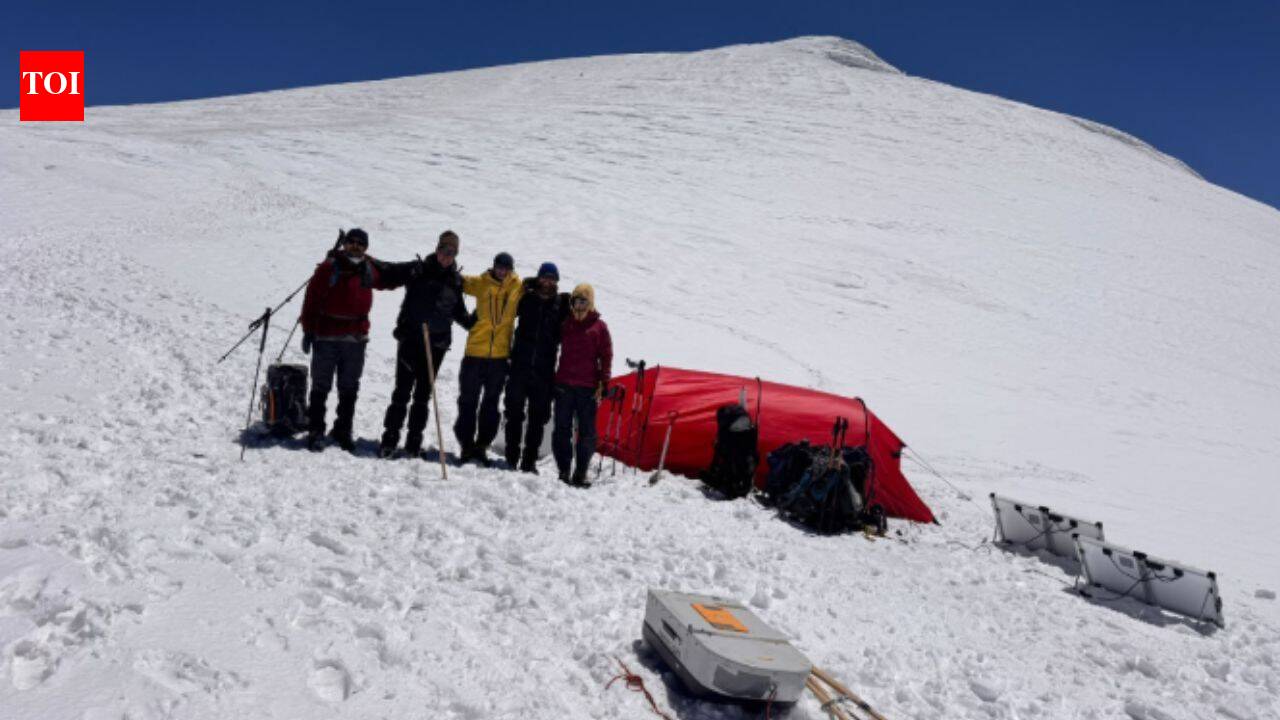

The research team at 5,050 metres altitude (University of Munster photo)
The glacier on Mount Ararat, Turkey’s highest mountain, has been surveyed for the first time as scientists race to study its shrinking ice before more evidence is lost.Researchers believe the shrinking glacier could preserve valuable information about both climate change and human history. While archaeologists usually study objects buried in the ground, glacier ice can preserve information in layers that build up over thousands of years. However, this natural archive is disappearing quickly as global warming causes the ice cap to melt faster each yearA German-Turkish team of researchers completed the survey in July at an altitude of more than 5,000 metres, where the team spent two weeks studying the ice despite harsh weather.
Mapping the glacier
According to University of Munster, before drilling into the glacier, scientists first mapped it using ground-based radio echo sounding and active seismic surveys. These methods allow scientists to measure how thick the glacier is and study the shape of the land beneath the ice. This information is important because it helps them identify the best location to drill an ice core during a future expedition.Ice cores are long cylinders of ice removed from glaciers. Each layer of the ice represents snowfall from a different period, much like the rings inside a tree trunk record its age. By studying these layers, scientists can learn what conditions were like when the snow originally fell.”Despite wind and cold, we obtained all the data we need,” says Dr Coen Hofstede of the Alfred Wegener Institute, who led the measurements during the expedition. “Now we can determine where to drill the longest continuous ice core,” he adds.If the next expedition is successful, it will produce the first ice core ever collected from Mount Ararat.
Ancient clues in ice
Researchers say the glacier could become an important new source of information, especially for archaeologists. According to Prof Dr Achim Lichtenberger, the project leader from the University of Munster, it represents an entirely new source of data for archaeology.”So far, we have had to depend on what lies in the ground. The ice, on the other hand, could preserve a continuous chronicle of human activity, layer by layer over millennia,” he says.