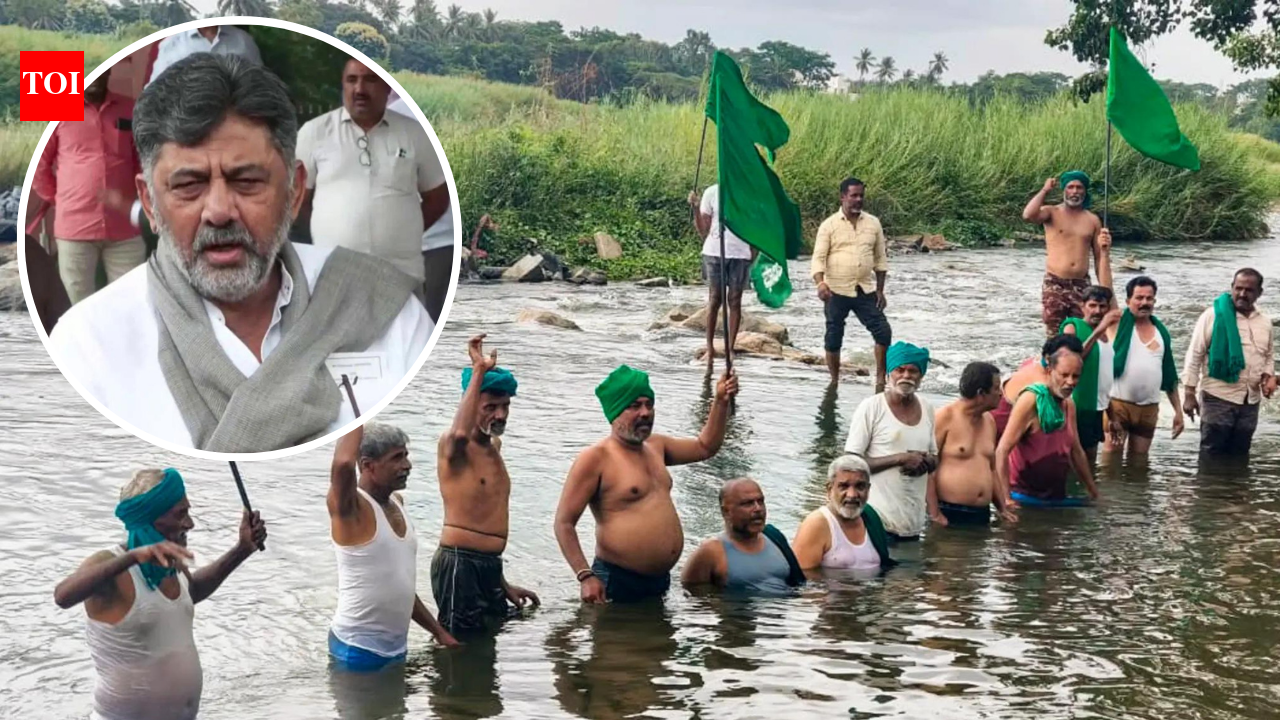

Responding to the growing protests in Karnataka, chief minister DK Shivakumar appealed on Saturday to organisations opposing the release of water to withdraw their proposed agitation.
NEW DELHI: The Dravida Munnetra Kazhagam (DMK) on Saturday moved the Supreme Court seeking directions to the Karnataka government to immediately release Cauvery water to Tamil Nadu, arguing that Karnataka must comply with the apex court’s 2018 verdict and the recent directions issued by the Cauvery Water Management Authority (CWMA).The plea seeks an order directing Karnataka to implement the Cauvery Water Regulation Committee’s recommendation, upheld by the CWMA on Thursday, to release 3,500 cusecs of water per day for 15 days to Tamil Nadu at the inter-state border point of Biligundlu.”Direct the State of Karnataka / Respondent No. 1 to forthwith and fully implement the direction of the CWRC dated July 28, 2026, as affirmed by the CWMA on July 30, 2026, by ensuring a flow of 3,500 cusecs per day at Biligundlu for the period of 15 days commencing from date of the order passed by this Hon’ble Court, and to make good the shortfall in compliance from July 29, 2026 onwards,” the DMK said in its plea.The party also sought a direction to Karnataka to clear the accumulated shortfall in water releases. It asked the court to direct the state to “make good the accumulated backlog of about 9.46 TMC due at Biligundlu as on July 26, 2026, computed on the pro-rata/distress-sharing basis, by ensuring releases such that about 7,000 cusecs per day is realised at Biligundlu over a period of 15 days”.In addition, the DMK urged the Supreme Court to direct the CWMA to monitor reservoir releases in Karnataka and the flows realised at Biligundlu on a day-to-day basis and submit compliance reports. The move comes amid renewed tensions between the two southern states over the sharing of Cauvery waters during the current monsoon season. On Thursday, the CWMA upheld the Cauvery Water Regulation Committee’s recommendation that Karnataka release 3,500 cusecs of water daily for the next 15 days to Tamil Nadu.Responding to the growing protests in Karnataka, chief minister DK Shivakumar appealed on Saturday to organisations opposing the release of water to withdraw their proposed agitation. The farmer groups and pro-Kannada organisations staged demonstrations across the Cauvery basin, arguing that the state could not spare even a drop of water for Tamil Nadu because major reservoirs did not have enough water even for drinking.Shivakumar said the Kabini reservoir was rapidly filling up and warned that water could not be retained once the reservoir reached full capacity.”Kabini reservoir is filling up. Once a dam is full, water has to be released. It is impossible to hold it back. I humbly appeal to those planning to agitate against the release of water to withdraw their decision,” he said.Shivakumar also cautioned protesters against approaching water release points, saying, “Even if we decide not to release water, once the reservoir is full, it is impossible to hold it back. Protesters should not go near the points where water is being released. The force of the water can sweep you away. No one should lie down in the path of flowing water.”The Karnataka CM said the state would protect the interests of its farmers while respecting judicial orders. “There is an order to release 177 TMC of water to Tamil Nadu, and the Supreme Court has upheld it. We must respect the court’s order while also protecting the interests of our farmers. Our government is committed to safeguarding the welfare of Karnataka’s farmers,” he said.
Join conversation
Share your thoughts in the comments
Be respectful · TOI community guidelines
He also accused the BJP of “politicising” the issue and said an all-party meeting would be held to consult former chief ministers, political leaders and legal experts before deciding the state’s next course of action. According to Shivakumar, Tamil Nadu had sought 9,000 cusecs, but the Authority had directed Karnataka to release only 3,500 cusecs.The Cauvery Water Management Authority was constituted by the Centre in 2018 following the Supreme Court’s final verdict on the decades-old Cauvery river water dispute among Tamil Nadu, Karnataka, Kerala and Puducherry. The Authority includes representatives of the riparian states as well as a nominee of the central government and is responsible for overseeing implementation of the court-mandated water-sharing arrangement. Go to Source