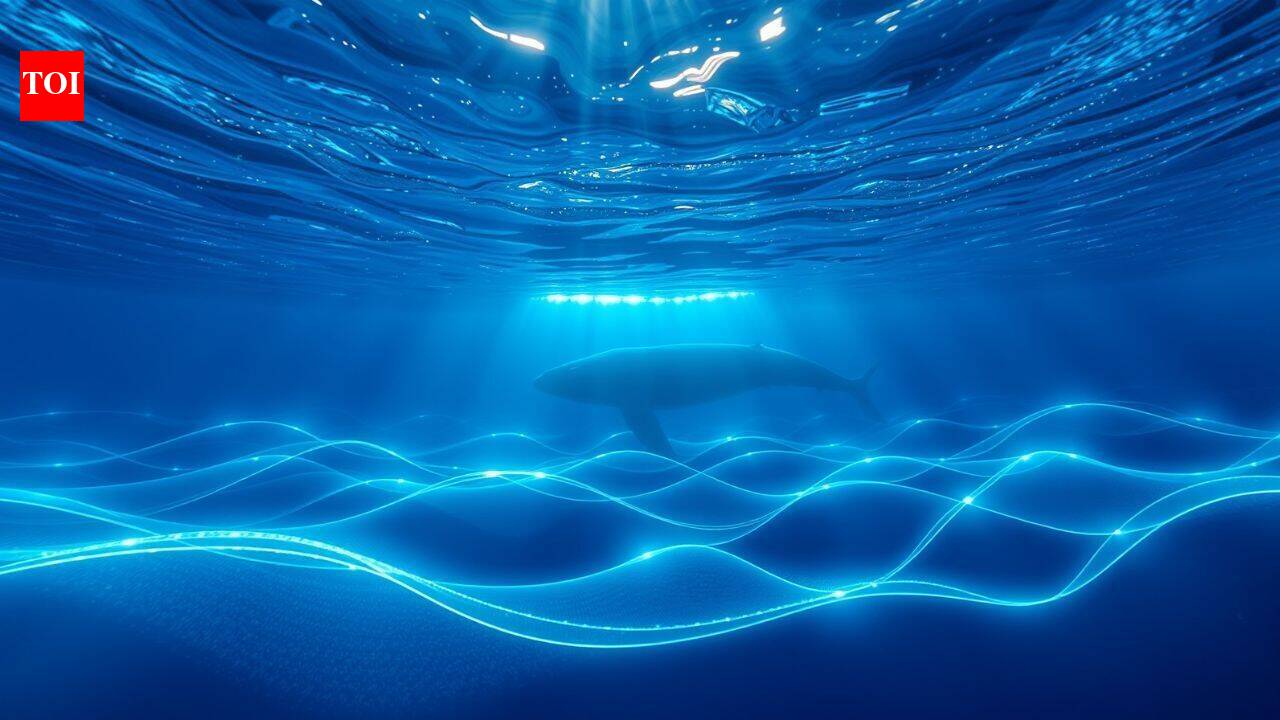

The deep ocean has a way of turning ordinary events into unanswered questions. Far below the waves, sounds travel through water in ways that can make distant sources appear much closer or far stranger than they really are. In 1997, a powerful low-frequency noise recorded across the Pacific Ocean created one of the most unusual acoustic mysteries in modern marine science. The signal was unlike anything scientists had heard before, leading to years of speculation about its origin. The answer, when it finally emerged, came not from an unknown creature beneath the waves but from a vast natural process taking place thousands of kilometres away.
The 1997 ‘Bloop’ mystery: How a strange Pacific sound led scientists to Antarctica
During routine monitoring in the South Pacific in 1997, instruments operated by the National Oceanic and Atmospheric Administration (NOAA) detected an unusual signal. The network of underwater microphones, known as hydrophones, was designed to capture sounds linked to earthquakes, volcanic activity and other ocean events.The recording stood out immediately. It was unusually strong and could be picked up by sensors separated by thousands of miles across the Pacific. Most underwater noises weaken significantly over long distances, but this signal travelled through the ocean with remarkable intensity.Scientists gave it the nickname “the Bloop”. At the time, they had no clear explanation for what had produced it.The enigma increased due to the fact that the sound was different from anything normally occurring in the sea. The sound had some characteristics of biological sounds, thus raising the suspicion of the involvement of a big sea creature.
Why people thought it could be a giant creature
The ocean’s unexplored depths have long encouraged speculation about unknown life forms. The Bloop appeared to fit that imagination. Its strength suggested a source far larger than typical marine animals, and comparisons were quickly made with creatures such as blue whales, the largest animals currently known to exist.Some theories moved into the realm of fiction. The location of the recording was close to the fictional underwater city of R’lyeh from H.P. Lovecraft’s stories, a coincidence that helped fuel online discussions about sea monsters and hidden creatures.Others suggested the colossal squid might be involved. The species can grow to impressive sizes and remains difficult to study in its natural environment. However, scientists pointed out that squid do not possess the type of structures usually associated with producing powerful underwater sounds. The idea did not fit what was known about their biology.While speculation spread, ocean researchers continued examining the signal itself.
How scientists traced the ‘Bloop’ to Antarctica’s breaking ice
The first clues came from studying the physical characteristics of the sound. Scientists began considering whether the source might not be alive at all.Large pieces of ice breaking apart can release enormous amounts of energy into the ocean. When glaciers fracture or ice shelves collapse, the resulting vibrations can travel through seawater and create sounds that resemble unusual animal calls.As NOAA expanded its monitoring efforts closer to Antarctica, similar low-frequency signals appeared. The pattern suggested a connection with large-scale movements of ice rather than a previously unknown creature.By 2005, researchers had identified the likely cause of the Bloop: massive icequakes produced by cracking and shifting Antarctic ice.These events occur when glaciers fracture under stress, sending vibrations through the surrounding ocean. Other related sounds include iceberg calving, when large sections of ice break away, and harmonic tremors created as icebergs move and grind against the seafloor.
A natural event louder than any animal
The Bloop’s explanation was less mysterious than some imagined, but it revealed another side of the ocean’s power. Ice formations covering vast areas of Antarctica can produce sounds strong enough to cross entire ocean basins.The original 1997 event was traced to the region between the Bransfield Strait and the Ross Sea, with areas near Cape Adare considered possible sources. However, scientists were never able to identify the exact glacier or ice formation responsible for that first recording.Similar sounds have since been detected in other polar regions, helping researchers better understand how changing ice conditions influence ocean acoustics.
What the Bloop revealed about a changing planet
The mystery of the Bloop eventually moved away from stories of hidden creatures and toward a different kind of discovery. The sound came from one of Earth’s largest natural systems: the movement and breakup of Antarctic ice.Icequakes are not new. Glaciers have always shifted, cracked and released energy. But scientists have become increasingly interested in these sounds as warming temperatures contribute to changes across polar environments.The strange noise recorded in 1997 remains one of the most memorable examples of how little is still understood about the deep ocean. A signal once linked to imaginary monsters turned out to be a reminder that Earth’s own processes can be just as powerful, and sometimes just as difficult to explain. Go to Source