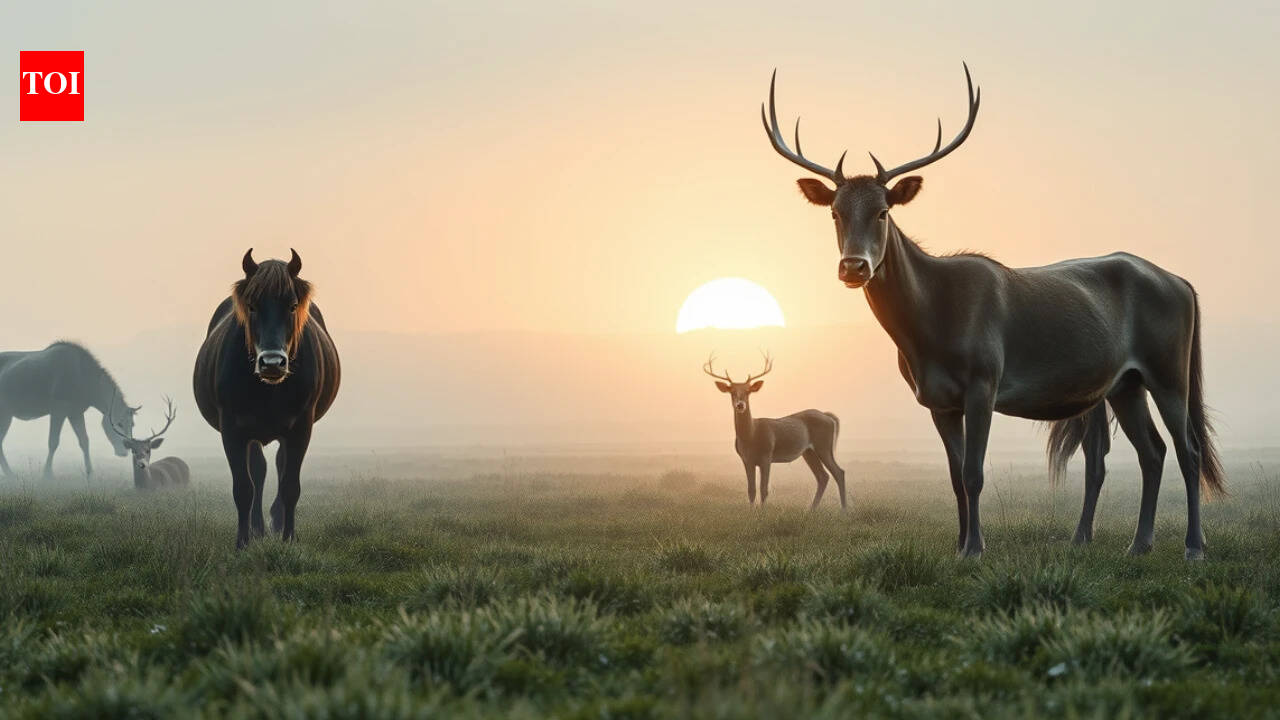

Representative Image of large herbivores grazing in a rewilded wetland reserve (AI-generated image)
In the early 1980s, Dutch ecologist Frans Vera introduced Heck cattle, Konik horses and red deer together into the Oostvaardersplassen, a stretch of reclaimed wetland in Flevoland province that had been left undeveloped after failed plans to use it for industry. Vera’s idea was that these large grazing animals, left to roam freely without human intervention, would recreate the open landscapes he believed large herbivores had maintained across pre-agricultural Europe, before farming and fencing reshaped the continent. For years, the experiment appeared to be working, drawing rare bird species and international conservation recognition. Then, over a series of increasingly severe winters, culminating in the highly controversial winter of 2017-18, the fundamental flaw in the plan became impossible to ignore, as mortality exceeded 50 per cent in parts of the reserve’s large herbivore population.
How the Oostvaardersplassen rewilding experiment began
According to a peer-reviewed study published in Ecology and Evolution, the herbivore population at Oostvaardersplassen developed after the initial introduction of a small number of individuals in 1983. That release brought all three grazing species into the reserve together, according to Vera’s own account and reporting from NBC News: 32 Heck cattle, 18 Konik horses and 40 red deer, all introduced in the same year rather than staggered over time. Left without predators and without conventional wildlife culling to manage their numbers, this mixed herd of grazing species grew steadily for more than three decades.Vera’s underlying theory, detailed in an account published in the journal Isis, challenged the conventional assumption that domesticated farm animals were needed to prevent grassland from naturally reverting to woodland. Vera proposed that wild grazing herds could achieve the same outcome on their own, and the Dutch government endorsed the plan, allowing the reserve to be managed on the basis of minimal human interference once the animals were introduced.
Why the reserve’s animal population grew largely unchecked
Without wolves, bears or other natural predators present, and without proactive population targets in place, the numbers of all three grazing species expanded for years. According to the Ecology and Evolution study, herbivore numbers at the reserve reached carrying capacity, the maximum population the available land could sustain, around 2008, after which numbers began fluctuating more dramatically depending on winter conditions each year.This did not mean the herds were left entirely to their own devices. Rangers already practised a form of reactive culling, shooting individual animals judged unlikely to survive the winter, rather than allowing visible suffering to continue unchecked. What the reserve avoided was the more conventional wildlife management approach of setting population targets in advance and culling proactively to stay within them, accepting winter mortality instead as part of natural population regulation.
What happened during the reserve’s most severe winters
The consequences of this approach became starkly visible over a series of harsh winters, most notably in 2005-06 and, most severely, in 2017-18, when mortality exceeded 50 per cent in parts of the reserve’s horse, cattle and red deer populations. According to NBC News, rangers at the 14,800-acre reserve continued shooting animals judged to be suffering too severely, since the reserve’s management maintained a policy of treating the herds as genuinely wild and declined to introduce regular supplementary feeding that might interfere with natural population regulation.Images of horse carcasses scattered across the reserve during the 2017-18 winter, combined with the scale of the die-off, triggered significant public backlash in the Netherlands, sparking a national debate over whether the reserve represented a genuine ecological achievement or a poorly managed experiment that had allowed large numbers of animals to suffer unnecessarily.
How Dutch authorities changed course after the controversy
The public reaction eventually forced a change in how the reserve was managed. Provincial authorities in Flevoland called for a significant reduction in animal numbers, setting an upper limit of 1,100 large grazers for the entire reserve, a target that required culling more than 1,800 deer, much of whose meat was subsequently sold for food. Herds of surviving horses were relocated to other nature reserves in Spain and Belarus. The central shift in policy was this move toward active, proactive population management, setting and enforcing numerical limits in advance, rather than a shift toward routine supplementary feeding, which has remained limited and continues to be debated among the reserve’s managers.
What Oostvaardersplassen reveals about the limits of rewilding
The Oostvaardersplassen experience has since become a widely cited cautionary case study in the broader field of rewilding, illustrating what can go wrong when large herbivores are introduced without the natural predators or environmental constraints that would normally regulate their numbers in an unenclosed wild ecosystem. Unlike rewilding projects that unfold across vast, connected landscapes, the reserve’s fenced boundaries meant animals had no ability to migrate elsewhere during periods of food scarcity, removing one of the natural checks that would typically limit population growth in the wild.More than four decades after Vera’s original idea was first put into practice, Oostvaardersplassen continues to operate as a nature reserve, but with significantly more active population management than its founders originally envisioned. The site remains a frequently referenced example within conservation science of the gap that can emerge between an elegant ecological theory and the messier, sometimes brutal realities of applying that theory to a fenced, finite piece of land. Go to Source