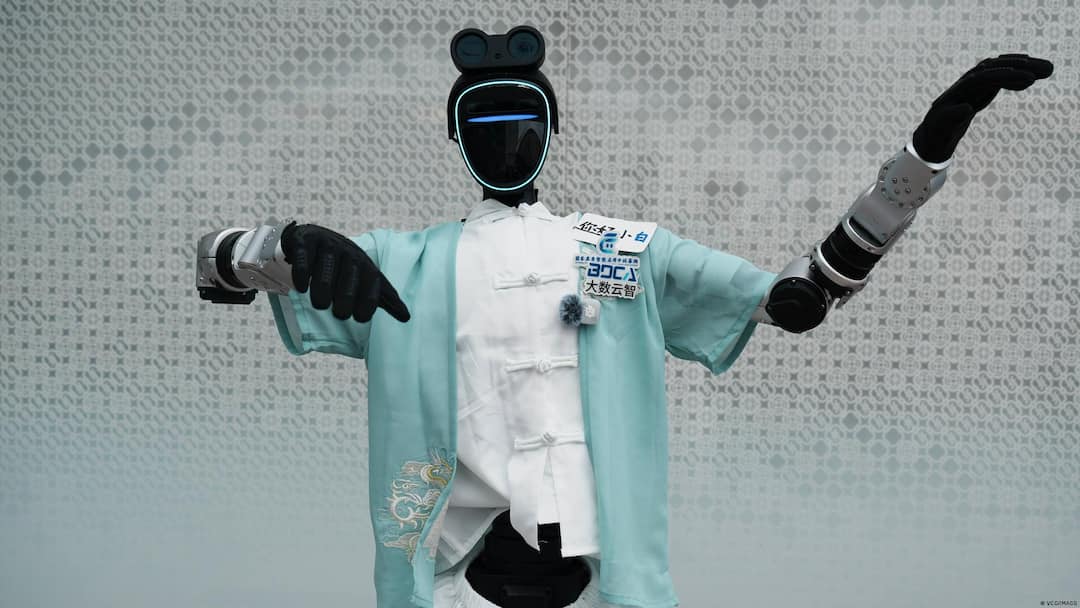

- Decision may strain US-China relations before September summit.
Edited by: Elizabeth Schumacher
The United States has announced a ban on the import of foreign-made humanoid and quadruped robots in a move which will likely exclude Chinese manufacturers from the US market and could strain tensions between Washington and Beijing.
The US Federal Communications Commission (FCC) said on Tuesday that “advanced robotic devices” produced abroad posed national and cyber security risks to the United States.
The decision was based on findings from a White House task force which concluded that foreign-built robots could create “a cybersecurity risk that threatens the security of critical infrastructure” and “the safety and security” of US residents.
The FCC defines the relevant mobile robots as devices weighing more than two kilograms that use sensors, network connectivity and software to achieve autonomous navigation, including the avoidance of obstacles.
ALSO READ | Zelenskyy Holds Talks With Trump On Air Defence And Strategic Cooperation
China Dominates The Market In Humanoid Robots
The market for humanoid and quadruped (also known as four-legged “robot dogs”) is seen as a major international growth area, with US and Chinese companies competing to develop the technology.
And China has a clear lead, with analysts at Barclays estimating that Chinese-made humanoid robots account for around 85% of the global market share. Morgan Stanley experts predict that China’s humanoid robot market could be worth $15 billion (€13.2 billion) by 2030.
“Chinese manufacturers have been scaling production and reducing costs faster than most overseas competitors,” Morningstar analyst Kangyuxiao Li told the Associated Press.
In the US, firms such as Figure AI are already deploying humanoid robots on production lines, while tech giant Tesla plans to begin production of its “Optimus” robot this year.
Currently, however, US robot exports remain in their hundreds while Unitree and AGIBOT, two of China’s biggest advanced robotics companies, each shipped more than 5,000 humanoid robots in 2025 alone, according to the technology research and advisory group Omdia.
FCC chairman Brendan Carr said the ban was also aimed at “secur[ing] America’s critical supply chains.”
But Li said the measures would not “materially slow China’s overall humanoid development, given the size of its domestic manufacturing base and opportunities in other export markets.”
Trump-Xi Summit: The Diplomatic Ramifications
Beyond the industrial market effects, the FCC ban could also have diplomatic consequences ahead of a meeting between US President Donald Trump and Chinese Premier Xi Jinping in September.
The US has already banned imports of Chinese-made drones and is considering restrictions on Chinese open-source artificial intelligence (AI) models, citing cybersecurity concerns including espionage, surveillance and data collection.
The Pentagon recently placed Unitree and several other major Chinese technology companies on its list of firms which it claims have links to the Chinese military, a claim that Beijing said it “firmly opposes.”
“It’s a steady drumbeat of potential flashpoints heading into [the] Trump-Xi summit,” said Samm Sacks, a senior fellow at New America, a think tank focused on Chinese technology policies.
Most humanoid robots are currently used for industrial applications in confined spaces, such as automobile factories or storage warehouses. Stationary industrial robots are to be exempt from the FCC ban but the definition could also cover advanced robot vacuum cleaners.
ALSO READ | Rescuers Race Against Time In Japan As Earthquake Death Toll Rises To 13
The FCC also added foreign-made power inverters to the list – devices that, among other functions, convert direct current from solar panels into standard alternating current, which can be used by the electrical grid.
The agency cited similar cybersecurity concerns, saying network-connected inverters could be remotely disabled or used to collect data.
Like the ban on humanoid robots, the restrictions on inverters are also expected to hit Chinese manufacturers hardest, given that they currently dominate the global solar inverter market.
(Disclaimer: This report first appeared on Deutsche Welle, and has been republished on ABP Live as part of a special arrangement. Apart from the headline, no changes have been made in the report by ABP Live.)