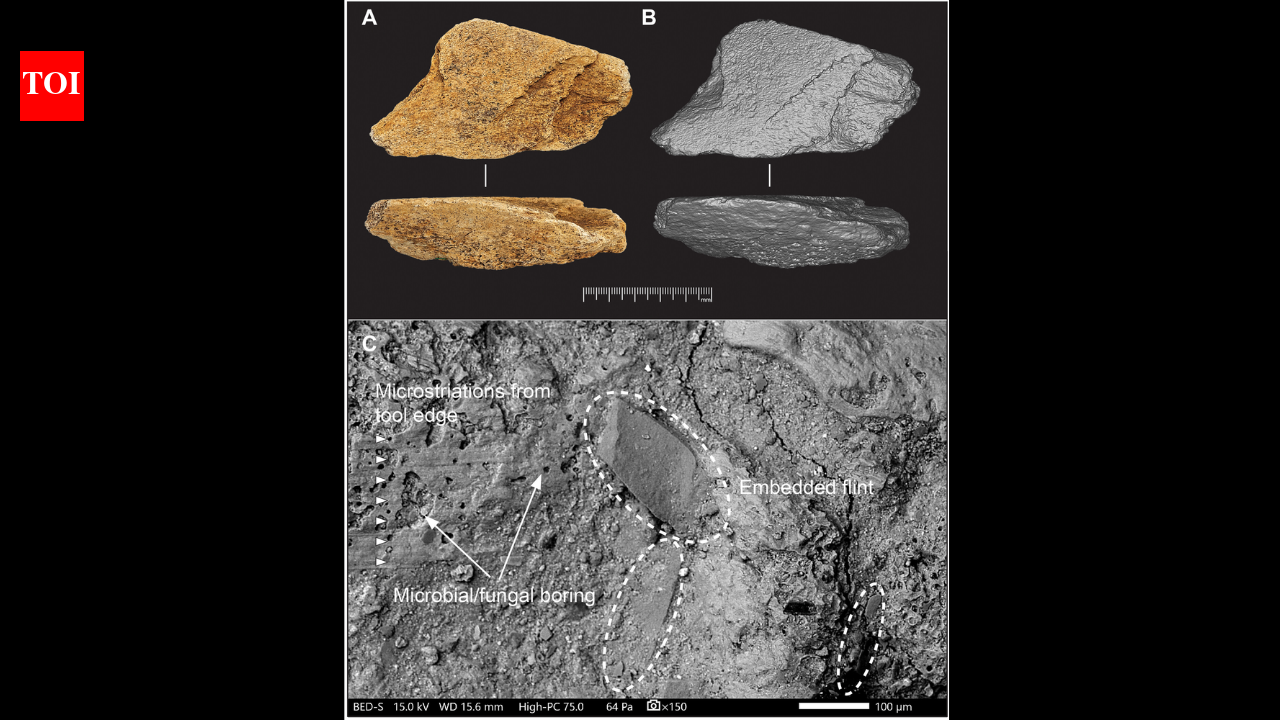

pc: Study: Elephant-bone tool (NHMUK PV UNREG 4339) from intertidal deposits at the Boxgrove Waterhole Site
Half a million years ago, people living in what is now southern England were doing far more than shaping stone into cutting tools. A newly analysed elephant bone from the famous Boxgrove archaeological site suggests they were carefully choosing, modifying and carrying specialised implements made from animal remains to improve their stone-working techniques. The discovery offers one of the clearest glimpses yet of how sophisticated Acheulean technology had become during the Middle Pleistocene. Rather than using whatever materials happened to be nearby, these hominins appear to have selected an unusually durable elephant bone, shaped it into a practical hammer and repeatedly used it to maintain finely crafted flint handaxes. According to the study published in Science Advances, titled “The earliest elephant-bone tool from Europe: An unexpected raw material for precision knapping of Acheulean handaxes”, this represents the earliest confirmed elephant-bone knapping hammer discovered in Europe and provides fresh evidence of long-term planning in early human technology.
How the 500,000-year-old elephant bone tool was made
The object itself is a fragment of elephant cortical bone measuring just over 10 centimetres long. At first glance it might seem unremarkable, but microscopic examination revealed a sequence of deliberate modifications that separated it from ordinary animal remains.The bone was first broken while it was still fresh before large flakes were intentionally removed from its edges to create a workable shape. The pattern of fractures did not resemble damage caused by trampling, weathering or attempts to extract marrow. Instead, the scars indicated deliberate shaping that prepared the fragment for use as a handheld implement.The researchers also identified fine cut marks that appear to have been made before the bone became a tool. These marks may have resulted from removing remaining soft tissue so the fragment could be prepared for later use, although the authors note that their exact purpose cannot be confirmed.
Microscopic evidence confirms the elephant bone was used as a tool
The strongest evidence came from microscopic damage spread across three areas of the bone’s surface. The battered patches contained clusters of pits, grooves and fine scratches unlike those expected from natural wear.Using scanning electron microscopy and chemical analysis, the team detected numerous tiny fragments of embedded flint inside these impact marks. As per the study, the combination of pits, parallel scores and flint chips is characteristic of a bone retoucher, a soft hammer used to reshape and sharpen stone tools with greater precision than a hard stone hammer could provide.The pattern of damage also suggested repeated use. The bone was probably employed to deliver relatively light blows during the final stages of maintaining cutting edges rather than during the heavy shaping of new handaxes. The researchers estimate it may have delivered well over one hundred strikes across multiple episodes of tool maintenance before being discarded or left behind.
Why the Boxgrove elephant bone tool is an extraordinary discovery
Boxgrove in West Sussex has long been recognised as one of Europe’s richest Lower Palaeolithic sites, preserving evidence from roughly 480,000 years ago. Excavations have uncovered hundreds of carefully made handaxes, butchered animal remains, rare human fossils and numerous bone and antler implements associated with flint working.According to the paper, the elephant bone hammer fits into a much broader technological toolkit. Early humans at Boxgrove were already using different kinds of hammers for different stages of tool production. Hard stone hammers helped rough out handaxes, while softer antler and bone tools allowed finer thinning, sharpening and reshaping. The elephant bone appears to have been selected for these more delicate finishing tasks because of its thick, durable outer layer.The researchers also point out that elephant bones are exceptionally rare at Boxgrove, making the choice of raw material especially significant. The bone was probably collected elsewhere, shaped before arriving at the site and transported for repeated use, suggesting that valuable tools were curated rather than simply made and discarded where they were found.
What the elephant bone tool reveals about early human intelligence
The find adds another piece to a growing picture of Middle Pleistocene hominins as flexible and thoughtful toolmakers rather than simple stone knappers. Producing the refined Boxgrove handaxes required careful selection of raw materials, the use of different hammer types for different stages of manufacture and the ability to plan. They argue that the elephant-bone tool demonstrates deliberate resource selection, repeated maintenance of equipment and an adaptable technological approach suited to changing environments. Such behaviour, the researchers suggest, helped these populations expand into cooler parts of Europe and cope with increasingly varied landscapes. Go to Source