
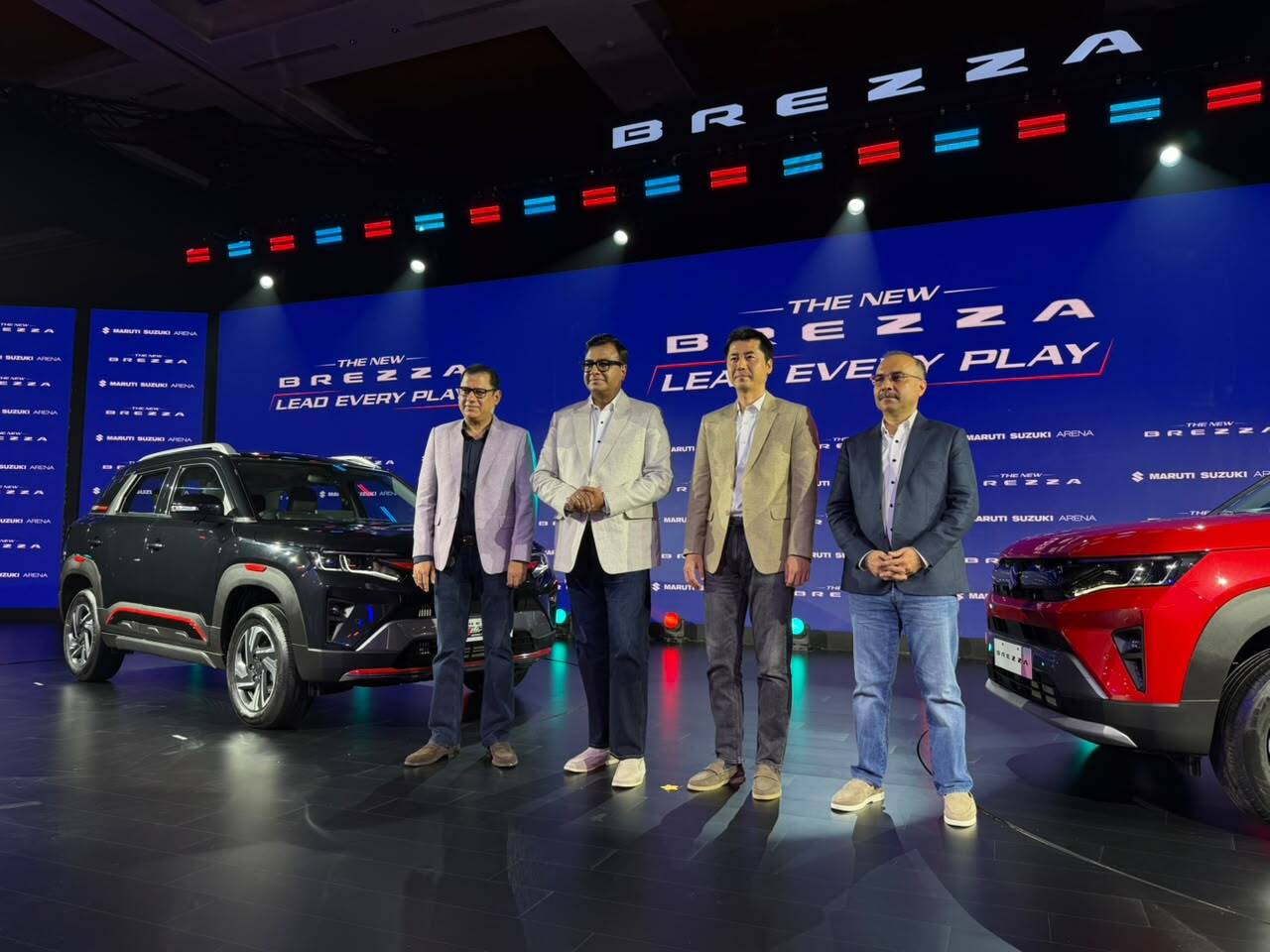
 The updated Brezza lineup features a new 1.0L turbo-petrol, improved performance, an underbody CNG option, and a 1.5L NA engine.
Maruti Suzuki looks to reposition the Brezza around performance rather than cosmetic upgrades, as India’s largest carmaker attempts to regain its leadership in the country’s fiercely contested compact SUV segment. The refreshed version of the compact SUV was launched on Friday at an introductory price of ₹7.40 lakh.
“We could have done a superficial refresh—change the bumper or grille—but that wasn’t the brief. We wanted to understand what customers actually wanted from the product,” says Partho Benerjee, Senior Executive Officer – Marketing and Sales, Maruti Suzuki India, during an interaction with journalists ahead of the launch in Mumbai.
The outcome is a Brezza lineup centred on three propositions—a new 1.0L turbo-petrol powertrain, higher performance and an underbody CNG variant. The refreshed Brezza is also available with a 1.5L Naturally Aspirated engine option.
The strategy comes at a time when the sub-four-metre SUV market has become one of the most competitive passenger vehicle (PV) segments in India, with rivals such as Tata Motors, Hyundai, Mahindra and Kia steadily intensifying the fight for market share. There has been at least one new model introduction in the segment every year since the Brezza debuted in 2016.
The compact SUV segment has seen an estimated CAGR of 23 per cent over the past five years. Currently, almost one out of ten passenger vehicles sold in India is a compact SUV.
Beyond performance, Maruti is also seeking to reposition CNG variants beyond their traditional image as low-running-cost alternatives. Banerjee argues that a growing section of buyers chooses CNG vehicles for environmental reasons in addition to operating costs.
He says Maruti Suzuki India currently holds around a 54 per cent share of India’s clean and green vehicle market of CNGs, hybrids and EVs, and believes the underbody CNG packaging in the refreshed model will offer a stronger value proposition for former diesel buyers.
Focus on psychographics over demographic segmentation
Banerjee says Maruti’s consumer clinics revealed that buyers were less interested in technical specifications such as horsepower or torque figures than in how the vehicle performed in real-world driving. “The message was very loud and clear. Customers wanted quicker acceleration initially and more power for highway driving,” says Banerjee. The company believes this shift reflects evolving buyer psychographics rather than conventional demographic segmentation. “Everybody talks about demographics. We believe it is increasingly about understanding the customer’s mindset,” he says.
Defending leadership in a rapidly expanding segment
The product refresh comes as the compact SUV category continues to outperform most other passenger vehicle segments. In FY26, the compact SUV segment grew around 6 per cent by clocking a sales volume of 1.47 million units.
Banerjee estimates compact SUVs now account for around 30 per cent of India’s PV market, while SUVs overall has a 57-58 per cent share in the industry. Rising disposable incomes, easier financing and consumer aspirations are seen as factors that continue to drive the shift toward SUVs.
Since its launch in 2016, the Brezza has sold over 1.4 million units, establishing itself as one of India’s most successful SUVs. The model sold around 180,000 units in 2025-26, and was the third-largest player in its segment with a claimed market share of 31 per cent.
However, the competitive landscape has changed dramatically. When the Brezza was introduced, competition was limited to a handful of products. Today, the segment has a plethora of options – Tata Nexon, Hyundai Venue, Kia Sonet, Mahindra XUV 3XO, Renault Kiger, Nissan Magnite, Skoda Kylaq and others.
GST 2.0 altered competitive equation?
Responding to questions on whether the Brezza had lost some of its dominance, Banerjee argued that the shift in market shares should be viewed in the context of the revised GST regime for compact SUVs.
“After the GST, we were at around 45 per cent market share and then came to around 40 per cent. India is a price-sensitive market. As prices come down, demand increases,” he says.
He maintains that Brezza’s monthly volumes have remained broadly stable at around 15,000 units per month, adding that the recent moderation in dispatches was linked to the impending product refresh and production constraints rather than weakening consumer demand.
Banerjee also dismissed suggestions that Maruti introduce the new 1.0L engine to benefit from revised taxation norms. “Product cycles are much longer. These products take three to four years to develop. GST was not the consideration,” he says. GST on petrol engines of up to 1200 cc (1.2L) in PVs within 4m in length was reduced from 28 per cent to 18 per cent in the GST revision made in September 2025.
Demand outstripping supply
Maruti Suzuki claims that another factor that affected Brezza and Fronx sales was constrained production capacity. Banerjee says the company entered Q4 of the previous financial year with dealer inventory of only about seven days and was unable to fully capitalise on demand because of supply limitations.
Additional production from Maruti Suzuki’s Kharkhoda plant, inaugurated on July 2, is expected to ease supply bottlenecks. Will that help the Brezza power ahead to its once-held numero uno position? Possible, though not easy, as OEMs like Hyundai, Tata, Mahindra have also lined up launches in the compact SUV segment for later this year, and next year too. The consumer, though, may be spoilt for choice.