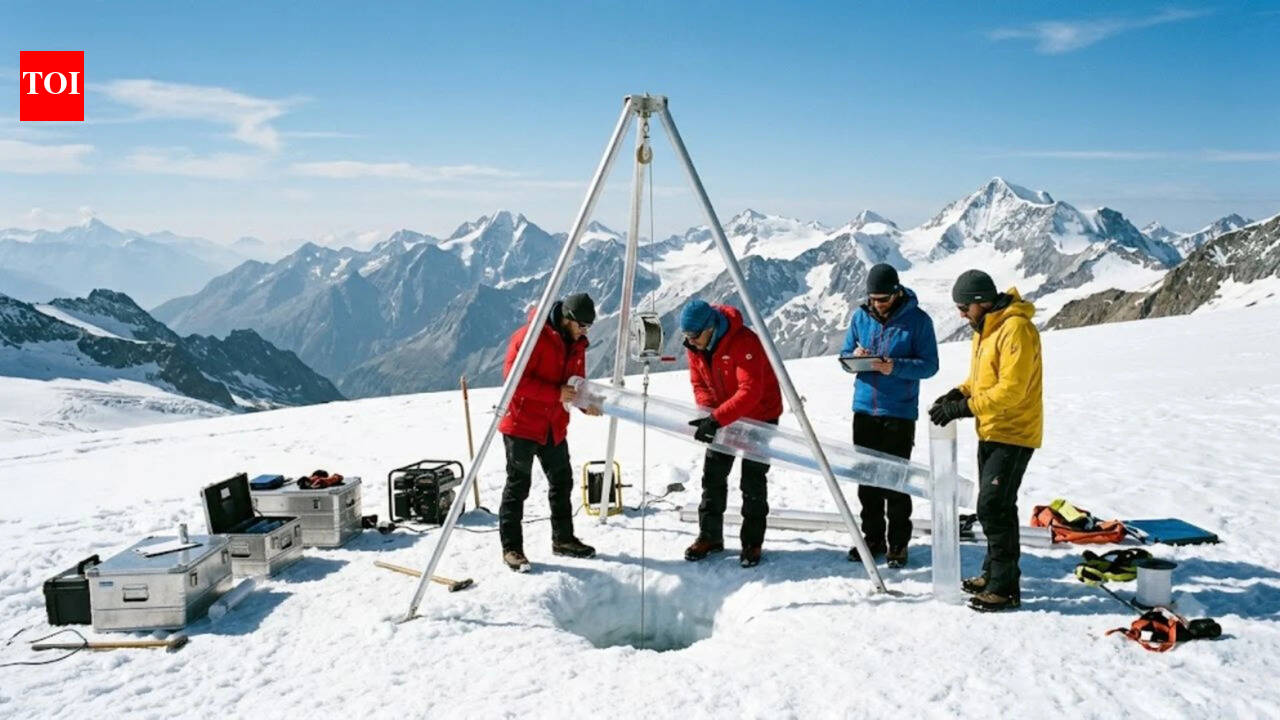

Scientists working on Alpine glacier (AI-generated image)
Scientists drilled 33 feet into ice and recovered a 2,000-year climate record, a frozen capsule that can reveal how the atmosphere breathed long before modern measurements.High on the Weißseespitze glacier in the eastern Alps, an international research team extracted an ice core barely 33 feet long that preserves two centuries of European environmental history.Published in the official study in Frontiers in Earth Science, the research details a timeline stretching from the Roman era around the year 128 through to 1641. The upper section of the core preserves microscopic traces of ancient metal smelting, forest fire smoke, mineral dust, and far-off volcanic fallout trapped inside compressed snow layers.The research was led by Azzurra Spagnesi of Ca’ Foscari University of Venice, working alongside Pascal Bohleber of the Alfred Wegener Institute, Andrea Fischer of the Austrian Academy of Sciences, and colleagues from Heidelberg University.
Reading history frozen in snow
At roughly 11,480 feet above sea level, the summit ice cap acts as a high-altitude mountain mailbox. Winds carry dust, salts, smoke, and metal particles directly to the peak, where falling snow buries them layer by layer over centuries.“These remarkable climate archives function much like a history book,” said lead author Azzurra Spagnesi.Unlike deep polar ice cores that trap ancient air bubbles, this Alpine core works by trapping fallen airborne particles. The scientists tested the core for 18 trace elements, organic acids, microscopic charcoal, and levoglucosan, a chemical created when wood and plant material burns. Statistical analysis allowed the team to separate human pollution from natural sources like windblown rock dust and sea salts.Direct human emissions accounted for only about seven percent of the total chemical records found in the core. Because natural materials make up the remaining 93 percent, the sample gives scientists a clean baseline showing how European air behaved long before factories, heavy coal burning, and car exhaust changed the atmosphere.
Medieval mining and forest fires
Despite low overall human pollution, the ice core clearly captured the growth of early European industry. Between the years 700 and 1200, metal levels remained low. However, sharp spikes in lead, copper, silver, and arsenic appeared starting around the year 950.These increases match historical records of expanding silver and copper mining across the Italian Alps, nearby Alpine valleys, and Germany’s Harz Mountains, where melting metal ores released toxic metals into the air.The ice also documented ancient fires. Researchers found high levels of levoglucosan dated between 902 and 1280. A separate peat core taken from a bog 12 miles away recorded a matching surge in microscopic charcoal between 822 and 1092.This overlap points to widespread or long-lasting fires across the region rather than a single local blaze. A warm, dry climate period from 950 to 1040 dried out Alpine plants and made them easier to burn, while growing populations cleared forest land for farming and fields using fire. Climate provided the dry conditions, and human land use supplied the sparks.
Volcanic fallout and vanishing ice
The glacier also recorded global events happening hundreds or thousands of miles away. Chemical spikes paired with rare metal concentrations appeared around the years 1235 and 1580, marking volcanic eruptions whose fine particles traveled through the air before falling with snowfall on the Alps. The 1235 signal matches giant volcanic eruptions previously found in Greenland and Antarctic ice cores.To place each chemical signal on an accurate calendar, the team combined advanced carbon methods with argon-39 dating, a process that measures extremely rare radioactive atoms to estimate when ice formed. The testing showed that even the surface ice collected in 2019 was already 400 years old, meaning modern industrial-era ice layers had already melted away.Earlier research from 2023 showed that chemical and climate signals remained readable despite surface loss, while a separate dating study showed that deeper ice at the site reaches back roughly 6,000 years.However, rapid warming is destroying the mountain archive. Measurements show the drilling site lost nearly 15 feet of ice thickness between 2019 and 2025, dropping from 33 feet deep to roughly 18 feet. A companion study estimated that the entire summit glacier could vanish within 10 to 20 years if recent average ice losses continue.When the glacier ice melts, scientists lose far more than frozen water. The chemical particles, trapped gases, and climate clues wash away permanently and cannot be brought back.“It is about safeguarding the memory of Earth’s climate,” Spagnesi said.Researchers are racing to collect and save cores from threatened mountain glaciers so future laboratories can analyze them with tools that do not exist yet, keeping a record of how mining, land use, drought, fires, dust, and volcanoes once shared the same sky. Go to Source