
Britain’s canal network was never designed with nature in mind. Built more than two centuries ago to move coal, clay and cotton across an industrialising country, these engineered waterways were about as far from a natural habitat as a landscape could get. Yet today, nearly 8,000 kilometres of canals crisscrossing the country have quietly become something else entirely, a refuge for some of Britain’s most threatened wildlife. From water voles clinging on after a catastrophic population crash to otters returning to cities they vanished from decades ago, these industrial relics are now doing ecological work nobody originally intended, offering a rare example of infrastructure built for one purpose becoming essential for something else altogether.
Why canals behave so differently from natural rivers
Robert Grabowski of the Cranfield Water Science Institute describes canals as behaving more like long, thin lakes than like rivers, since their water levels stay largely fixed rather than shifting with floods and erosion. Natural rivers create constantly changing habitat through eddies, pools and rapids as water speed and volume fluctuate, while canals offer something steadier: silty beds, uniform banks and slow-moving water lined with grassy, wildflower-rich margins. This predictability, while ecologically less dramatic than a wild river, has turned out to suit several species extremely well.
How a near-extinct mammal found refuge in canal banks
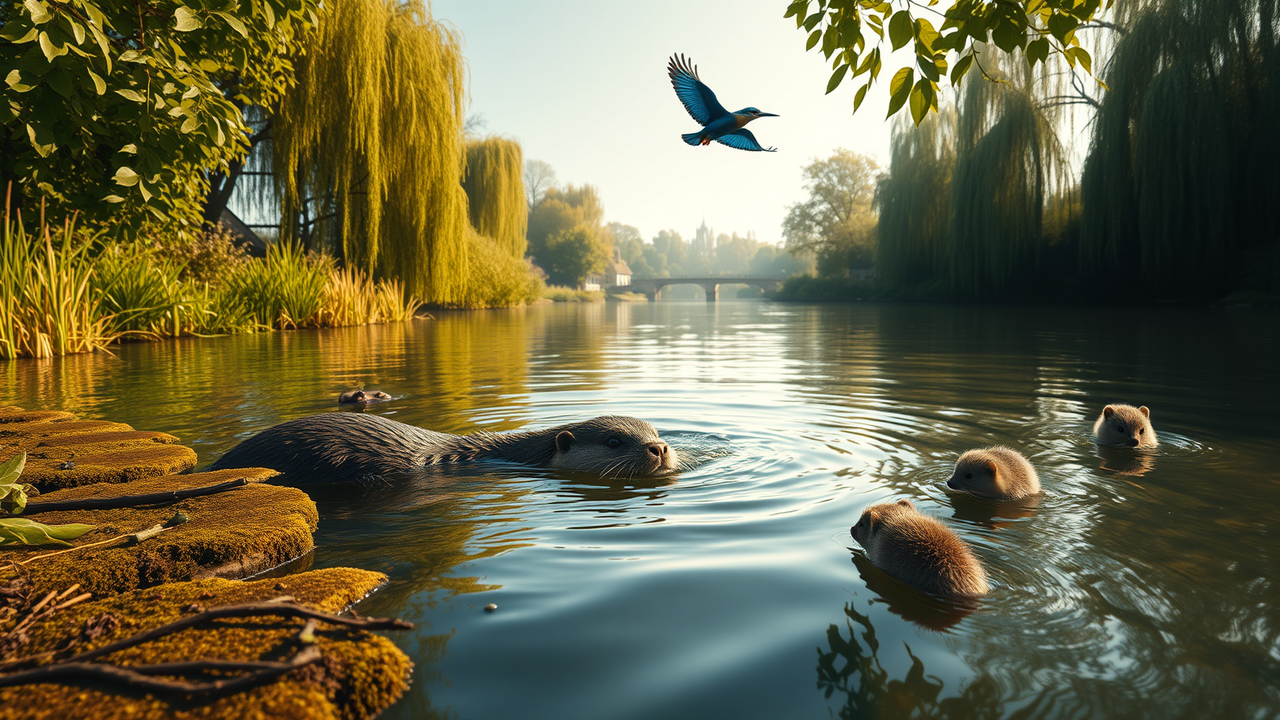
Few species illustrate this better than the water vole, once a familiar sight along British waterways and now considered one of the country’s most endangered mammals. According to People’s Trust for Endangered Species, Britain had lost more than 90 per cent of its water voles by the end of the 1990s due to habitat loss and predation by invasive American mink, and more recent monitoring shows their distribution declined by a further 39 per cent across Britain between 2006 and 2022. For this shy, solitary species, canals with consistently calm waters and gently sloping banks have become a critical refuge, and conservation groups including Warwickshire Wildlife Trust have gone further still, reshaping stretches of the Coventry and Oxford canals with coir rolls, climbing ramps and even purpose-built vole shelters to help them recover.
The comeback of otters and what it means for other species
Otters offer a similarly striking recovery story. Once locally extinct across much of England, they have returned to almost every county, including establishing themselves along urban canals, a strong signal of improving water quality. Otters need clean water, reliable food and dense bankside vegetation, all of which canals can offer along their long, relatively undisturbed banks. There is also growing belief among ecologists that the otter’s expanding presence may be indirectly helping water voles recover, since otters appear to be suppressing American mink populations as they reclaim territory across the canal network.
Bats, eels and birds that depend on the water’s edge
Canals support an unusually wide mix of species beyond mammals. Daubenton’s bat, sometimes called the water bat, was among the first species to benefit from the original canal building boom, using the network for reliable foraging and roosting sites, with individuals recorded hunting along stretches of canal for up to ten kilometres in a single night. European eels, which hatch far away in the Sargasso Sea and drift on ocean currents for years before reaching Europe, often use canal systems as inland travel routes during the final stage of an extraordinary migration. Kingfishers, reed warblers and herons round out a community of species that rely on the canal network’s calm waters and sheltered banks in ways that other habitats do not always provide.
The measurable link between canals and human wellbeing
The benefits of canals are not limited to wildlife. A study titled The mental health benefits of visiting canals and rivers: An ecological momentary assessment study, published in PLOS One and carried out by King’s College London in partnership with the Canal and River Trust, used a smartphone application called Urban Mind to gather real-time reports on participants’ location and mental state. The research found that visits to canals and rivers were associated with higher levels of wellbeing, stronger feelings of safety and social inclusion, with improvements in mood reported to last as long as 24 hours after leaving the waterside. According to the Canal and River Trust, roughly nine million people currently live within one kilometre of a canal in Britain.
Why these ageing waterways remain fragile despite their value
Canals are not without serious pressures. Their slow-moving waters collect pollutants ranging from road runoff to agricultural nutrients, and rising boat traffic can stir up heavy metals long settled into canal beds, allowing hardier, pollution-tolerant species to crowd out more sensitive ones. Invasive species add further strain, with floating pennywort forming dense mats that block light and oxygen, while signal crayfish continue to outcompete native white-clawed crayfish. Climate change compounds these problems further, with recent droughts forcing sections of canals such as the Leeds and Liverpool Canal to close entirely, stranding fish and aquatic plants as water levels dropped sharply.
A network that only survives with constant maintenance
Unlike wild rivers, canals cannot simply be left alone to function. Regular dredging, structural repairs and careful water level management are required to prevent large sections from silting up and reverting to marshland, much as happened during the nineteenth and early twentieth centuries when the network fell into disrepair after railways took over much of Britain’s freight traffic. Even small operational decisions, timing towpath mowing around nesting season or angling canalside lighting away from bat flight paths, can determine whether a stretch of canal continues to function as a genuine habitat or gradually loses its ecological value.
An accidental habitat that keeps proving its worth
Built entirely for industry, Britain’s canals have become something their original engineers could never have anticipated, blue-green corridors threading through farmland, suburbs and city centres alike, offering both struggling wildlife and increasingly urbanised human communities a rare, functioning connection to nature. In a country where wetlands have been drained, and rivers straightened for centuries, these 250-year-old channels continue to demonstrate that infrastructure built with no ecological intention whatsoever can still end up mattering enormously for the species and people who depend on it today. Go to Source