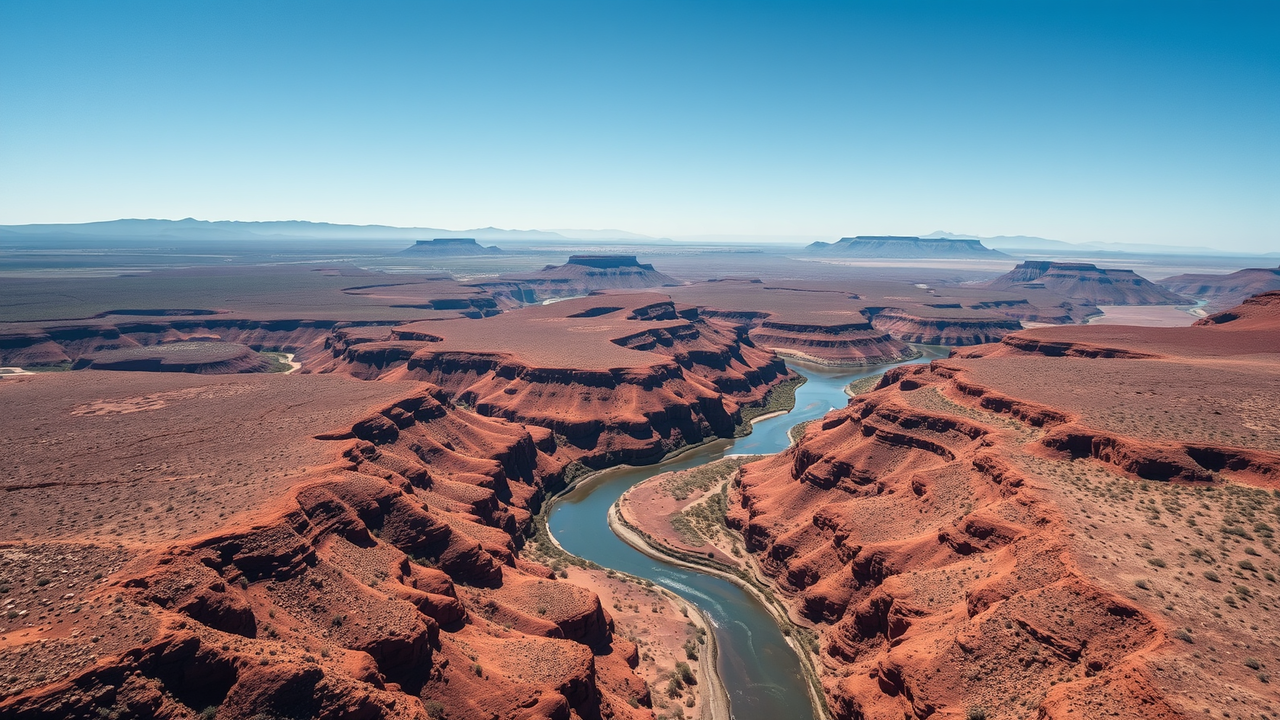

Somewhere in the dry heart of Central Australia runs a river with a reputation far bigger than its size. The Finke, also known by its Arrernte name Lhere Pirnte and commonly called Larapinta, is often described as the oldest river system on earth, older than the dinosaurs and already flowing before the first reptile ever walked on land. It is a striking claim, and one that sounds almost too neat to be true. Looking closely at the geology behind it, the real story turns out to be both more careful and more interesting than the headline version, resting on inherited drainage patterns rather than one unbroken channel of water running for hundreds of millions of years.
What it actually means for a river to be ancient
Calling a river hundreds of millions of years old does not mean the exact same water has followed the exact same banks since the Palaeozoic Era. Rivers are naturally restless, with bends shifting, floods cutting new shortcuts, sediment blocking old channels, and the land itself tilting or rising over time. Even the sand and gravel inside a riverbed get buried, resurface, and move again. When geologists talk about the Finke’s age, they are really talking about something called inherited drainage, meaning the upper river may still follow a route across Central Australia that was first established in the Palaeozoic Era, even though every gorge and layer of sediment along that path has been reworked many times since.
Why the river cuts straight through mountain ranges
Most rivers take the easy path downhill, following valleys and avoiding harder rock wherever possible. The upper Finke does something unusual by cutting directly across folded ridges in the MacDonnell, Krichauff and James ranges, carving deep bends through solid rock rather than flowing around it. Geologists explain this through a process called antecedence, where a river sets its course across low ground and then keeps cutting downward as the land slowly rises or folds beneath it. The surrounding ranges were shaped during a long period of mountain building known as the Alice Springs Orogeny, and the argument for an ancient Finke rests on the idea that its course across these ranges predates at least some of that deformation, some of which dates back roughly 300 million years.
What a major 2022 study actually found
A widely cited 2022 paper in Earth and Planetary Science Letters, led by geomorphologist John Jansen, examined a strange stretch of overlapping active and abandoned gorges along roughly 30 kilometres of the upper Finke. The researchers studied the shape of these gorges and measured cosmogenic isotopes in old river gravels, which can reveal how long sediment has been buried or exposed near the surface. Their results pointed to gravel being stored underground for several million years, supporting a picture of repeated, gentle tilting where the river cut a gorge, filled it with sediment, shifted course and then cut again. Importantly, the study itself describes the extreme antiquity of the Finke as speculative, and it never actually produced a firm 300 million year date for when the river began.
A river that spends much of its life completely dry
The Finke begins in the MacDonnell Ranges and travels roughly 800 kilometres southeast toward the Lake Eyre Basin, though quoted lengths vary depending on which channels are counted. For long stretches of the year, it runs completely dry, while certain waterholes remain permanent or semi-permanent along the way. After heavy rain, these separated sections can reconnect and carry significant flows through the country that looked bone dry only weeks earlier. According to the Finke Gorge National Park joint management plan, the river’s Arrernte name Lhere Pirnte translates to salty river, and the plan describes it as part of a living cultural landscape for Arrernte Traditional Owners, a meaning that exists well beyond any geological ranking.
Why the dinosaur and reptile comparison does not fully hold up
Dinosaurs first appear in the fossil record around 230 million years ago, so even the lower end of the Finke’s estimated age would place it roughly 70 million years earlier. The claim about predating reptiles altogether is harder to defend since a 2025 study published in Nature by John Long and colleagues described probable amniote footprints, the group that includes reptiles, birds and mammals, from rocks in Victoria dated to about 356 million years ago. This pushed the likely origin of amniotes much further back than previously accepted, meaning a Finke age closer to 300 million years would actually be younger than these footprints, while only the upper end of its estimated range would predate them.
The more accurate way to describe the Finke
Rather than claiming an outright world record, Geoscience Australia describes the Finke as one of the oldest rivers in the world, a description that better reflects the evidence. There is no single global method for certifying the oldest surviving river, since ages are pieced together from incomplete landforms, sediment layers, erosion rates and tectonic history, and different studies may be measuring slightly different things entirely. What makes the Finke remarkable is not an unbroken ancient channel but the survival of an old drainage pattern, shaped and reshaped many times over, in a landscape stable and slow-eroding enough to keep that pattern visible for hundreds of millions of years. Go to Source