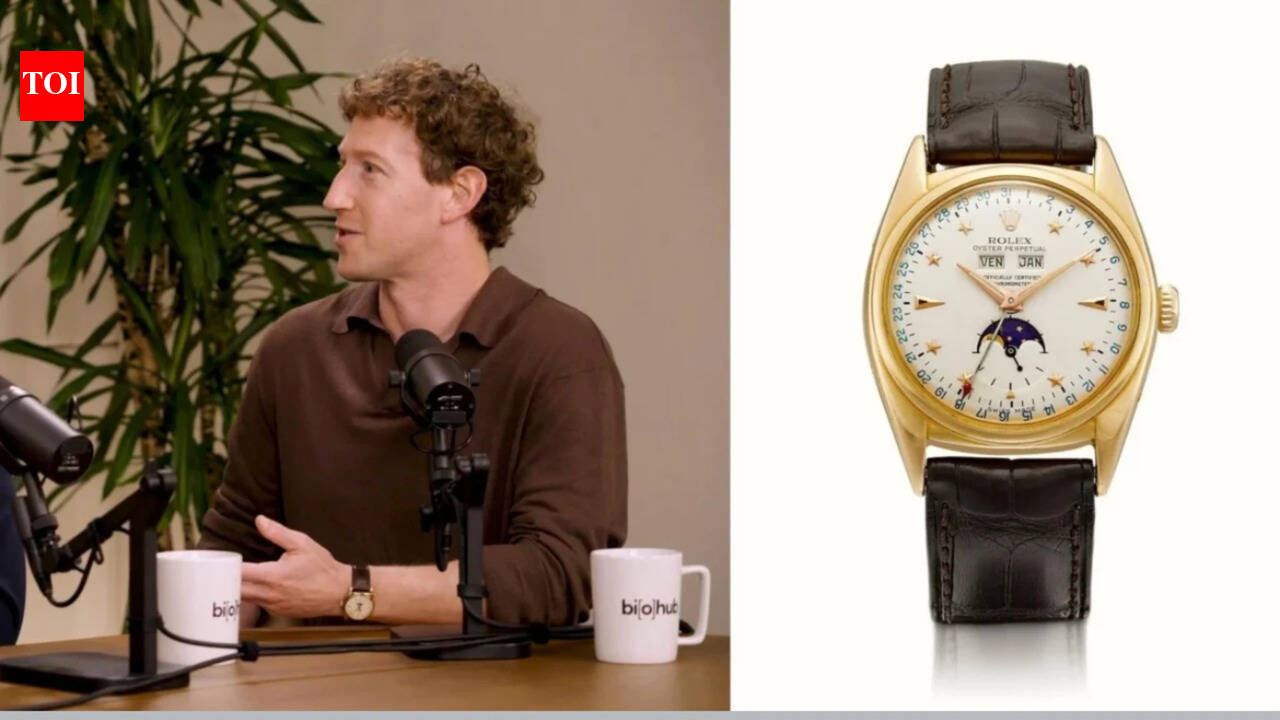

Mark Zuckerberg wore a $2 million Rolex that tracks the moon while talking about an AI lab trying to change the clock on disease
Meta CEO Mark Zuckerberg recently detailed his plans to use artificial intelligence (AI) to permanently accelerate medical research while wearing a vintage $2 million Rolex designed to track the mechanical cycles of the moon.The tech billionaire was spotted with the rare timepiece on his wrist during a filmed interview on the ‘No Priors’ podcast alongside his wife, Priscilla Chan. The couple used the platform to discuss the goals of their medical research facility, Biohub, an initiative funded by the Chan-Zuckerberg Initiative that aims to deploy cutting-edge computer models to identify, treat and eradicate human diseases.The conversation focused on the future of digital science, but horological experts were immediately drawn to the historical masterpiece sitting on Zuckerberg’s left wrist. The watch was identified as a vintage Rolex reference 6062 “Stelline,” an incredibly scarce mid-century creation that stands as one of the most valuable and highly sought-after collector pieces in the world. Depending on the specific case metal and overall state of preservation, examples of the Stelline routinely cross the seven-figure threshold at international auction houses, with top-tier variations valuing upto $2 million. Zuckerberg is an executive worth an estimated $200 billion who spent his early career pioneering the digital world. Yet, he chose an entirely mechanical, analogue instrument from the 1950s to accompany a discussion on solving complex biological problems with modern AI algorithms.
A masterpiece from the Golden Age of horology
The Reference 6062 holds a special place in Rolex history. It was introduced around 1950, before the Swiss watchmaker became best known for tough tool watches such as the Submariner, Explorer and GMT-Master. Produced for only a few years, the Reference 6062 was one of just two Rolex models ever fitted with an automatic triple calendar and an integrated moonphase complication. The other was the Reference 8171.What made the Reference 6062 stand out was its ability to combine advanced watchmaking with Rolex’s reliable design. It used the automatic calibre 9¾ movement inside the brand’s signature 36 mm Oyster case with a screw-down case back, helping it retain the water-resistant qualities for which Rolex had become famous.