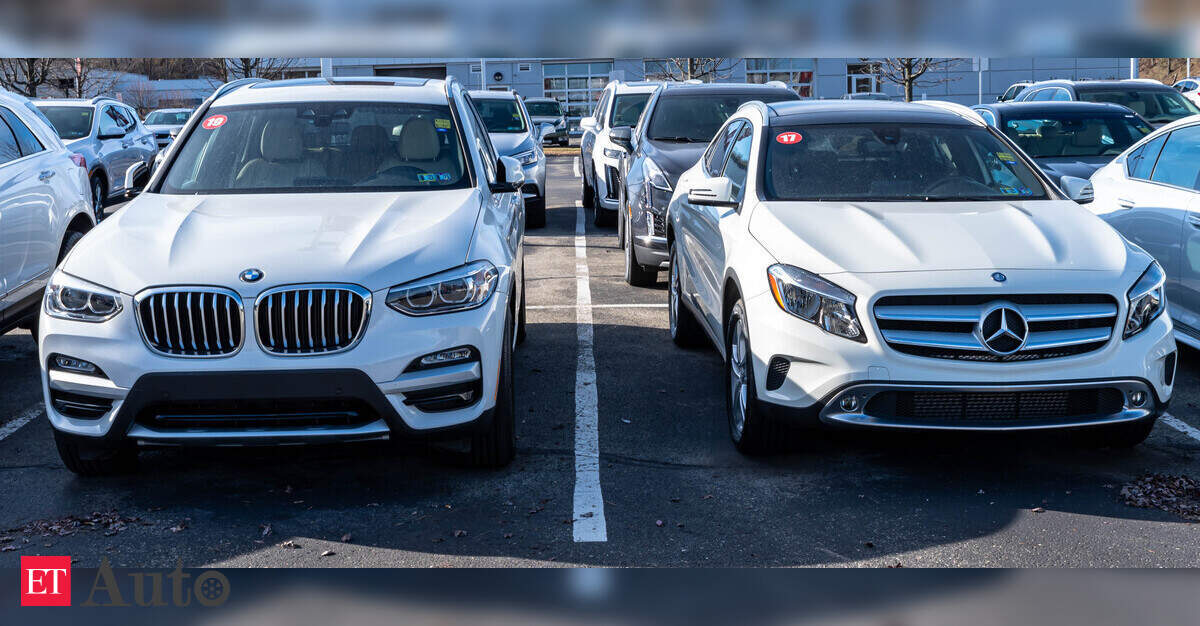

 The two German rivals captured nearly 75% of India’s luxury car market, which grew 4% YoY to 26,688 units in H1.
India’s luxury car market has entered a new phase of competition with the latest Vahan data indicating a changing landscape. BMW Group India has moved ahead of Mercedes-Benz India in H1 2026 retail sales, overtaking its arch rival in a close fight that separated the two by just 571 units in the six-month period.
According to Vahan retail registration data for January-June 2026, BMW sold 10,043 vehicles (up 15 per cent YoY), securing a 38 per cent market share, while Mercedes-Benz registered 9,472 units (a 3 per cent decline), closing the first half with a 35 per cent retail market share.
Together, the two German rivals accounted for nearly three-fourths of India’s luxury car market, which stood at 26,688 retail registrations during the six-month period, recording a 4 per cent YoY growth.
However, on the wholesales front, Mercedes-Benz India continued to lead the H1 game with 9,768 units dispatched in the January-June 2026 period (+9 per cent / 9,013), whereas BMW sold 9,075 units (+17 per cent / 7,774) to its dealers.
Experts suggest BMW’s rise has been driven by strong demand across internal combustion, electric and performance models, as well as a fast-growing network. According to Puneet Gupta, Director, Mobility Global, “BMW India’s strong conviction in electric mobility has been a key factor behind its recent growth in India. As an early mover in the premium EV segment, the company was well positioned to benefit from the sharp increase in EV demand, particularly following the Middle East crisis, which accelerated consumer interest in electric vehicles.”
EVs key differentiators for BMW
Electric vehicles have emerged as a key differentiator between the two German brands. BMW has consistently reported strong demand for models such as the iX1 Long Wheelbase, iX, i5 and i7, giving it an early-mover advantage in the premium EV space where affluent buyers are increasingly willing to adopt electric mobility.
In its H1 2026 wholesales numbers, the company reported a 78 per cent YoY growth in electric vehicle sales to 2,359 units, commanding a 69 per cent market share in the luxury EV category in India. The iX1 Long Wheelbase at the lower end is one of the major drivers of this growth, taking the company’s EV penetration in its portfolio to 26 per cent in H1 2026, up from being pegged at 21 per cent a year ago.
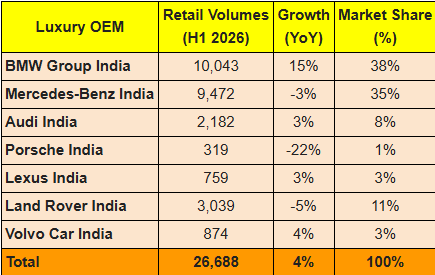 Luxury car retail in India between January and June 2026. Data Source: Vahan.
“BMW also has a wider EV portfolio across relatively more accessible price points than Mercedes-Benz, whose current EV lineup is more concentrated in the higher-end EV luxury segment,” Gupta added.
In addition, BMW’s SUV lineup, including the X1, X3, X5 and X7, continued to maintain healthy demand. The recently-launched new-generation X3 also added momentum during the first half. The result is a healthy 15 per cent retail growth, significantly outpacing the overall luxury segment.
Mercedes pins focus on profitability
On the other hand, Mercedes-Benz remained India’s second-largest luxury carmaker but recorded a 3 per cent decline in retail registrations in the period. Experts suggest that this does not necessarily indicate weakening brand equity. “Mercedes-Benz India has adopted a more measured strategy, with a greater emphasis on profitability this year rather than volume expansion. This reflects the cyclical nature of competition between the two brands, while BMW is currently pursuing market share through an aggressive growth strategy,” Gupta said.
The company currently offers five EVs, with a majority of them positioned in the top-end category, priced upwards of ₹1.4 crore, ex-showroom. Its recently-introduced CLA BEV – carrying a sub₹60 lakh price tag – emerged as a key growth driver in Q2 2026, doubling its EV penetration to 14 per cent, according to the company.
Despite offering limited entry-level EVs, the automaker continues to command one of the widest luxury portfolios in India. While the E-Class Long Wheelbase continues to remain one of the best-selling luxury sedans in the country, the GLE, and GLS remain key SUV demand drivers.
According to Mercedes-Benz India, the recently-introduced new V-Class luxury MPV is also witnessing strong traction, particularly among film stars and is sold out for the year.
The company has also consciously prioritised profitability over volumes in recent years, with its top-end portfolio registering a 20 per cent YoY growth in H1 2026, and comprising a 28 per cent sales penetration. According to the company, these cars include the likes of the flagship S-Class, Mercedes-Maybach, Mercedes-AMG, and the new V-Class.
On the performance front, sales of the Mercedes-AMG models reported a surge of 50 per cent in H1 2026, indicating a robust demand for high-performance luxury cars in the country.
Audi at No. 3, JLR, Volvo post modest growth
Lower down the pecking order, Audi India registered 2,182 vehicles, growing 3 per cent and maintaining its No. 3 position. Its performance was supported by the Q3, Q5 and Q7 SUVs, along with sustained demand for the A4 sedan. The German marque has also expanded its EV presence with models such as the Q8 e-tron, although electric volumes remain relatively niche.
On the other hand, British luxury marque Land Rover retailed 3,039 vehicles in India, though registrations declined 5 per cent year-on-year. The company continues to benefit from sustained demand for the Defender, Range Rover and Range Rover Sport, which remain among the most aspirational luxury SUVs in the country.
Volvo Cars India grew 4 per cent to 874 units, driven primarily by demand for its electrified portfolio and SUVs. The brand has increasingly positioned itself around safety and sustainability, attracting environmentally conscious premium buyers.
Lexus India also posted 3 per cent growth, retailing 759 vehicles. The Japanese luxury brand continues to benefit from its strong reputation in self-charging hybrid technology, with models such as the NX and RX finding favour among customers seeking fuel efficiency without fully transitioning to battery-electric vehicles.
According to industry experts, with a festive season approaching in H2, several premium launches lined up and steadily rising luxury EV adoption, the luxury car market in India is poised for healthy growth in 2026, despite near-term headwinds such as currency depreciation.