
- Zero-tax Form 16 does not remove ITR filing obligation.
- Filing depends on total income, transactions, and tax laws.
- File for refunds, carrying losses, or exceeding income limits.
Income Tax Deadline: For many salaried employees, receiving a Form 16 that shows zero tax deducted often leads to one question: Do I still need to file an Income Tax Return (ITR)?
The short answer is yes, in many cases, you still do.
A zero-tax Form 16 does not automatically exempt a taxpayer from filing an ITR. Tax experts say the requirement to file depends on several factors, including your total income, financial transactions and eligibility under the Income-tax Act, rather than whether your employer deducted tax at source.
With the ITR filing deadline for Assessment Year (AY) 2026-27 approaching, taxpayers are being advised to review their tax position carefully instead of relying solely on Form 16.
What Does A Zero-Tax Form 16 Actually Mean?
Form 16 is a certificate issued by an employer that details salary paid during the financial year, deductions claimed and tax deducted at source (TDS).
If no tax has been deducted, it simply means your employer calculated that no TDS was payable based on the information available. It should not be interpreted as confirmation that you have no tax filing obligations.
According to the Income Tax Department, filing requirements are governed by the provisions of the Income-tax Act and prescribed conditions, which extend beyond the amount of tax deducted by an employer.
Also Read : Will Petrol, Diesel Prices Come Down Now? Oil Minister Explains Why You May Have To Wait
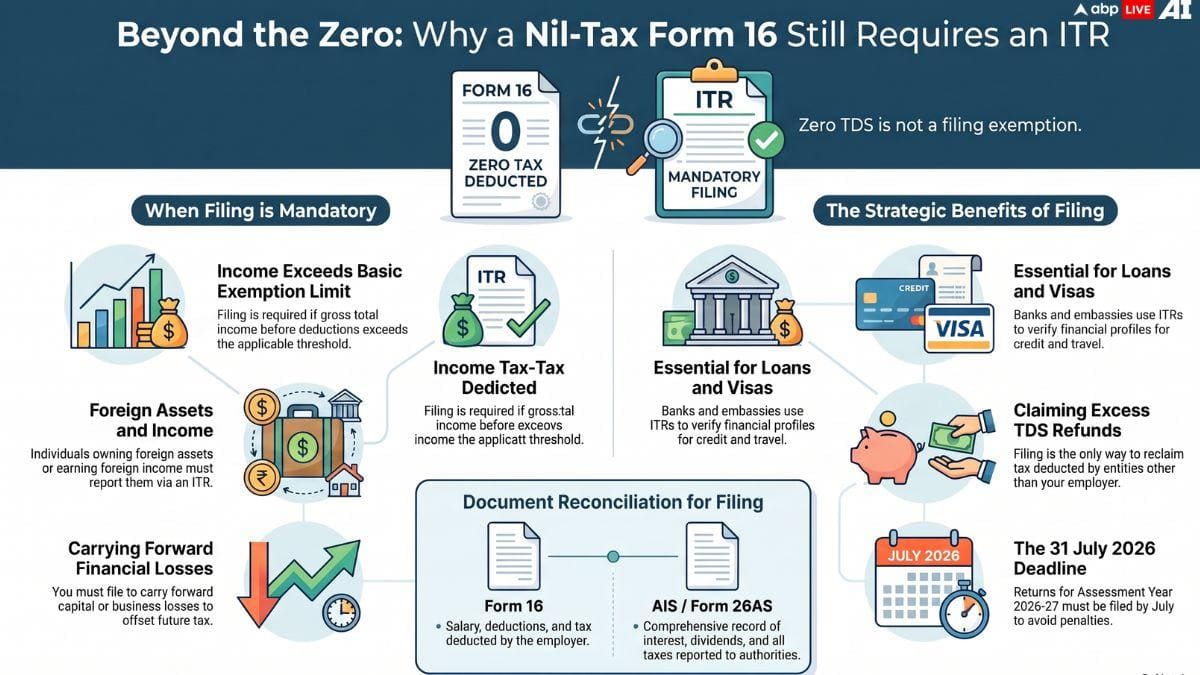
When You May Still Have To File An ITR
Several situations may require an individual to file an income tax return even if Form 16 reflects zero tax deduction.
These include cases where:
- Gross total income before deductions exceeds the applicable basic exemption limit.
- The taxpayer wants to claim a refund of excess TDS deducted elsewhere.
- There are capital losses or business losses that need to be carried forward.
- The individual owns foreign assets or earns foreign income where reporting requirements apply.
- Certain specified high-value financial transactions trigger mandatory filing requirements under tax rules.
In other words, the absence of TDS does not necessarily mean the absence of a filing obligation.
Why Filing An ITR Can Still Be A Smart Move
Even where filing may not be legally compulsory, tax experts say submitting an ITR offers several long-term advantages.
Income tax returns are frequently sought by banks and financial institutions while processing applications for home loans, personal loans and education loans. They are also commonly requested during visa applications and while assessing an individual’s financial profile.
For taxpayers expecting a refund or planning to carry forward eligible losses to offset future tax liabilities, filing an ITR within the prescribed timeline is also essential.
Also Read : EPFO’s New PF Rules Explained: What The EPF Scheme 2026 Means For Your Salary
Don’t Depend Only On Form 16
Experts caution that Form 16 represents only one part of a taxpayer’s financial picture.
Income earned through bank interest, fixed deposits, capital gains, rental income or other sources may not be fully reflected in the document.
Before filing, taxpayers are advised to reconcile the information available in Form 16 with the Annual Information Statement (AIS) and Form 26AS, both available through the Income Tax Department’s e-filing portal. These documents provide a more comprehensive record of income, taxes deducted and specified financial transactions reported to the tax authorities.
Keep An Eye On The Filing Deadline
The countdown to the ITR deadline has already begun.
For most salaried individuals and other taxpayers whose accounts are not subject to audit, the due date for filing income tax returns for AY 2026-27 is July 31, 2026, according to the Income Tax Department.
Missing the deadline could result in additional compliance requirements, including filing a belated return within the permitted timeframe, along with applicable fees and other consequences under the Income-tax Act.
A Form 16 showing zero tax deduction should not be viewed as a free pass to skip filing an income tax return.
Whether an ITR is mandatory depends on your overall financial position, not merely on whether tax was deducted from your salary. As the filing deadline draws closer, reviewing your income details, AIS, Form 26AS and other financial records can help ensure you remain compliant and avoid unnecessary complications later.