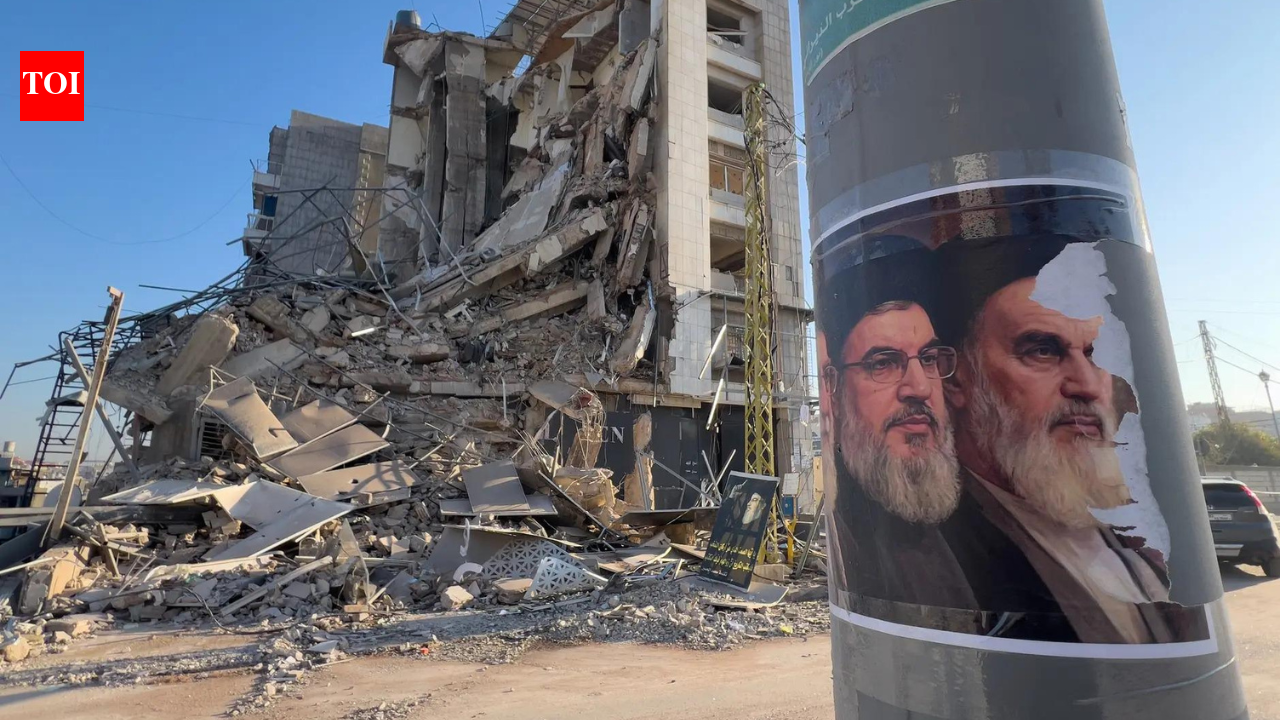

Hezbollah warns of ‘civil war’ over ‘disarmament of non-state armed groups’ (AP)
The US-Israel-Lebanon trilateral framework unveiled on Saturday (local time) calls for the complete and verified disarmament of all “non-state armed groups” across Lebanon as part of a roadmap towards ending decades of conflict, but Hezbollah swiftly rejected the agreement, warning that attempts to enforce it could trigger “civil war.”Signed in Washington in the presence of US secretary of state Marco Rubio, the 14-point framework commits Israel and Lebanon to work towards formally ending their state of war through direct negotiations, with the United States acting as mediator and guarantor of implementation.While the document does not explicitly name Hezbollah, it repeatedly commits the Lebanese government to establishing a state monopoly on the use of force by achieving the “complete and verified disarmament of all non-state armed groups” and dismantling their military infrastructure across the country.Also read: US, Israel & Lebanon sign trilateral framework deal after fifth round of talksThe framework also envisages a phased Israeli military redeployment from Lebanese territory, linked to verified disarmament and the deployment of the Lebanese Armed Forces (LAF) in designated pilot zones. A US-supported military coordination group will oversee implementation, while Washington also pledged humanitarian and reconstruction assistance to Lebanon.The agreement says Lebanon will ensure that non-state armed groups have “no military or security role and no armed capabilities anywhere in Lebanon” and reaffirms that only the Lebanese state has the authority to make decisions on war and peace.
What Hezbollah said
Hezbollah rejected the US-backed Israel-Lebanon framework, saying it would neither accept the agreement nor give up its weapons.Hassan Fadlallah, a member of Hezbollah’s parliamentary bloc, warned that Lebanese authorities would be unable to enforce the agreement “unless they go, with American support, to civil war.”He also rejected the direct negotiations between Lebanon and Israel that produced the framework, calling the Washington agreement “an attempt to disrupt the Islamabad path” — a reference to the parallel US-Iran understanding aimed at ending the wider regional conflict.Hezbollah supporters took to the streets of Beirut to protest the agreement. Lebanon’s state-run National News Agency (NNA) reported that supporters rode motorbikes through central Beirut and along the airport road, while protesters blocked at least one major road with burning tyres.Hezbollah supporters rode through the group’s southern Beirut stronghold before heading towards the city centre, chanting slogans. Lebanese army personnel set up temporary checkpoints across parts of the capital and later dispersed protesters who had blocked the main road leading to Beirut’s airport, reopening the route, according to AFP.Hezbollah has consistently opposed proposals requiring it to disarm across Lebanon, maintaining that previous agreements and UN resolutions only require it to withdraw its weapons from areas south of the Litani River near the Israeli border.
Read full text of framework
The Government of Israel and the Government of Lebanon, with the full support of the United States under President Donald J Trump, affirm their shared goal of achieving lasting peace and security. As reflected in this Trilateral Framework (“Framework”), and through future agreements, the two countries declare their ambition to end conflict between them, ensure the sovereignty and security of both countries, and establish peaceful neighborly relations between the two countries.
- Israel and Lebanon affirm the right of each state to exist in peace, and their mutual desire to live in security as neighboring sovereign states. Israel and Lebanon hereby declare their intent to conclusively end the conflict, address its underlying causes, and to therewith formally conclude any state of war between them. This Framework, reached after multiple rounds of direct negotiations between the parties, builds upon previous successful agreements and understandings, and expresses a determination to make irreversible progress towards the comprehensive resolution of all issues between the two countries. Both countries affirm their intention to resolve these issues as sovereign states through direct bilateral negotiations, with the mediation and support of the United States.
- The Government of Israel and the Government of Lebanon commit to a reciprocal, sequenced process, with clear conditions, whereby the LAF will restore effective sovereign authority over all Lebanese territory, pending the verified disarmament of non-state armed groups and dismantlement of associated infrastructure, enabling the Israel Defense Forces (IDF) to progressively redeploy out of the Lebanese territory. The components of this process will be detailed in a Security Annex, developed with the full support of the United States, that will complement this Framework. The Framework will set out the requisite measures, security arrangements, and verification mechanisms to advance this process. Successful implementation of this Framework will pave the way for a stable and peaceful relationship between the two countries and will enable the IDF to redeploy out of the Lebanese territory.
- Pursuant to the Security Annex, and as part of the broader effort toward the Lebanese state’s monopoly of arms and sovereign territorial control, the LAF will gradually assume full and effective security responsibility in pilot zones, which will serve as the mechanism for phased and verified redeployments of the IDF and the deployments of the LAF. Two initial zones have been agreed to by the IDF and the LAF, and future pilot zones will also be agreed upon by mutual consent. Upon the confirmation of successful disarmament of non-state armed groups and dismantlement of their infrastructure in these zones, the LAF will assume full and effective security responsibility in these zones, internationally supported reconstruction efforts will begin, and Lebanese civilians will be able to safely return to these areas under the exclusive control of Lebanese state authorities. The United States intends to work closely with both countries to verify and support this process.
- The Government of Lebanon reaffirms its resolute and irreversible commitment to restoring and exercising full sovereignty over all its territory. The Government of Lebanon will rebuild the State’s monopoly on the use of force, achieve the complete and verified disarmament of all non-state armed groups, and ensure that such groups will have no military or security role and no armed capabilities anywhere in Lebanon. The Government of Lebanon herewith requests the support of international and particularly Arab partners, under the leadership of the United States, to achieve this outcome.
- The Government of Israel stresses that its military actions in Lebanon are solely a consequence of the attacks, threat posed by, and hostile intent of non-state armed groups, particularly Hizballah. The Government of Israel underscores that the termination of this threat, through the disarmament and dismantlement of such groups in all of Lebanon and additional security arrangements to be agreed upon between the two countries, will eliminate any future need for IDF military action or presence in Lebanon. Pursuant to the above, the Government of Israel declares that it has no territorial ambitions in Lebanon.
- The Government of Lebanon, in accordance with the Charter of the United Nations and in exercise of its sovereign authority, reaffirms that its security forces hold exclusive responsibility for Lebanon’s security and defense and that the Government of Lebanon holds the exclusive sovereign authority to make war and peace. The Government of Lebanon rejects the claims of any state or non-state actor to use force on its behalf without its explicit authorization, and reiterates that any claim by any state or non-state actor to exercise a military or security role is illegal per the decisions of the Lebanese Government and contrary to Lebanese national interests.
- The Government of Lebanon and the Government of Israel affirm that nothing in this Framework prevents them from exercising their inherent right to defend themselves, as recognized in the Charter of the United Nations and consistent with applicable international law, reaffirming that no third party may exercise that right on their behalf. Both governments commit to establishing a military coordination group, with U.S. support and participation, to ensure overall implementation of this Framework.
- The two countries affirm that they share the objective of a secure, rebuilt Lebanon, under full Lebanese state sovereignty, in which no non-state armed group poses a threat to Israel, Lebanon, or citizens of either country. Furthermore, the two countries recognize that the restoration of security in South Lebanon through the deployment of the LAF, the safe return of its civilian population, and the security of Israel’s northern communities, are essential to long-term stability and peace.
- The Government of Lebanon commits to a rigorous, performance-based program to enable the capacity of the LAF to assert full military and security control within Lebanon in accordance with security arrangements, agreed upon within the framework of negotiations, and to implement the disarmament of all non-state armed groups and exercise effective authority across Lebanon. The Government of Lebanon welcomes the readiness of the United States to support such efforts, recognizing that any new U.S. assistance will be strictly conditioned on verifiable milestones, full transparency, demonstrated results, and ongoing oversight. This effort will enable the safe and orderly re-establishment of Lebanese sovereignty, also contributing to the broader stability and security of the entire Middle East.
- Separately, and simultaneously, the United States will rally international partners to actively support the Government of Lebanon in rebuilding the country, repairing infrastructure, restoring the economy, and creating opportunities for prosperity. This is expected to include mobilizing substantial reconstruction and humanitarian assistance for Lebanon, economic recovery programs, and investment initiatives so that Lebanon can recover from years of conflict and provide a better future for all its citizens.
- Lebanon and the United States commit to preventing funds from flowing to any entity, organization, or individual affiliated with non-state armed groups and to take available legal measures to proscribe the activity of any such entity, organization or individual. The Government of Lebanon explicitly commits to prevent reconstruction funds from flowing to non-state armed groups and connected entities.
- Upon the signing of this Framework, the two countries will work to establish working groups to draft the full comprehensive peace and security agreement. Moreover, to achieve the goals of the Framework, the two governments will immediately establish complementary tracks of ongoing direct engagement, facilitated by the United States. The two governments commit to proceeding in good faith until a full and lasting peace is achieved, bringing security, stability, and prosperity to the people of Israel and Lebanon.
- In line with their shared goals to establish stable and peaceful relations, Israel and Lebanon commit to take good faith measures that demonstrate positive intent, including the cessation of all hostile or adverse actions in international political or legal fora, and pledge to work towards the search for and return of remains and the release of detainees.
- The two governments acknowledge the role of the United States in supporting their efforts to end decades of conflict and establish lasting stability and comprehensive peace between the two countries and express their deep appreciation for the vision and leadership of President Donald J Trump.