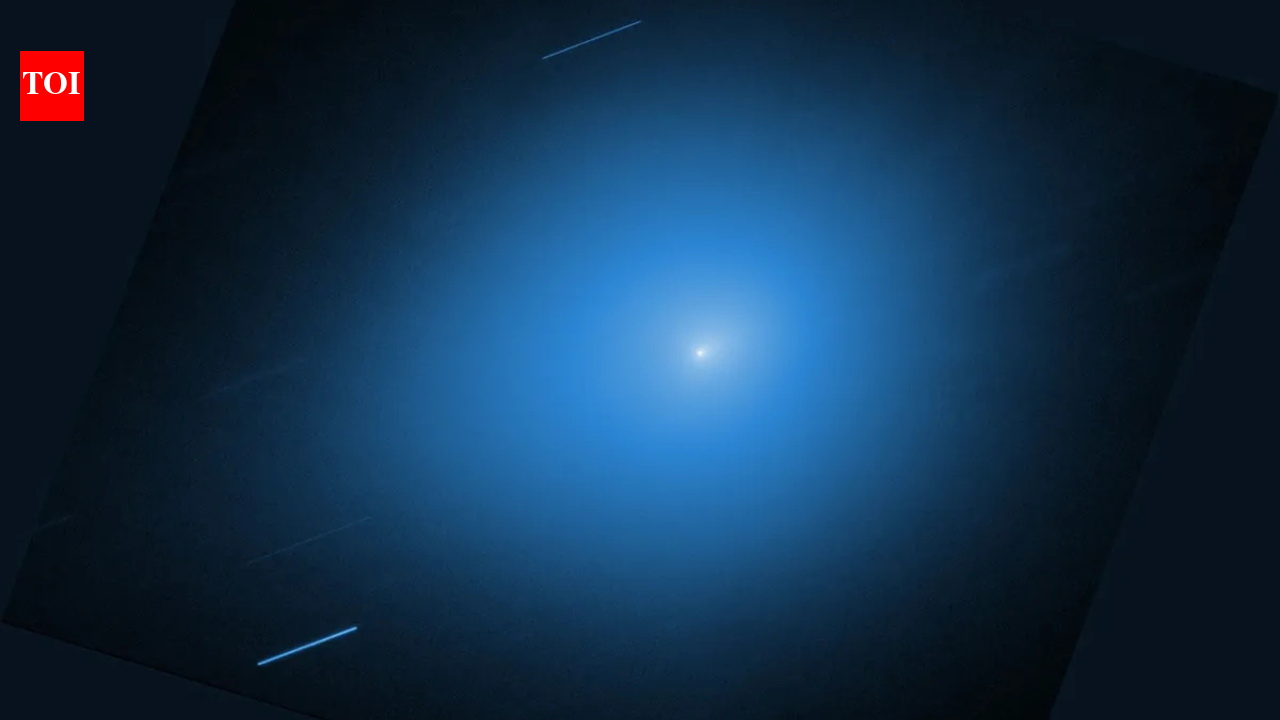

When interstellar comet 3I/ATLAS was discovered by the ATLAS survey telescope in Chile on July 1, 2025, it quickly attracted attention for more than just being the third known object from outside the Solar System. Some researchers, including Harvard astrophysicist Avi Loeb, argued that several unusual features were intriguing enough to keep the possibility of artificial origins on the table, sparking widespread speculation about alien technology. Most astronomers favoured a natural explanation. Now, a new analysis by researchers at the University of Oxford suggests the object may be even more extraordinary. Their model indicates that 3I/ATLAS could be around 7 billion years old, meaning it may have formed billions of years before the Sun and could be older than our entire 4.6-billion-year-old Solar System, making it potentially the oldest comet ever observed.
Why some people thought interstellar comet 3I/ATLAS could be alien
Soon after 3I/ATLAS was discovered, Harvard astrophysicist Avi Loeb and his collaborators turned it into one of the most talked-about objects in astronomy by asking whether it could be more than a comet. In their paper, they argued that the object’s unusually high speed, steep trajectory and other odd features were worth treating as potential signs of something far stranger. The paper’s most striking line was that 3I/ATLAS could be a “technological artifact” and, under a “Dark Forest” reading of the Fermi paradox, might even be “possibly hostile. ”Loeb and his co-authors pointed to several details they thought made the object unusually intriguing. They said 3I/ATLAS passed surprisingly close to Venus, Mars and Jupiter, and argued that such a path could theoretically help a technological object observe planets while staying difficult to detect from Earth. In the paper, they went further and suggested that the object’s trajectory through the Solar System, along with the possibility of a hidden propulsion-related manoeuvre near perihelion, made it worth considering as a possible interstellar probe rather than dismissing it as a routine comet.That framing quickly captured public imagination because Loeb had already become known for pushing unconventional interpretations of interstellar visitors. In later writing, he said scientists should keep open the possibility of a “Trojan Horse” that might look like a rock on the outside but hide advanced technology within, and he described 3I/ATLAS as a chance to explore an “exciting possibility” rather than a settled conclusion. His argument was not that the alien explanation was proven, but that the anomalies were interesting enough to keep the idea alive.
Oxford scientists estimate the comet may be older than the Sun
The new analysis comes from Matthew Hopkins of the University of Oxford, who developed the Ōtautahi-Oxford Model with Professor Chris Lintott and collaborators at the University of Canterbury in New Zealand. The model uses the trajectories of interstellar objects to estimate where they originated and how old they might be. When Hopkins ran the newly discovered 3I/ATLAS through the model, the results surprised even the researchers.According to the team’s findings, the comet has about a two-thirds probability of being older than our 4.6-billion-year-old Solar System. The statistical best estimate places its age at roughly 7 billion years. “Our statistical method suggests that 3I/ATLAS is very likely to be the oldest comet we have ever seen,” Hopkins said in a statement released by the Royal Astronomical Society.
The object may have come from the Milky Way’s thick disk
One clue to the comet’s age lies in its unusual path through the Solar System.Most stars, including the Sun, belong to the Milky Way’s thin disk. Above and below it lies a thicker, older population of stars known as the thick disk. These stars are believed to be around 10 to 12 billion years old.Because 3I/ATLAS entered the Solar System at a steep angle, the Oxford team believes it most likely originated from this ancient region of the galaxy.Professor Chris Lintott said the object “appears to come from the thick disk of the Milky Way”, giving astronomers a rare opportunity to study material formed around stars much older than the Sun.
Why 3I/ATLAS is scientifically important
Comets preserve ancient material from the protoplanetary disks in which they formed. If the age estimate is correct, 3I/ATLAS could contain clues about conditions that existed billions of years before our Solar System formed.Initial observations suggest the comet is rich in water ice and volatile compounds. Scientists hope that detailed spectroscopic studies will reveal more about the chemistry of ancient stellar systems and how the Milky Way evolved over time.In that sense, 3I/ATLAS is not just another comet. It may represent one of the oldest pieces of planetary material ever observed.
The age estimate is still a probability, not a certainty
Astronomers stress that the 7-billion-year figure is not a direct measurement.Nobody can determine the age of the comet in the same way geologists date rocks on Earth. Instead, the estimate comes from a statistical model based on the object’s orbit and likely galactic origin.That means future observations and discoveries of other interstellar objects may refine or even challenge the current estimate.Even so, the researchers believe 3I/ATLAS is likely to become an important benchmark for understanding objects arriving from distant star systems.
More interstellar visitors could soon be found
Until 2017, no confirmed interstellar objects had ever been seen. Since then, astronomers have identified ‘Oumuamua, 2I/Borisov and now 3I/ATLAS.The Vera C. Rubin Observatory, which has begun operations in Chile, is expected to dramatically increase that number. Scientists believe it could discover several interstellar visitors every year.Each new object will offer a chance to compare different regions of the galaxy and test the Oxford model further.As for 3I/ATLAS, it is already leaving the Solar System on a one-way journey back into interstellar space. But the data collected during its brief visit may keep astronomers busy for many years to come. Go to Source