


Photo credit: PTI
Planning a holiday has never been easier. A few years ago, most travellers would either visit a travel agency or spend hours researchingdestinations, hotels and transport options online. Today, many simply open an AI chatbot, type in a destination and budget, and receive a detailed itinerary within seconds.As artificial intelligence increasingly enters the travel industry, a question naturally arises: can AI plan a holiday better than an experienced travel agent?To find out, TOI conducted a simple experiment. We asked both an AI system and a veteran travel consultant to plan the same trip: a Budget-friendly holiday from Delhi to Manali.The AI chatbot used was OpenAI’s ChatGPT, one of the most commonly used generative AIs. The travel consultant was Rakesh Mohan Singh, who has spent more than 25 years in the tourism industry and holds an MBA in Tourism. The destination, duration and mode of transport were kept broadly similar for both planners.The results were surprising.
AI and the travel agent came up with almost the same holiday
Interestingly, both plans followed a similar route.The AI itinerary included Hadimba Temple, Old Manali, Solang Valley, Atal Tunnel, Sissu, Naggar and Vashisht Hot Springs. Singh’s packagecovered many of the same attractions, including Hadimba Temple, Manu Temple, Solang Valley, Atal Tunnel, Naggar and Vashisht. Both recommended travelling by an overnight Volvo bus from Delhi and returning in the same manner.The overlap highlights something important: for popular destinations such as Manali, AI is already capable of identifying the attractions and experiences that human travel professionals routinely recommend.
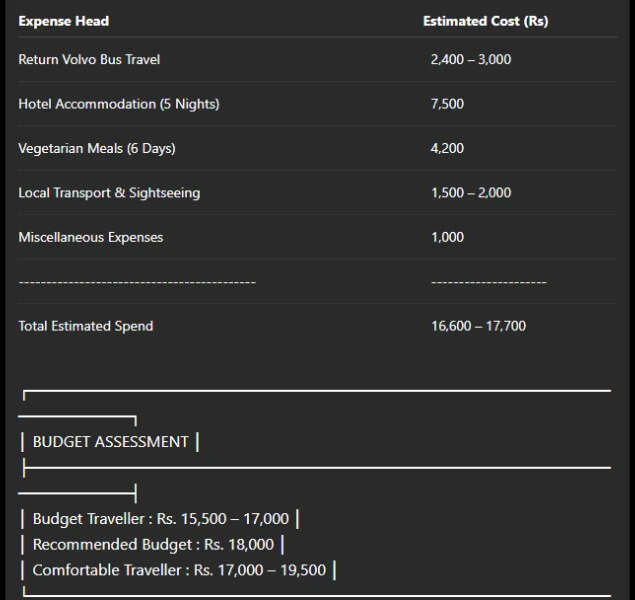
ChatGPT’s pitch
In other words, AI is not merely pulling random information from the internet. It is increasingly capable of producing travel plans that resemble those created by experienced tourism professionals.
Where AI had an edge
The most obvious advantage was speed and transparency. The AI-generated plan provided a detailed breakdown of expenses, estimating everything from Volvo fares and hotel costs to daily food expenses and local transport. It suggested that a solo traveller should budgetroughly Rs 18,000 for the trip and explained how that figure was calculated.
Quote
For a traveller trying to understand where their money is going, such transparency can be useful. The itinerary was also personalised. It considered accommodation preferences, food requirements and even included a flexible day that could be used for shopping, photography, café visits or additional sightseeing.This ability to customise a trip almost instantly is one of AI’s greatest strengths. Travellers can modify budgets, destinations or travelstyles in seconds and generate multiple versions of a holiday plan without making a single phone call.
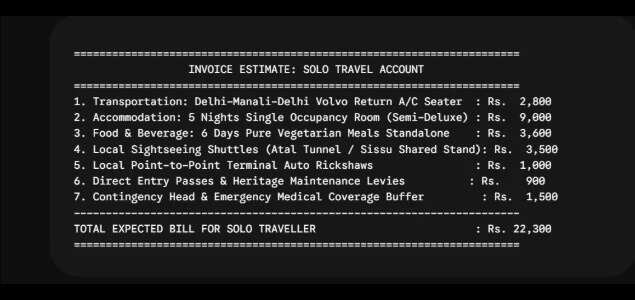
Gemini’s pitch
While stating its weakness, even Singh acknowledges the usefulness of the technology.”In my opinion, AI will give you an idea. It provides a rough overview it can create a package or a programme for you, and even provide pricing. But it lacks the on-ground experience that a travel agent has,” he says.For travellers at the research stage, that capability can save considerable time.
Planning vs execution
However, the travel agent pulled ahead of AI in execution. While the AI itinerary estimated costs, Singh offered an actual package. His proposal included accommodation, Volvo tickets, sightseeing arrangements and local transport. The AI itinerary, meanwhile, still required the traveller to find hotels, compare transport options and make bookings independently.This distinction may seem small on paper, but it becomes important when things go wrong.Travel rarely unfolds exactly as planned. Hotels can overbook. Buses can be cancelled. Weather can disrupt schedules. Roads can close unexpectedly.An AI system may suggest alternatives, but it cannot negotiate with a hotel manager, arrange replacement transport or contact local operators on a traveller’s behalf.That human element remains one of the strongest arguments for traditional travel agents.
The battle over pricing
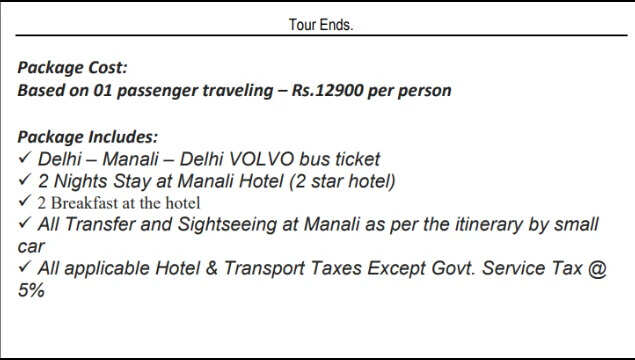
Travel agent’s pitch
The biggest difference between the two plans emerged when costs were compared. The AI-generated itinerary estimated that a solo traveller would spend between Rs 15,500 and Rs 19,500, depending on accommodation andspending habits. Singh’s package, however, came in at Rs 12,900 for a solo traveller.According to Singh, this reflects a challenge that AI has yet to overcome. He also seeks government intervention in the case of dynamic price changes, which have undermined a travel agent’s credibility.”Nowadays, hotel rates are dynamic and fluctuate instantly, similar to airline prices,” he says.Earlier, hotels typically followed seasonal pricing structures. Rates would remain relatively stable during a particular season before changing when the next season began.That is no longer the case. Hotels now routinely adjust prices based on occupancy levels, demand patterns, festivals, long weekends and booking trends.”Because rates fluctuate based on occupancy, AI cannot provide completely accurate pricing; it can only give you an idea that your price will be approximately a certain amount,” Singh explains.In his view, this is where experienced agents retain an advantage. Having established relationships with hotels and transport providers allows them to access negotiated rates and confirm prices before presenting a quotation to the client.
The value of local knowledge
Another issue raised by Singh is something many travellers never consider until they encounter a problem: local realities.Travel planning is not simply about identifying attractions on a map. It often involves understanding road conditions, vehicle restrictions, permits and seasonal challenges.To illustrate this, Singh points to the Chardham Yatra.”AI will simply pull data from what is available, but it doesn’t know which vehicles are actually permitted or capable of running in those specific regions. Big buses are not allowed there; the routes only accommodate a maximum of 18 to 20-seater buses,” he says.He recalls a case involving a large travel company that promised clients a Volvo bus on a route where such a vehicle could not operate.”When the clients arrived and realised the bus couldn’t run there, they insisted on the original commitment. Eventually, senior management had to intervene, apologise and provide an Innova for every family as compensation,” he says.For Singh, AI suffers from a similar limitation.”AI operates in a similar way; it lacks accurate, real-world insight and simply extracts whatever data has been fed into its system.”Whether that criticism will remain valid as AI systems gain access to more real-time information is another question. But for now, destination expertise remains one of the travel agent’s strongest selling points.
Why do many travel agents feel threatened

Quote
The rise of AI comes at a time when traditional travel agencies are already facing intense pressure from online booking platforms.”In the past five or six years, online travel agencies have introduced AI-driven features and dynamic pricing,” Singh says.The result, according to him, has been a gradual shift in consumer behaviour.”We can’t enjoy this profession anymore; the clients think we are cheating them. Older clients return, but their children book vacations online.”The challenge is that travellers often compare an agent’s quote with online prices that may have changed by the time they make the comparison.”A client doesn’t understand the dynamics of this market; as a result, traditional travel agencies are witnessing a slow decline,” he says.Yet despite these concerns, Singh does not view AI as an outright threat. Instead, he sees it as a useful tool when used appropriately.”You should use AI as a consultant for an estimate but consult an expert to finalise your plans,” he says.He compares the technology to a navigation app.”Just as you cannot always depend on Google Maps because it sometimes leads you to a dead end, you should use AI as a consultant for an estimate but consult an expert to finalise your plans.”
So, can AI plan a better holiday?
The answer depends on what travellers expect from a holiday planner.If the goal is to research destinations, compare options, estimate costs and create a personalised itinerary within seconds, AI is proving remarkably capable. In this experiment, a plan was produced that closely mirrored the recommendations of a tourism professional with more than two decades of experience.However, if the objective is to secure bookings, obtain negotiated rates, navigate local complexities and have someone to call when plans unravel, travel agents still hold a clear advantage.The experiment suggests that AI is becoming an increasingly effective travel planner. What it has not yet become is a travel manager.For now, the future of holiday planning may not be a choice between AI and travel agents. It may lie in combining the strengths of both, using AI to explore possibilities and experienced professionals to turn those plans into reality. Go to Source